A patient finishes their gum disease treatment. Their gums look better. They return in 3 months for a recall visit. Your hygienist cleans their teeth. And then someone on your team accidentally bills it as a routine cleaning. That one mistake can cost your practice hundreds of dollars per patient per year, and expose you to a payer audit.
According to the American Dental Association, periodontal maintenance is a distinctly defined procedure that follows active therapy and cannot be interchanged with prophylaxis billing. Yet thousands of dental practices still confuse CDT code D4910 with D1110 every single day.
This blog explains the periodontal maintenance dental code from both a clinical and billing perspective. You will learn who qualifies, which ICD-10 codes to pair, how often to bill, and exactly what documentation keeps your claims paid. Whether you are a dentist, hygienist, or biller, this is the only guide you need.
The CDT code for periodontal maintenance is D4910. It is used after a patient completes active periodontal therapy, such as scaling and root planning (D4342 or D4342) or surgery.
This is not a preventive cleaning. It is a medically necessary, ongoing treatment for a patient who has been diagnosed with periodontal disease.
What D4910 Clinically Includes:
The ADA defines D4910 as a procedure that must include all of the following:
Every one of these steps must be performed and documented. If they are not, the claim is vulnerable and so is your practice.
Periodontal disease does not get cured. It gets controlled. Once the bone and tissue around a tooth are damaged, that damage is permanent. Bacteria that cause gum disease live in deep pockets around the roots. Even after successful scaling and root planing, those bacteria begin rebuilding their colonies within 8 to 12 weeks.
The SRP Follow-Up Protocol:
The ADA and most periodontists follow this evidence-based maintenance schedule after active therapy:
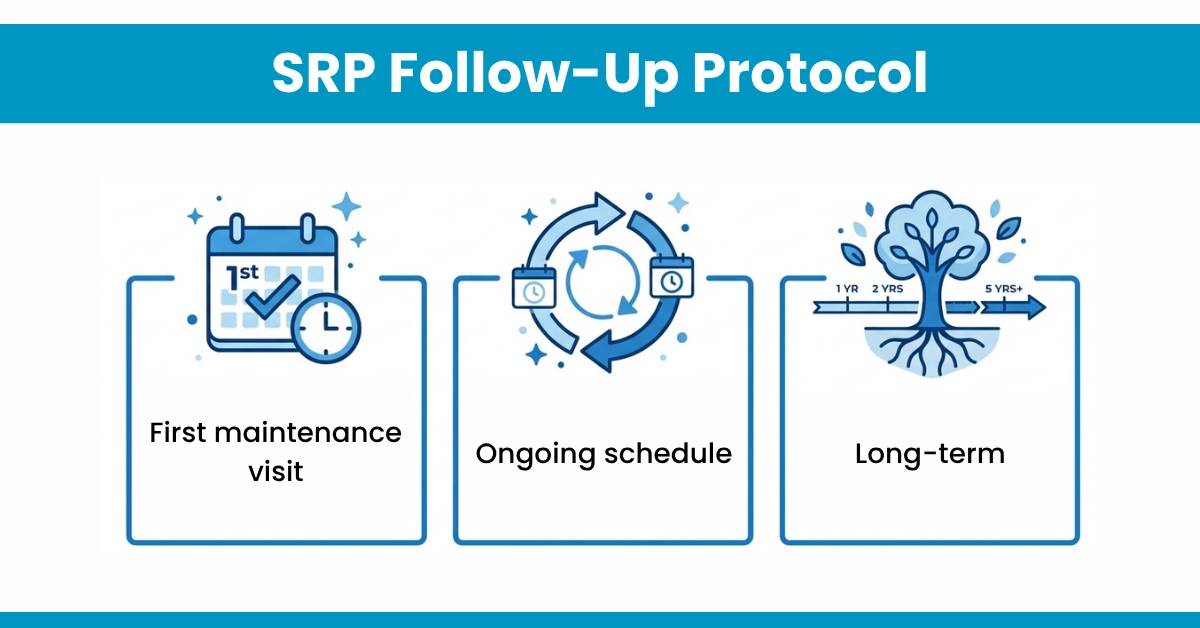
This is why D4910 can be billed 3 to 4 times per year for most patients, because the clinical need is real, not just a billing preference.
A patient qualifies for D4910 only after completing a course of active periodontal treatment.
This includes:
Once that history exists, every future maintenance visit for that patient should be billed as D4910, for life.
The Key Rule to Remember:
Even if the patient’s gums look healthy at the maintenance visit, the code does not change. The history of periodontal disease is permanent. The code follows the patient, not the current condition.
This single distinction is responsible for the majority of periodontal billing denials and audit flags.
Feature | D4910 (Periodontal Maintenance) | D1110 (Adult Prophylaxis) |
Patient Type | Active periodontal treatment completed | No periodontal disease history |
Subgingival Scaling | Yes, required | Not indicated |
Medical Necessity | Yes | Preventive only |
Insurance Frequency | 3-4x per year | 2x per year |
ICD-10 Pairing | K05.30-K05.32 | Z01.20 |
Billing Risk if Wrong | Audit, refund demand | Lost revenue, compliance flag |
Ask these three questions before coding any hygiene visit:
If you are unsure, the safest path is to review the patient’s full chart, not just today’s periodontal readings.
Pairing the right ICD-10 diagnosis code with D4910 is not optional. It is what tells the payer that this procedure is medically justified.
Use these ICD-10 codes based on the patient’s documented diagnosis:
Always match the ICD-10 code to your clinical notes. If your chart documents “generalized chronic periodontitis,” the code must be K05.32. A mismatch between the chart and the claim is a fast path to denial.
Medical Billing Note:
In rare cases, periodontal treatment is billed through a patient’s medical insurance. For example, when gum disease is linked to diabetes or cardiovascular disease, CPT code 99213 (established patient office visit) or similar evaluation codes may apply alongside dental codes.
HelloMDs manages both dental billing and medical billing crossovers to make sure nothing falls through the cracks.
Most major insurance plans allow D4910 to be billed 3 to 4 times per calendar year.
However, coverage rules vary by payer.
Your clinical protocol may call for a 3-month recall. But your patient’s insurance may only cover 2 visits per year. These two things are not in conflict, but they do require a conversation with the patient before treatment.
Key points to know:
Verifying benefits before every appointment prevents billing surprises for your practice and your patients. HelloMDs offers real-time Insurance Eligibility Verification that checks frequency limits, plan type, and patient responsibility before the patient sits in the chair.
The risk of using the wrong code or missing documentation is not just a lost claim. It is an audit trail that can go back years.
Every D4910 claim should be supported by:
One Simple Fix That Prevents Most Denials
When submitting D4910 for the first time with a new insurance plan, include a two-sentence clinical narrative:
“This patient completed full-mouth scaling and root planing on [date]. Today’s visit is part of their ongoing three-month periodontal maintenance protocol following active therapy.”
The periodontal maintenance dental code D4910 exists because gum disease requires lifelong management, not just a one-time treatment. Using it correctly protects your revenue, keeps your practice ADA-compliant, and ensures your patients receive the proper insurance benefits they are entitled to.
The gap between a paid claim and a denied one is almost always documentation, correct ICD-10 pairing, and a clear understanding of which code to use and when.
If your practice is experiencing repeated D4910 denials, revenue loss from incorrect prophylaxis coding, or audit concerns, HelloMDs is ready to help. Our AAPC-certified billing and coding team works with dental and medical practices across all 50 states.
Follow HelloMDs on Facebook and Instagram for weekly coding tips, denial management strategies, and revenue cycle updates built for modern practices.
The blog we write is just to give you information about dental billing and dental coding. The data shared here is collected from different trusted sources and explained in our own words to make it easy to understand. It is not professional advice, and coding rules or codes may change anytime, so please verify them. We are not responsible for any claim denials, financial loss, or billing errors that may occur from using this information. We are medical billers who help solve billing and coding problems, so you can stay relaxed and focus on your practice. Some images or examples used in this blog may be created using AI tools only to help you understand concepts better.