
A single expired malpractice certificate, a mismatched taxonomy code, or unattested CAQH profile errors trigger a full credentialing rejection, and your clock resets completely. Many providers don’t realise this until it happens to them.
Think about it. Your practice bills high-volume codes like CPT 99213 and CPT 99214 daily. Without active credentialing, every one of those claims returns as a denial. Revenue stops, not because of a clinical error, but an administrative one.
According to CAQH, providers spend over 2 million hours annually on credentialing tasks. Most of that time is wasted on preventable errors. This guide to medical insurance credentialing walks you through every step, documents, payer requirements, denials, and best practices, so your practice never loses revenue to the process. First of all, we will understand medical insurance and credentialing in health, then we will move further to the steps.
Medical insurance credentialing is the formal process of verifying a provider’s qualifications, licenses, education, and professional history against a payer’s standards. Once approved, the provider joins the insurance network and can bill for covered services. Without it, no in-network claims can be submitted, period.
The Centers for Medicare & Medicaid Services (CMS) requires healthcare providers who want to bill Medicare to complete the provider enrollment process using the Provider Enrollment, Chain, and Ownership System (PECOS) or a paper application before any Medicare claims can be submitted for payment.
Industry best practices for credentialing align with standards set by the National Committee for Quality Assurance (NCQA), which provides frameworks and quality benchmarks for credentialing processes.
These three terms are not interchangeable.
All three must be completed in sequence. Credentialing first, enrollment second, contracting third. Skipping or rushing any step delays the others.
Credentialing in medical billing determines whether your claims are processed or denied at the payer level. Active credentials mean claims like CPT 99214 (moderate-complex office visit) and CPT 99213 (low tomoderate complexity office visit) pass through cleanly. Lapsed credentials mean those same claims return as automatic denials, even if every diagnosis code, like ICD-10 I10 (essential hypertension) or ICD-10 Z00.00 (general adult exam), is coded perfectly.
Here is the direct financial impact:
This is why RCM depends on credentialing accuracy above everything else. A billing team cannot fix a credentialing problem; it must be resolved at the source.
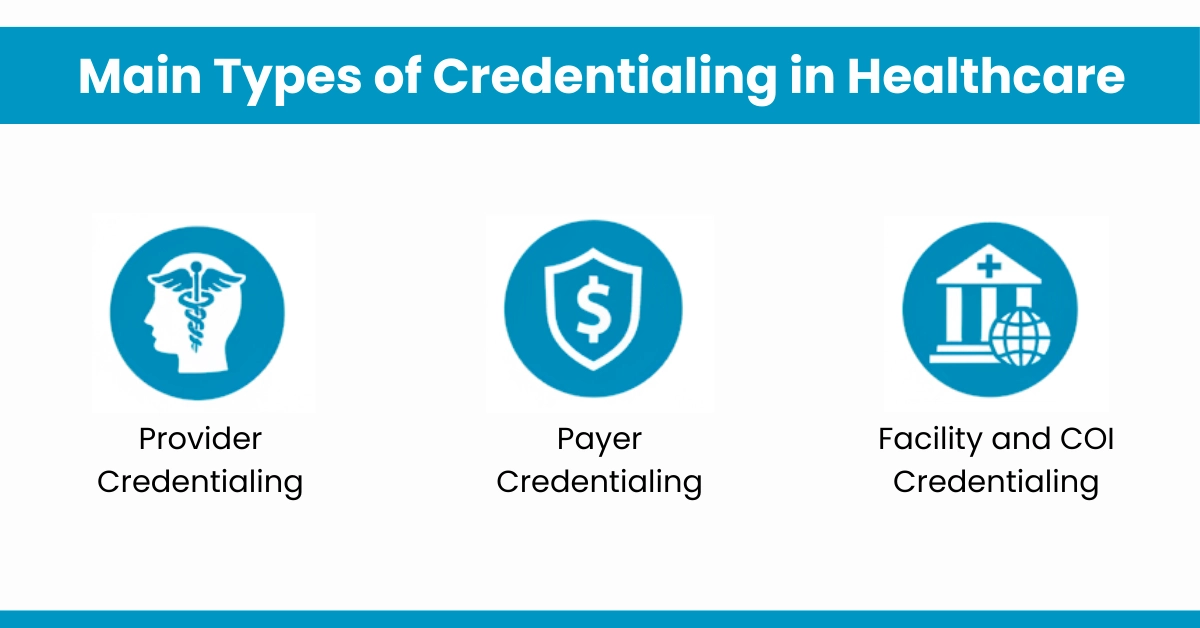
Do you know there are three main types of credentialing every provider must navigate?
One gap in any of the three creates billing interruptions that compound month over month.
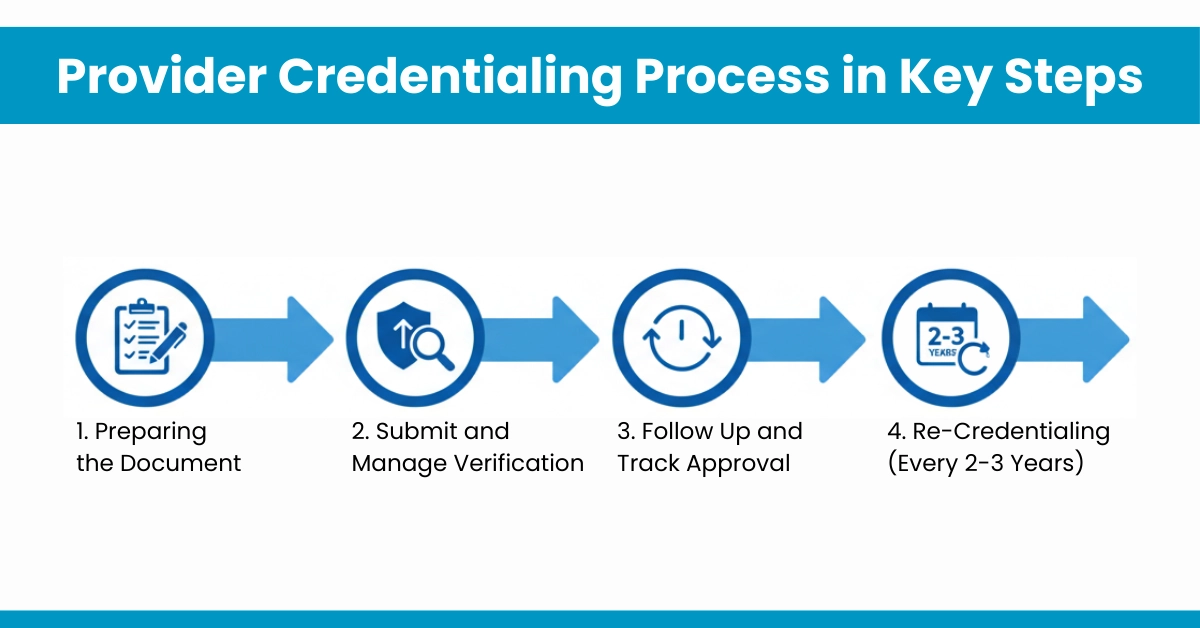
The medical credentialing process follows a defined sequence. The typical timeline is 90-120 days for commercial payers and 40-60 days for Medicare and Medicaid.
Apply only when every document is ready. A partial submission goes to the back of the queue, not on hold.
Core documents required:
That last point is what most guides skip. Taxonomy code mismatches between the W-9 and NPI registry are a leading hidden cause of automatic rejection. Always cross-check both before submitting.
Payers verify credentials directly with issuing bodies, medical schools, licensing boards, malpractice carriers, and the National Practitioner Data Bank (NPDB). Every document must be accurate at the source, not just in your packet.
Follow up with payers every two weeks. Delays usually come from missing documents, not payer backlog. Once approved, confirm the contract’s effective date before submitting your first claim.
Credentialing is not one-time. Most payers require re-credentialing every 2 to 3 years. Begin renewals at least 6 months before expiration to prevent any network gap.
Credentialing denials are preventable in most cases. When they happen, every CPT code billed under that provider’s NPI, including CPT 93000 (ECG) and CPT 71046 (chest X-ray), denies regardless of clinical accuracy.
Denial Cause | Prevention |
Incomplete application | Pre-submission checklist every time |
Expired license or malpractice certificate | Set alerts 6 months before expiration |
CAQH profile not re-attested | Quarterly CAQH review required |
Taxonomy code mismatch | Verify against the NPI registry before applying |
Unexplained work history gaps | Prepare written explanations upfront |
When denials do occur, HelloMDs’ denial management team identifies the root cause, corrects the credentialing issue, and resubmits claims efficiently, protecting your collections from long-term revenue loss.
Outsourcing insurance credentialing for providers delivers real ROI when you choose the right partner.
Look for:
Avoid any company with:
Ask before hiring:
HelloMDs provides complete enrollment and credentialing services for physicians and multi-specialty practices across all 50 U.S. states. AAPC-certified credentialing professionals handle every step, from initial application to re-credentialing cycles, with HIPAA-secure workflows and dedicated account management throughout.
Medical insurance credentialing is the foundation every practice builds its revenue on. From CPT 99213 to complex surgical procedures, every code your practice bills depends on active, verified credentials being in place before the first claim is submitted. Credentialing gaps cause denials that clinical accuracy cannot fix.
The key takeaways: Treat credentialing as an ongoing process, keep CAQH attested, track every expiration date, and partner with specialists who manage it correctly from the start.
For end-to-end support, including medical billing, denial management, and RCM, HelloMDs serves practices nationwide with scalable, HIPAA-compliant solutions built for accuracy and maximum reimbursement at every step.
Disclaimer:
The content in this article is provided for general informational purposes only and does not guarantee specific results or reimbursement outcomes without partnering with us.