
You billed the visit. The care was real. The chart was clean. Then the denial hit, or the payment came back far lower than it should have.
According to AAPC, CPT code 99213 accounts for nearly 30% of all outpatient E/M claims, making it the single most impactful code in your entire revenue cycle. Yet it remains one of the most undercoded, misdocumented, and misunderstood codes in outpatient billing today.
In 2026, this established patient office visit code carries more earning potential than ever. Thanks to permanent telehealth approval, the G2211 add-on expansion, and updated MDM guidelines, most practices still haven’t implemented.
This guide gives you exactly what you need: the rules, the rates, the codes, and the fixes.
CPT 99213 is a Level 3 E/M code for an established patient office or outpatient visit involving low-level medical decision-making (MDM) or 20-29 minutes of total time on the date of service.
It applies only to established patients, someone seen by the same provider or same-specialty group within the last three years. New patient? Use CPT 99202-99205 instead. Billing 99213 for a new patient triggers an automatic denial.
Typical clinical scenarios:
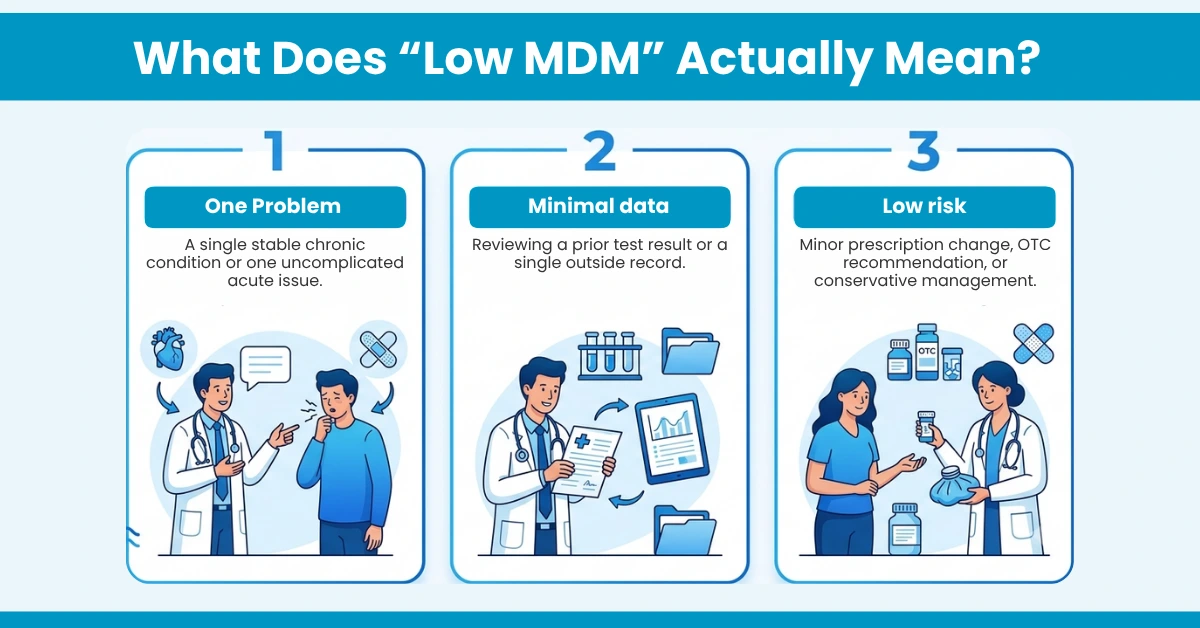
Under the 2021 AMA E/M overhaul, fully enforced by CMS in 2026, the old three-key-component system is gone. Documentation now supports one of two paths: low MDM or total time.
Low MDM requires all three of the following:
Simply listing diagnoses from a previous chart does not support this code. Each problem must be actively addressed with its current status documented as stable, worsening, or improving.
If you prefer time-based billing, write the exact total minutes. “Brief visit” is not documentation; it is a denial waiting to happen.
This is where most revenue quietly disappears. Defaulting to 99213 when the chart supports CPT Code 99214 is not conservative billing, it is revenue abandonment.
|
Feature |
99212 |
99213 |
99214 |
|
MDM Level |
Straightforward |
Low |
Moderate |
|
Total Time |
10-19 min |
20-29 min |
30-39 min |
|
Problem Complexity |
Minor/self-limited |
One stable chronic or uncomplicated acute |
Multiple chronic or worsening |
|
2026 Medicare (Non-Facility) |
~$46 |
~$91.85 |
~$134-$140 |
If a patient’s hypertension is flaring and they present with new shortness of breath, that is 99214, not 99213. Document each problem’s complexity individually, not just the diagnosis name.
Common ICD-10 Pairings
Key Modifiers
The 2026 Medicare Physician Fee Schedule introduced two separate conversion factors for the first time, one for standard participants, one for qualifying APM participants.
Geographic Practice Cost Index (GPCI) adjustments mean your exact rate depends on your ZIP code. A practice in New York City reimburses more than one in rural Mississippi for the exact same code. Always verify with the CMS Physician Fee Schedule Lookup Tool.
HCPCS code G2211 adds approximately $15-$16 per qualifying Medicare encounter. CMS estimates 90% of primary care E/M visits should include it. Most practices still miss it.
What Changed in 2026
The 2026 CMS Physician Fee Schedule made two major expansions:
Bill G2211 When:
Don’t Bill G2211 When:
A practice seeing 500 Medicare patients monthly that consistently captures G2211 adds approximately $7,500-$8,000 per month in previously uncollected revenue. That is not a small number.
In 2026, payer AI and automated claim review tools are flagging patterns that passed five years ago. Here are the six most common denial triggers, and what to do about each one:
At HelloMDs, our AAPC-certified coders run pre-submission audits on your most frequently billed codes, including 99213, to catch these patterns before they become denials. Our denial management team analyzes payer-specific trends, and our medical coding services are built to stop undercoding and overcoding before either costs you.
With a 99% first-pass ratio and a proven 30% revenue increase for practices we manage, we treat your most billed code like the precision instrument it is.
CPT code 99213 is not a routine code, it is the financial heartbeat of outpatient billing. In 2026, getting it right means documenting low-complexity MDM or 20-29 minutes of total time, pairing the right ICD-10 codes, applying modifiers correctly, and capturing the G2211 add-on for every qualifying Medicare encounter.
The practices winning in 2026 are not working harder; they are documenting smarter and billing with expert support. Explore HelloMDs medical billing services, RCM healthcare solutions, and follow us on Facebook and Instagram for the latest billing updates.
The information provided in this article is for general educational purposes only and doesn’t constitute medical, legal, or financial billing advice. Always verify current guidelines with the AMA, CMS, and your individual payer contracts before submitting claims. HelloMDs recommends consulting a certified medical billing professional for guidance specific to your practice. All visuals and infographics included in this article are for illustrative purposes only.