Every denied claim costs your practice time and money. When the CO-4 denial code appears on an Explanation of Benefits (EOB), it signals one specific problem. A modifier inconsistency, a missing required modifier, or documentation that does not support the modifier used.
According to AMA (American Medical Association) CPT guidelines, modifier errors rank among the top causes of claim rejections nationwide. For billing teams, unresolved CO-4 denials directly damage revenue cycle performance.
CO-4 Denial Code Description
The CO-4 denial code falls under the Claim Adjustment Reason Code (CARC) system, maintained by the National Uniform Claim Committee (NUCC). Its official description states:
“The procedure code is inconsistent with the modifier used, or a required modifier is missing.”
In simple terms, the payer rejected the claim because the modifier attached to a CPT code does not align with billing rules, or the required modifier was completely absent.
CO-4 is a technical denial, not a coverage denial. The service may be fully covered. The problem is always on the billing side, which means it is fully fixable.
Note: Denial codes such as CO-4 are typically reported on the payer’s Electronic Remittance Advice (ERA), which explains why a claim was denied or adjusted. The ERA provides details about issues like incorrect coding, missing modifiers, or documentation errors. To understand how these reports work in the billing process, read our guide on “What Is ERA in Medical Billing.”
How Payers Display Denial CO-4
CO-4 often appears in remittance advice in one of three ways:
- The first is a wrong modifier; the modifier attached does not match the procedure code’s billing rules.
- The second is a missing modifier; the claim went out without one that the payer requires for that specific CPT code.
- The third and often overlooked is a documentation gap. Even when the correct modifier is present, CO-4 can still trigger if the clinical documentation does not actually support the modifier’s use.
This is a compliance risk that goes beyond simple coding errors.
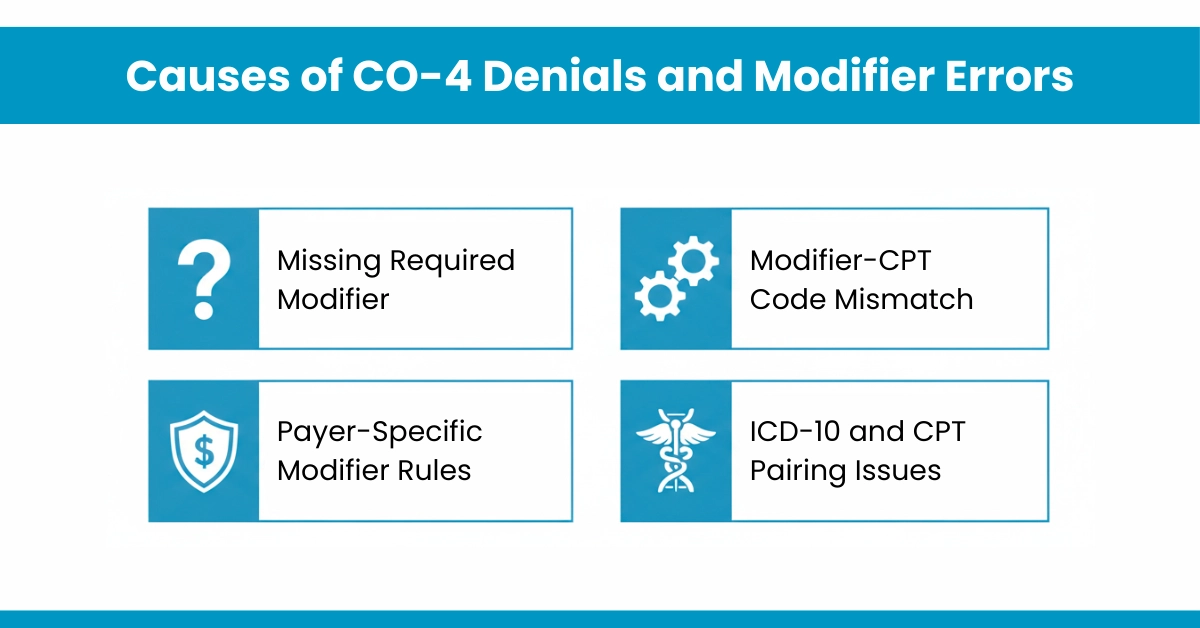
Causes of CO-4 Denials & Modifier Errors in Medical Billing
1. Missing Required Modifier
Certain CPT codes cannot be processed without a specific modifier.
- CPT 71046 (Chest X-ray, 2 views) requires modifier TC or 26 when billed separately.
- CPT 93000 (ECG with interpretation) requires modifier 26 in a facility setting. Submitting either code without the correct modifier triggers CO-4 automatically.
2. Modifier-CPT Code Mismatch
Not every modifier pairs with every procedure code.
- Applying modifier 51 to a modifier 51-exempt code
- Using modifier 59 where NCCI edits do not permit it,
- Attaching modifier 76 to a first-time procedure
All creates direct conflicts that payers flag immediately.
3. Payer-Specific Modifier Rules
- Medicare, Medicaid, and commercial payers each follow different modifier policies.
- A modifier accepted by one payer may trigger a denial code CO-4 with another.
Applying uniform modifier rules across all payers is one of the most common and costly billing mistakes.
4. ICD-10 and CPT Pairing Issues
The diagnosis code must support the modifier used.
- Modifier 25 on CPT 99213 is not justified without a documented separate complaint.
- CPT 27447 (knee replacement) without laterality modifier LT or RT triggers CO-4 because the payer cannot determine which side was treated.
Modifier 59 vs X-Modifiers: An Important Distinction
Many billing teams default to modifier 59 (distinct procedural service) when unbundling procedure pairs. However, CMS and a growing number of commercial payers now prefer, and in many cases require, the more specific X-modifiers in place of 59.
The four X-modifiers each carry a precise meaning.
- XE indicates a separate encounter on the same date.
- XS identifies a separate anatomical structure.
- XP applies when a different practitioner performed the service.
- XU signals an unusual non-overlapping service that does not fit the other three categories.
Tip:
Using modifier 59 where an X-modifier is required may trigger CO-4. Review CMS NCCI guidance annually.
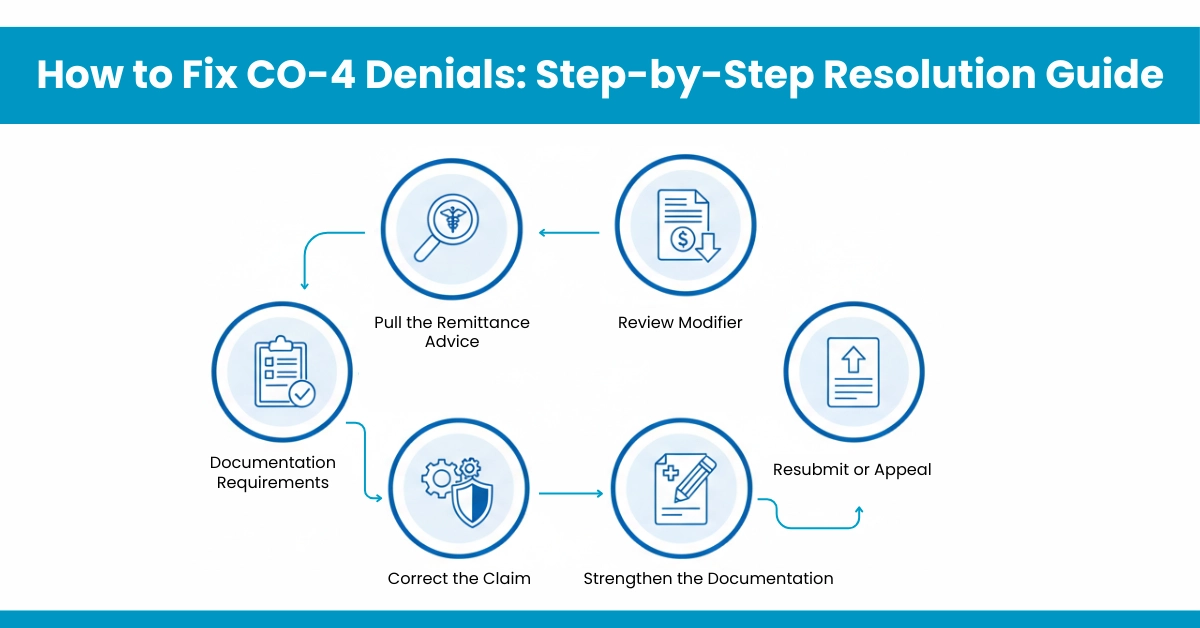
How to Fix CO-4 Denials: Step-by-Step Resolution Guide
- Pull the Remittance Advice: Identify which CPT code triggered CO-4 and what modifier was, or was not, applied.
- Review Modifier & Documentation Requirements: Check the CPT code requirements against payer-specific guidelines, CMS NCCI edits for Medicare claims, and the current AMA CPT manual. Also, review the clinical documentation to confirm it supports the modifier, not just that the modifier is present.
- Correct the Claim: Add the missing modifier, replace the incorrect one, or substitute modifier 59 with the appropriate X-modifier where required. Confirm the corrected modifier aligns with the supporting ICD-10 diagnosis.
- Strengthen the Documentation: If the denial was triggered by insufficient documentation, work with the clinical team to obtain an addendum or clarification note before resubmission. Payers require this during the review process.
- Resubmit or Appeal: If within the timely filing limits, resubmit the corrected claim. If outside the window, file a formal appeal with a cover letter referencing the original claim number, denial date, corrected modifier, and the clinical justification that supports it.
Prevention Strategies for CO-4 Denials in 2026
Prevention consistently saves more revenue than resolution.
- Run pre-claim modifier audits before every submission: Verify each CPT code’s modifier requirement, cross-reference NCCI edits, and confirm payer-specific rules for each insurance type. Apply laterality modifiers on all bilateral procedures without exception.
- Verify eligibility before every visit: Confirm not just coverage, but payer-specific billing rules. These change annually, and catching them early prevents avoidable CO-4 denials downstream.
- Invest in coder training: AAPC-certified coders stay current on annual CPT changes that directly affect modifier requirements. Practices that conduct quarterly training reports significantly lower CO-4 rates. Hello MDs’ medical billing and coding services include AAPC-certified coders who audit modifier usage across all claim types before submission.
- Activate modifier validation in your billing software: Most healthcare practice software comes equipped with this feature. Not using it means preventable errors pass through undetected every day.
- Track denial patterns by provider and CPT code: When CO-4 denials cluster around specific physicians or service lines, the cause is almost always a training gap, not a random error. HelloMDs’ denial management services identify these patterns early and correct them systematically.
CO-4 Denial in the Context of Medical Billing
- CO: Contractual Obligation, provider absorbs adjustment; patient usually not responsible.
- PR: Patient Responsibility, shifts the balance to the patient.
- OA: Payer-initiated adjustment, neither party responsible.
- N codes (e.g., N4): Supplemental remarks, often note missing documentation.
- Understanding these helps avoid improper billing and legal exposure.
Conclusion
The CO-4 denial code is one of the most preventable denials in medical billing. It always signals a modifier problem, either missing or inconsistent, that blocks payment unnecessarily.
Resolving denial code CO-4 requires accurate modifier knowledge, payer-specific awareness, and a structured appeal process. Preventing it requires proactive audits, updated coder training, and systematic denial tracking.
Practices that treat CO-4 seriously improve first-pass claim acceptance rates and recover revenue that would otherwise be permanently lost. If CO-4 denials are consistently impacting your revenue cycle, HelloMDs provides expert denial management, medical billing and coding, and full RCM healthcare services, built to reduce denials and protect your bottom line.
Follow Hello MDs on Facebook and Instagram to learn more about how our nationwide billing team supports your practice.
Disclaimer
The information provided in this article is for educational and informational purposes only and is not legal, medical, or financial advice. Practices and policies may vary by payer, region, and healthcare provider. Hello MDs certified medical billing professionals, follow these guidelines to manage claims accurately. Some images in this article are AI-generated for illustration purposes only.