
Neck pain is very common and can really affect how people feel day to day. Using the right ICD-10 code to record it is key. It helps doctors communicate clearly with each other. This code is like a standard label for diagnoses, making it easier for medical teams and insurance companies to work together.
When doctors document neck pain properly, they can track how often it happens and how bad it gets in different groups of people. It also helps them check if treatments are working well and create better plans to manage them. By sticking to the official neck pain ICD-10 code, healthcare pros can give better care and make the whole system run smoother. Neck pain affects more than 30 million Americans annually. If your notes and codes aren’t crystal-clear, payers deny the claim.
This guide provides clinicians and coders with a step-by-step approach to coding cervical pain accurately in 2026, including chronic pain, radiculopathy, disc disorders, facet joint pain, myofascial pain, and trauma-related cases.
Your neck supports your head all day, like a sturdy pillar. But when it hurts, simple things like driving or working become tough. Cervical pain refers to discomfort in the upper spine area, from the base of your skull down to your shoulders. It might feel like a dull ache, a sharp twinge or even tightness that spreads.
In healthcare, the right ICD-10 code for cervical pain ensures everyone, from your doctor to insurance, is on the same page.
If it’s lasted over 3 months, it might fall under chronic cervical pain ICD-10, still often coded as M54.2, but with notes on duration for clarity
Using these codes right helps doctors get paid fairly for treating neck pain. Good record-keeping with these codes makes billing faster and ensures providers get the money they deserve for patient care.
Note: Cervical Pain ICD-10 codes follow the same pain-coding structure used for other regions of the body. For comparison, you can also review our Rib Pain ICD-10 guide to understand how location-specific pain codes are applied.
Remember: If the patient mentions numb fingers or the MRI shows a disc, M54.2 becomes invalid the same day.
At Hello MD medical billing and denial management services ensure your documentation aligns with payer requirements before claim submission.
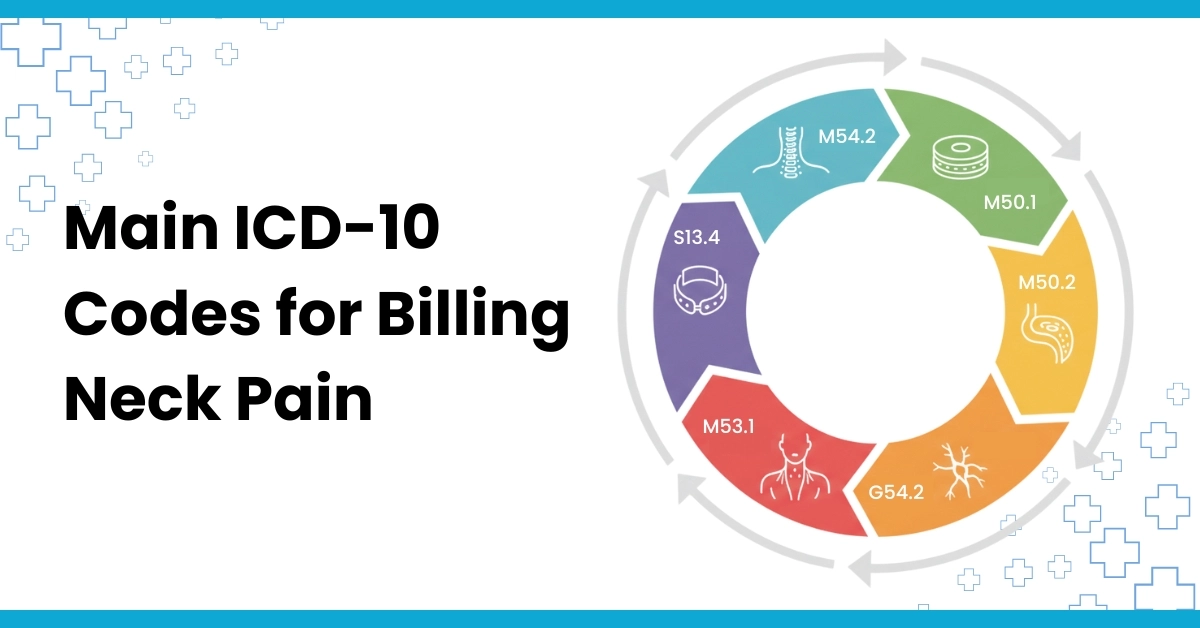
Cervical radicular pain ICD-10 choices depend on what is touching the nerve.
Clinical picture | Code | Tip |
Unknown cause | M54.12 | State “radiculopathy, cervical region; cause under investigation” |
Disc touching a nerve | M50.1- | Add level: M50.121 (C5-C6) beats M54.12 every time |
Bone spurs touching nerve | M47.21- | Pick level: M47.22 (C6-C7) bundles arthritis + radiculopathy |
If radiculopathy stems from a disc, choose M50.1 series. Practices using HelloMDs physician billing and coding services avoid errors from combining codes incorrectly.
Note: Do not list M54.12 + M50.121 together; the combo code already owns the radiculopathy.
For cervical discogenic pain, ICD-10, here’s a detailed reference:
Code | Meaning | Typical CPT match | Documentation Tip |
M50.0 | Disc + spinal cord | 62320 epidural, 22554 ACDF | Correlate imaging and symptoms |
M50.1 | Disc + nerve root | 64483 transforminal injection | Specific Level (e.g., M50.121) |
M50.2 | Disc displaced, no neuro | 0232T discography | Use MRI findings to confirm |
M50.3 | Disc degeneration | 20552 trigger point, 97014 e-stim | Note axial pain and imaging correlation |
Tip:
HelloMD’s medical billing audit services help verify that the level-specific code matches the procedural code, reducing denials by up to 30%.
Cervical facet joint pain ICD-10 code is M53.82. Optional add-ons include M47.812 (spondylosis) or M46.92 (inflammatory)
Using HelloMD’s prior authorisation services ensures that facet injection approvals are supported with complete documentation, avoiding procedural delays.
Tip: Practices that let a virtual assistant track these dates cut prior-auth delays by 35 %.
Use for: Muscle-related neck pain with trigger points.
Why:
Payers map 20552 (trigger-point injection) to M79.1. File M54.2, and the edit system denies the injection as “diagnosis-procedure mismatch.”
Example Notes: Right trapezius trigger band, twitch response palpable, pain 7/10, refers to temple → M79.1, 20552×3 muscles.
ICD-10 cervical spine pain of traumatic origin needs an S code, not M54.2:
Example:
Rear-ended 3 days ago, acute neck pain, no fracture, spasm present → S13.4XXA, Y92.411, V43.5XXA.
Tip: Trauma codes expire after 90 days; switch to M54.2 only if pain lingers and imaging is clean.
Copy this into every neck-pain note:
Tip: Missing two or more bullets increases the 30 % higher denial rate.
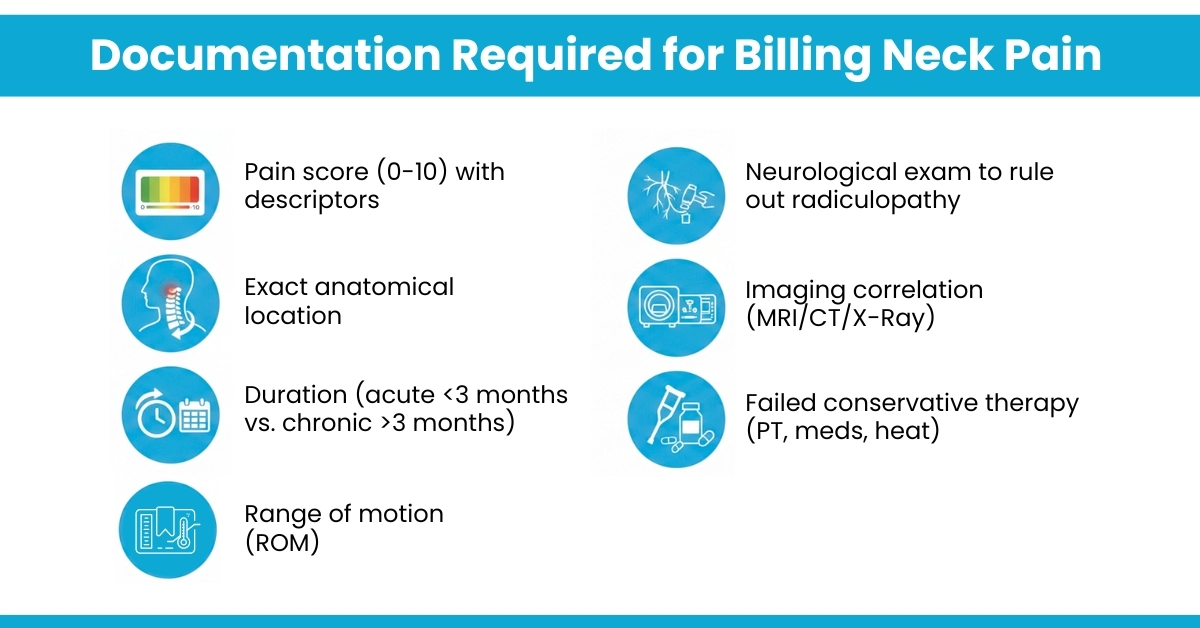
Pick the cervical pain ICD-10 code that matches the anatomical culprit you can prove: M54.2 for simple ache, M50.1 for disc-nerve, M53.82 for facet, M79.1 for muscle knots, S13.4 for trauma. Write pain score, ROM, neuro exam, chronicity, and failed therapy every time. Doing this with HelloMD’s integrated services enhances approval rates above 95 %, trims appeals, and adds roughly $7,500 per provider per year without extra equipment, just cleaner notes and the right five-digit string.
Master these rules once, and neck-pain claims become a reliable revenue stream instead of a monthly headache.
Disclaimer:
This article is for general informational purposes and is not professional advice. ICD-10 codes and documentation should always be verified with official sources or certified coders. Visual content is for demonstration purposes and may not reflect actual cases.