You’ve just paid $300 for a specialist visit out-of-pocket, only to find your reimbursement claim denied months later because of an obscure form called a superbill. This scenario is all too common: many patients see out-of-network providers and then struggle to get paid back. In fact, the NPR report found that 28% of Americans receiving mental health therapy saw an out-of-network provider, meaning they had to pay up front and seek reimbursement afterward.
This is where understanding what is a superbill in medical billing is becomes critical. A superbill turns this frustration into a clear process. It’s essentially a highly detailed receipt that the provider gives the patient, packed with coded information about the visit. The superbill “is not really a bill at all,” but a highly detailed receipt itemizing the services provided, so the patient (not the provider) can be reimbursed by insurance.
What is a Superbill in Medical Billing?
A superbill is a comprehensive encounter form that captures every service, diagnosis, and charge from a patient visit. Unlike a standard invoice, it uses standardized medical billing codes to communicate directly with insurance payers. Think of it as a detailed translator between clinical care and financial reimbursement.
As defined by the American Academy of Professional Coders (AAPC), a superbill is “a one-page form that lists all possible services a provider delivers, allowing quick selection of CPT codes, ICD-10 codes, and fees.” This superbill definition clarifies its purpose: to facilitate accurate coding on a superbill for claims submission, especially for out-of-network providers who don’t bill insurance directly.
The document becomes critical when a provider chooses not to enrol with a payer or when a patient sees a specialist outside their network. In these cases, the healthcare superbill empowers patients to seek reimbursement themselves while providing insurers with the precise data they need to process payments.
Components of a Superbill in Medical Coding
A properly structured superbill in medical billing contains eight essential elements. Missing even one can derail reimbursement. Here’s what every medical billing superbill must include:
Patient Information: Full name, DOB, address, insurance details
Provider Information: Name, NPI number, Tax ID, license, contact information
Date of Service: Exact appointment date
CPT Codes: Current Procedural Codes for services
ICD-10 Codes: Diagnosis codes linking services to medical necessity
Modifiers: Two-digit codes indicating service variations
Charges and Payments: Fees charged and amounts already paid
Provider Signature: Required attestation for claim validity
Superbills are a key part of medical billing, helping streamline patient-submitted and out-of-network claims. To see how they fit into the broader billing process, check out our guide on types of medical billing. Accurate coding on superbills ensures faster reimbursement and fewer claim denials.”
How a Superbill Is Used in Medical Billing
Understanding how to use a superbill reveals its role in the revenue cycle. The workflow follows in 5 steps:
Patient Visit & Payment: The patient receives care from an out-of-network or cash-pay provider and pays at the time of service.
Superbill Creation: After the visit, the provider’s office generates the superbill. In modern practices, this often happens automatically via an EHR or practice management system. The document itemizes exactly what care was given and what fees were paid
Patient Submission: The provider hands the superbill to the patient. The patient then submits it to their insurer, usually alongside the insurer’s out-of-network claim form if one is required. Submission methods include online portal, mail, or fax. Patient should do this promptly; most plans have a “timely filling” deadline (90-180 days from the service date)
Adjudication by insurer: The insurance company reviews the superbill and accompanying claim. They check the CPT and ICD codes against the patient’s benefits, deductible, coinsurance, and allowed amounts. If the codes provider information and documentation all satisfy the plan rules, the insurer approves a partial reimbursement to the patient.
Reimbursement: Assuming approval, the insurer sends the reimbursement directly to the patient. The patient may then apply that payment towards the balance they already paid. If the claim is denied, the insurer should send an EOB with reasons, and the patient can appeal or resubmit if corrections are made.
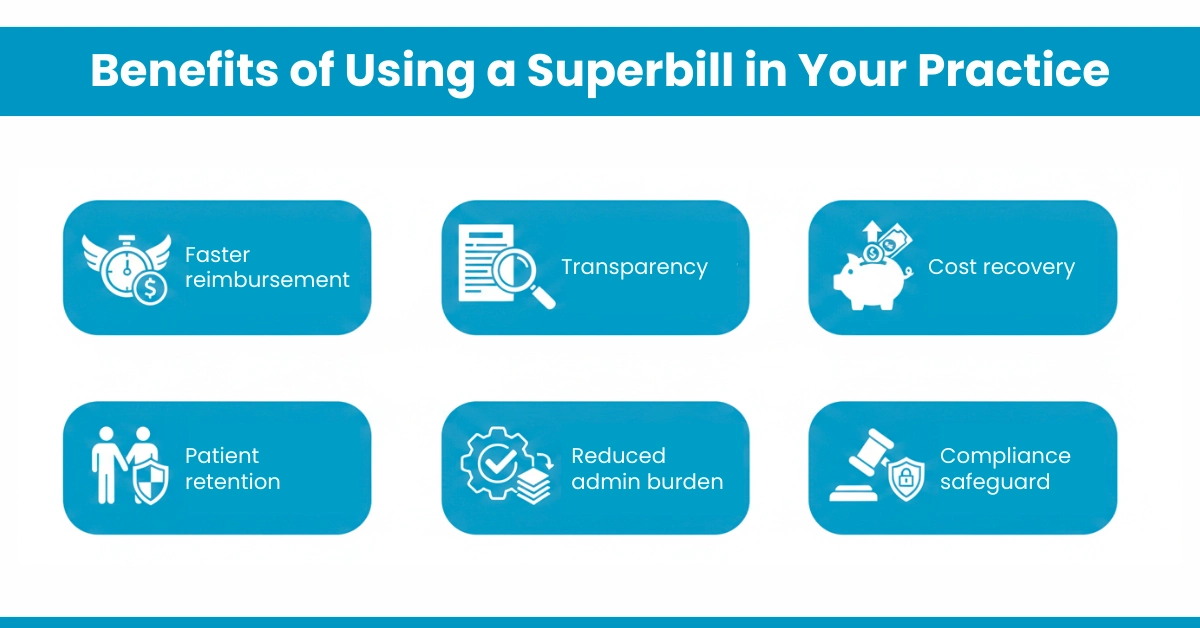
Benefits of Using a Superbill in Your Practice
Whether you’re a solo therapist or a multi-specialty clinic, Superbill advantages ripple across your entire operation:
For Patients:
Faster reimbursement: Properly coded superbills cut payment time from 90 to 30 days
Transparency: Clear CPT codes help patients understand what they’re paying for
Cost recovery: Up to 80% of out-of-network costs can be reimbursed
For Private Practices:
Patient retention: Offering superbill support builds trust. Patients return when they know you’ll help them get paid back
Compliance safeguard: Accurate coding on a superbill reduces audit risk
For Billing Teams:
Fewer denials: Automated superbill import reduces errors by 40%, per HealthTech Magazine.
Streamlined workflow: Integration with RCM healthcare services centralizes tracking.
Clear audit trails: Every superbill becomes a verifiable record for medical billing audit services
For Healthcare Startups:
User trust: Embedding superbill education increases platform retention by 25%
Scalable support: Automated generation reduces support ticket volume dramatically
Practices using our physician billing services report 15-20% higher collection rates when superbills are optimised through our denial management protocols.
Common Challenges with Superbill
Even with clear benefits, superbill errors plague practices. Here are the top pitfalls:
Incorrect CPT/ICD-10 Codes: Using outdated codes or mismatched pairs triggers denials. For example, billing an annual wellness visit (G0439) with a depression diagnosis (F32.9) raises red flags.
Missing Provider Information: Forgetting the NPI number or signature invalidates the entire claim. Becker’s ASC Review notes that 20% of superbill rejections stem from incomplete provider data.
Integration Failures: Manual data entry between EHR and PMS creates typos. Without automation, billing staff waste hours rekeying information.
Patient Confusion: Patients receive superbills without submission instructions, leading to delayed or abandoned claims.
Payer-Specific Rules: Some insurers require additional modifiers or separate medical billing forms. UnitedHealthcare, for instance, demands modifier GP for therapy services.
Solution Path: In the denial management service provided by Hello MDs, we review rejected superbills within 48 hours, correcting errors and resubmitting. This proactive approach recovers $12,000+ monthly for average practices.
Best Practices for Creating and Using a Superbill
Follow these superbill best practices to maximize efficiency:
Use Standardized Templates: Create templates for each specialty. Therapists need space for session notes; cardiologists require fields for ECG interpretations. HelloMDs provides customizable templates through our medical billing services for small practices.
Train Staff Quarterly: Conduct coding workshops focusing on CPT codes in Superbill updates. The AMA revises codes annually; missing these changes causes revenue loss.
Audit Monthly: Run medical billing audit services to catch errors before submission. Target: <2% error rate.
Automate Generation: Integrate EHR with billing software to auto-populate ICD-10 codes in Superbill from clinical notes. This cuts creation time from 10 minutes to 30 seconds.
Educate Patients: Provide a one-page guide with every superbill. Include payer portal links and submission deadlines (most insurers allow 90-180 days from service date).
Track Reimbursement Outcomes: Use accounts receivable services to monitor which payers reimburse fastest. This data informs future patient referrals.
Conclusion:
A superbill is more than paperwork; it’s the lifeline connecting patient care to insurance reimbursement. By capturing accurate components of a superbill, from CPT codes to provider signatures, practices empower patients while protecting revenue. For private practices, it builds trust and retention. For billing teams, it reduces denials and burnout. For patients, it means money back in their pockets.
At Hello MDs, we transform superbill management through end-to-end RCM healthcare services. Our AAPC-certified coders handle everything from prior authorisation to denial management, ensuring your medical billing superbill process is seamless, compliant, and profitable.
Disclaimer:
This article is for general information only and does not replace professional medical, legal, or insurance advice. Insurance rules and reimbursement policies may vary, so always check with your provider or insurer. Some images are digitally created and used only for illustration purposes.
Yes, most insurance companies accept superbills as supporting documentation for out-of-network reimbursement when all required information and codes are included accurately.
An insurance superbill is a one-to-two-page document listing provider details, patient information, CPT and ICD-10 codes, service dates, charges, and signatures.
A superbill is also called an encounter form, charge slip, fee ticket, or routing slip, depending on the healthcare practice and billing workflow used.