Your practice billed D9310 dental code correctly. The documentation looked complete. The referral was there. Yet the claim came back denied, again.
This is the most common frustration with dental code D9310. The code itself is straightforward. But the billing rules around it are where practices silently lose money. Wrong ICD-10 pairing, same-day treatment conflicts, frequency overlaps with exam codes, any one of these can kill a clean claim.
This guide gives you the complete D9310 dental code description, when the code is truly billable, ICD-10 combinations that support approval, the real denial triggers practices overlook and how to fix rejected claims fast. Just what you need to protect your revenue.
D9310 dental code is a CDT procedure used when a dentist or physician provides a diagnostic consultation requested by another provider, without performing treatment during the visit. The D9310 dental code falls under CDT’s Adjunctive General Services category.
Its official description reads:
“This code is used when an outside provider gives a diagnostic consultation at another provider’s request.”
This code covers a formal diagnostic opinion requested by one provider and delivered by another. It is not a routine exam. It requires a clear referral.
D9310 also appears as an HCPCS code, which matters for Medicaid and cross-payer billing. When billing Medicaid or Medicare Advantage dental plans, verify whether the payer accepts D9310 under CDT or HCPCS guidelines. The code is the same; the billing pathway can differ.
D9310 applies only when:
It is commonly used for:
The code exists to document collaboration between providers and ensures consultation services are reimbursed appropriately.
Any licensed dentist or physician providing a referred diagnostic consultation can bill D9310. This includes:
Do not use D9310 for:
Mixing up D9310 with related codes is one of the top reasons claims fail.
Code | Description | Key Difference |
D9310 | Professional consultation (dentist to dentist/physician) | Requires formal referral; no treatment same day |
D0150 | Comprehensive oral evaluation | Routine new patient exam; no referral required |
D0140 | Limited oral evaluation | Problem-focused exam; typically for emergencies |
D0120 | Periodic oral evaluation | Recall exam for existing patients |
D9311 | Medical professional consultation | Used when the consulting provider is a medical physician, not a dentist |
Rule of thumb:
If a referring provider didn’t formally request the visit in writing, D9310 does not apply.
Pairing D9310 with a mismatched ICD-10 code is a silent denial trigger. Payers cross-check the diagnosis against the procedure.
Common valid pairings include:
Always match the ICD-10 code to the specific reason for the referral, not a general dental diagnosis. Payers’ flag mismatches quickly, especially on specialist claims.
Strong documentation is the difference between a paid claim and a denial. Before submitting, confirm your chart includes:
Proper documentation supports reimbursement because consultation services must demonstrate independent diagnostic value.
Prior authorization:
Most private dental plans do not require prior authorization for D9310. However, some Medicaid programs and Medicare Advantage dental plans do. Always verify before the appointment, not after.
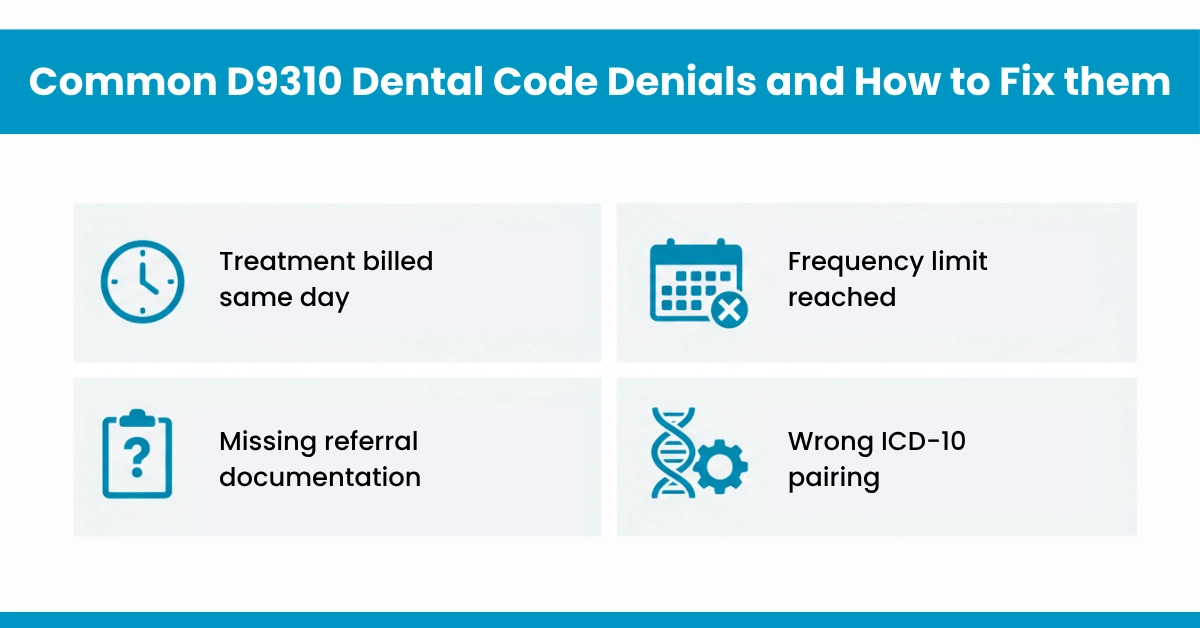
These are the most common D9310 denial reasons and their direct fixes:
Appealing a denial:
Submit a concise appeal with the referral letter, clinical notes, and a one-paragraph narrative explaining medical necessity. Most well-documented appeals succeed in the first round.
D9310 billing has more rules than most providers expect. One documentation gap can mean weeks of delayed revenue.
HelloMDs is an AAPC-certified medical billing and coding company serving dental and medical providers across all 50 U.S. states and territories. Their team handles D9310 claims from the first code of selection to the final payment, including denial management and appeals.
HelloMDs offers:
All services are HIPAA-compliant, backed by certified coders, and available at billing rates starting at just 2.95% of monthly collections.
The D9310 dental code is powerful, but only when billed correctly. Use it for formal, referral-based consultations, pair it with the right ICD-10 code, document everything, and never bill for treatment on the same claim. When claims still get denied, a fast and informed appeal makes all the difference.
If managing D9310 billing is slowing your practice down, HelloMDs is ready to handle it for you. Contact HelloMDs today for a free consultation and let certified experts protect your revenue.
This content is for informational purposes only and does not constitute legal, medical, or billing advice. CDT codes and payer policies change frequently. Always consult with a certified billing professional or refer to current ADA CDT guidelines before submitting claims.