
If you’re a dental biller, you’ve probably seen D0140 claims come back denied, or confused it with D0120 or D0150. That one wrong code choice costs your real revenue.
The D0140 dental code description is simple: it’s a Limited Oral Evaluation, Problem Focused. But billing it correctly is where most practices struggle. Wrong documentation, missing ICD-10 codes, or frequency errors lead to immediate denials.
This guide gives you everything you need, from the exact definition to denial fixes, so your D0140 claims go through clean, the first time.
D0140 is a CDT (Current Dental Terminology) diagnostic code defined by the American Dental Association (ADA). It covers a limited oral evaluation focused on a specific problem or complaint, not a full-mouth exam.
What D0140 Includes vs. Excludes
CDT Code | Name | Use Case |
D0120 | Periodic Oral Evaluation | Routine checkup for established patients |
D0140 | Limited Oral Evaluation, Problem Focused | Emergency or complaint-specific visit |
D0150 | Comprehensive Oral Evaluation | New patient or major health change |
D0160 | Detailed and Extensive Oral Evaluation | Complex medical history, multiple systemic conditions |
D0140 covers a focused clinical exam of one specific area. It may include visual inspection and same-day diagnostic radiographs, billed separately. It does not cover full periodontal charting, soft tissue screening, or a complete oral health review. That’s D0150 territory.
Practices that bill D0140 when D0150 applies, or use it as a substitute for D0120, face both denial risk and compliance exposure. Accurate code selection from the start protects your revenue cycle before a claim is ever submitted. This is exactly where HelloMDs medical coding services help practices avoid costly errors at the source.
D0140 is a problem-focused code, not a catch-all for any dental visit. Use it only when a patient presents with a specific complaint that requires immediate, targeted evaluation.
Qualifying Clinical Scenarios for D0140
Don’t bill D0140 for:
Routine checkups, preventive visits, or any exam that could qualify as D0120. Doing so is considered upcoding, which increases audit risk and triggers payer flags on future claims.
This is one of the most overlooked parts of billing D0140. Pairing the correct ICD-10 diagnosis code is what proves medical necessity to the payer. Without it, your claim is weak and vulnerable to denial.
Diagnosis Codes That Support D0140 Claims
ICD-10 Code | Description | Common D0140 Scenario |
K04.0 | Pulpitis | Acute tooth pain requires emergency evaluation. |
K04.6 | Periapical abscess with sinus | Swelling and infection. |
K02.9 | Dental caries, unspecified | Emergency cavity evaluation. |
K08.89 | Other specified disorders of teeth | Generalized tooth complaints. |
K12.2 | Cellulitis and abscess of the mouth | Oral infection or facial swelling. |
S02.5XXA | Fracture of tooth, initial encounter | Traumatic dental injury. |
K01.1 | Impacted teeth | Wisdom tooth eruption evaluation. |
Always match the ICD 10 code to the chief complaint documented in clinical notes. Mismatches between diagnosis and procedure are frequent denial triggers. In cases such as trauma (e.g., S02.5XXA), claims may also be submitted to medical insurance, which has distinct coding requirements and may improve reimbursement outcomes if correctly documented and justified.
Accurate billing starts with accurate documentation. Payer’s audit D0140 claims regularly because this code has a high rate of misuse.
Before submitting a D0140 claim, confirm the chart includes:
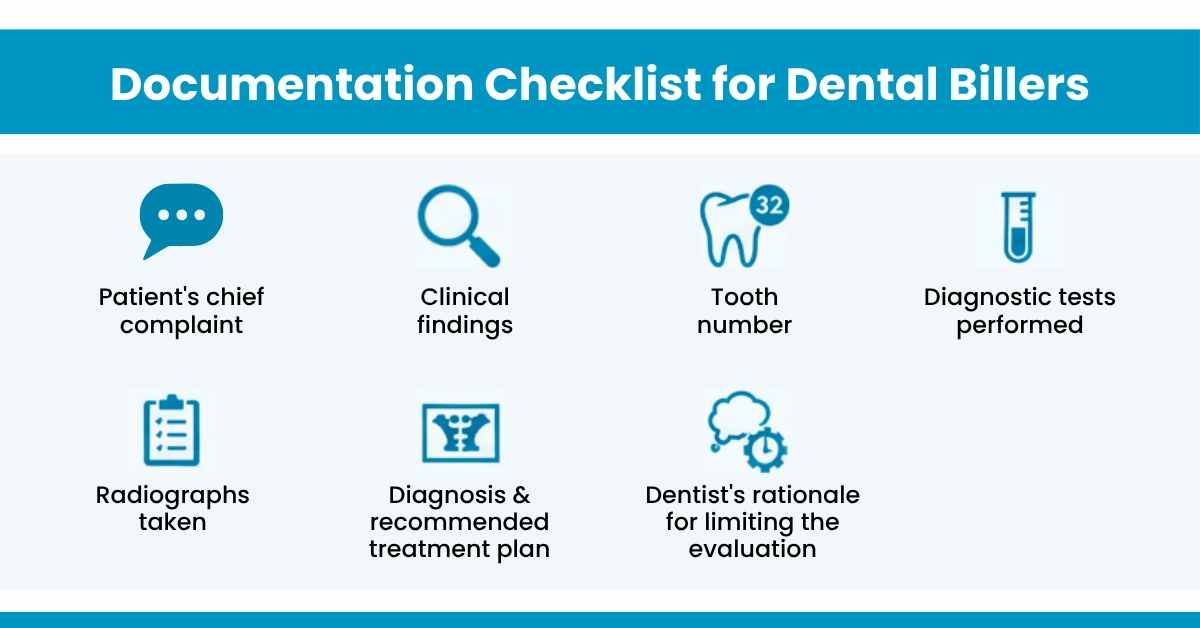
On the ADA claim form:
Enter D0140 in the procedure code field, attach supporting notes, and include the matched ICD-10 code. Submit radiographs as separate line items. Note whether the patient is new or established; this affects frequency of eligibility under some plans.
Tip:
Incomplete documentation is the number one reason clean D0140 claims become denial cases. Practices that implement a structured documentation workflow, or partner with a billing team that conducts regular medical billing audits, catch gaps before the claim ever leaves the office.
Denials on D0140 are common, but most are preventable. Here are the top reasons and the exact fix for each.
When both are performed on the same date, most payers will not reimburse D0140 alongside D9110; they consider it bundled.
Denial Reason | Fix |
Billed same day as D9110 | Submit only one; choose based on what was primarily performed |
Missing ICD-10 code | Always attach a matched diagnosis code to every D0140 claim |
Frequency limit exceeded | Verify plan allows another evaluation; use D0120 for routine visits |
No supporting documentation | Attach clinical notes with every submission |
Duplicate claim, same provider | Check if D0140 was already billed within the plan’s frequency window |
The wrong code should be D0120 | Review: Was the visit truly problem-focused or routine? |
If a claim is denied, appeal with a letter of medical necessity and the complete clinical note. Most D0140 denials are overturned when documentation is clean and specific. Practices with a dedicated denial management process resolve these appeals faster and recover revenue that most billing teams write off.
Most dental insurance plans limit how often D0140 can be billed per patient, per provider. Ignoring these limits is a fast path to denials and compliance issues.
Prior authorization is rarely required for D0140 but always verify before the appointment for new patients with unfamiliar plans. Use real-time eligibility verification to confirm coverage, frequency limits, and co-pay details before the patient even sits in the chair.
If a patient has already used their D0140 frequency, document whether D0120 (periodic) applies, or whether the visit warrants a D0150 if the scope expanded to a comprehensive review.
D0140 is one of the most audited dental procedure codes. Payers track billing patterns across providers, and high D0140 frequency flags your practice for review.
The D0140 dental code description, Limited Oral Evaluation, Problem Focused, is one of the most used and most misused codes in dental billing. Knowing when to use it, how to document it, and which ICD-10 codes to pair with it makes the difference between fast reimbursements and costly denials.
“Clean documentation, correct coding and the right ICD-10 = fewer denials, faster payments”.
If your practice is struggling with claim accuracy or denial management, HelloMDs is built for exactly this. Our certified billing experts handle the complexity so you can focus on care.
Contact HelloMDs for a free billing consultation and see how much revenue you’ve been leaving behind.
Follow HelloMDs on Facebook and Instagram for weekly billing tips, code updates, and RCM insights.
This content is intended for informational purposes only and should not be considered medical, legal, or insurance advice. Coding and billing practices can vary by payer, plan, and policy changes; always verify with the latest coding guidelines and individual insurance requirements. HelloMDs are not responsible for any errors, omissions, or outcomes from using this information. Images in this blog are created by AI tools for illustrative purposes.