
Medical Billing

How to Bill CPT Code 93268 Without Denials

Home / 93268 CPT Code Description

Struggling with 93268 CPT code denials? Cardiology billers lose $200-400 per claim from vague ICD-10s or missing 24-hour logs. If you’re a cardiology biller, coder, or physician’s office manager and you’ve Googled “93268 CPT code description,” you’re probably dealing with one of three problems:

  • A claim just got denied, and you don’t know exactly why.
  • You’re unsure whether to bill 93268 globally or split it into component codes.
  • You’re not confident your documentation will survive a payer audit.

You’re not overthinking it. 93268 is genuinely one of the trickiest event monitoring codes to bill cleanly. This guide solves it fast with checklists, payer-proof tips and HelloMDs AAPC-certified fixes.

What Does CPT Code 93268 Actually Mean?

CPT 93268 covers an external cardiac event monitor worn by a patient for up to 30 days. It records the heart’s electrical activity either when the patient activates it due to symptoms or when the device automatically detects an abnormal rhythm.

The official description:

External, patient- and auto-activated electrocardiographic rhythm event recording with a symptom-related memory loop, remote download capability up to 30 days, 24-hour attended monitoring, including transmission, review, and physician interpretation.

Three words matter most here: 24-hour attended monitoring

CMS confirms event monitors:

  • Use a symptom-related memory loop.
  • Can be worn up to 30 days.
  • Require remote monitoring capability.

Missing proof of attended monitoring = top audit failure.

CPT 93268 vs. Codes 93270-93272: Which to Bill?

Bill 93268 globally if your practice handles everything. Use components if outsourcing.

Code

Covers

Who Bills

2026 RVU Est.

93268

Full service: setup, recording, transmission, and physician interpretation.

Practice that owns equipment and interprets

1.2 Global ($247 avg)

93270

Recording only (connection, recording, disconnection)

Device company or technical-only provider

0.5 tech

93271

Transmission/analysis only

Monitoring center

0.4 tec

93272

Physician review and interpretation only

Interpreting physician only

0.85 pro

The rule: If your practice owns the equipment and the physician interprets the results, bill 93268 globally. If the device company does the recording and your physician only interprets, bill 93272 for your side.

Note:

Do not bill 93270 and 93271 in the same 30-day period as 93268. Payers treat 93268 as inclusive of the others. All codes in this family (93268-93272) are telemedicine codes, listed in CPT Appendix P. In 2026, audio-only temporary telehealth codes were removed. Use permanent telehealth codes with Modifier 95 and full documentation.

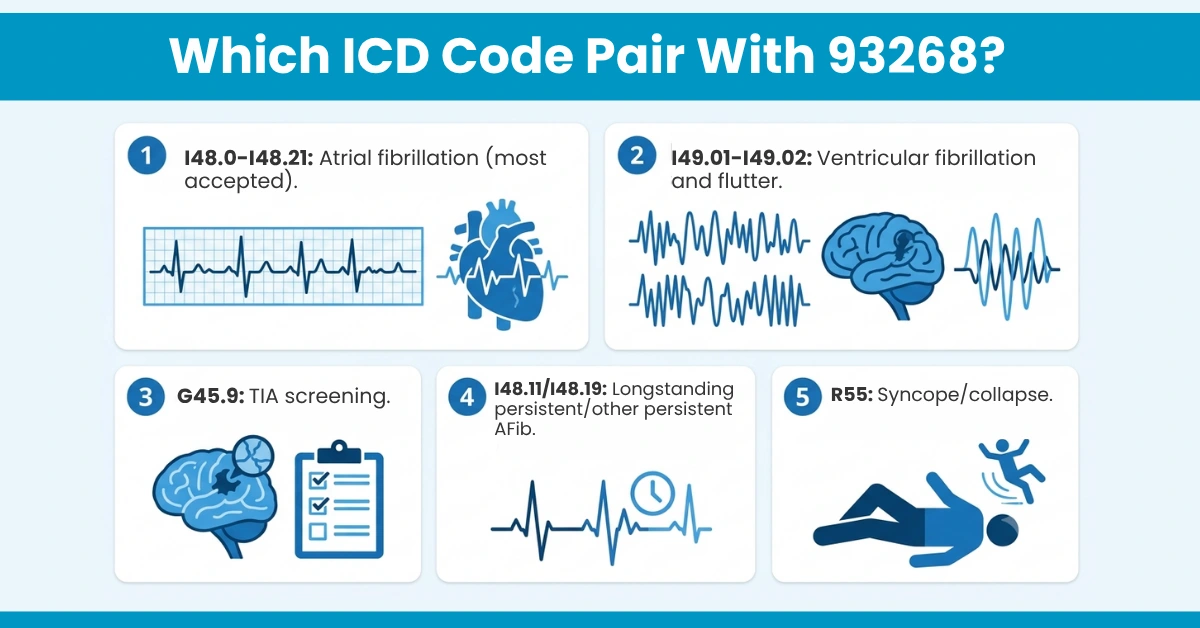
Which ICD Code Pair With 93268?

Vague codes are the #1 reason 93268 claims get flagged as “not medically necessary.”

Strong Primary Diagnosis (Most accepted):

  • I48.0-I48.21: Atrial fibrillation (most accepted).
  • I49.01-I49.02: Ventricular fibrillation and flutter.
  • G45.9: TIA screening.
  • I48.11/I48.19: Longstanding persistent/other persistent AFib.
  • R55: Syncope/collapse.

Symptoms-Based Pairings (Use them with caution):

  • R00.2: Palpitations (Often preferred over R00.8 for specific “fluttering” sensations).
  • R06.02: Shortness of breath.
  • R07.9: Chest Pain, unspecified.
  • R00.0: Tachycardia, unspecified.
  • R00.1: Bradycardia, unspecified.

Avoid: Using I49.9 (cardiac arrhythmia, unspecified) or I10 (hypertension) alone as your primary diagnosis. These trigger automatic medical necessity reviews at most payers.

Cigna, UnitedHealthcare, and Anthem all require documentation showing the monitoring is for presyncope, severe palpitations, post-TIA, or when Holter monitoring was inconclusive. Document that specifically in your chart notes.
Which ICD Code Pair With 93268

How Payers Decide to Approve or Deny 93268

Payers evaluate 3 key factors:

  1. Clinical necessity: Was extended monitoring justified vs Hotler?
  2. Prior testing: Was shorter monitoring inconclusive?
  3. Symptom severity:
    • Syncope.
    • Intermittent arrhythmia.
    • Post-TIA monitoring.

Missing any of these causes high denial risk

What Modifiers Work for 93268 Billing?

Getting modifiers wrong on 93268 is expensive. Here’s what applies:

Allowed:

  • Modifier 59: Same-day E/M service (e.g., 99214-59).
  • Modifier 95: Synchronous telehealth delivery (permanent code, 2026 compliant).
  • Modifier 52: Less than 12 hours of monitoring (rare but documented).
  • Modifier 76: Repeat by the same MD.

Not Allowed:

  • Modifier 26 (professional component) is already global.
  • Modifier TC (technical component) is already global.
  • Modifier 25 on 93268 itself.

Frequency watch:

UnitedHealthcare classifies 93268 as a time-span (monthly) code, with only one unit per 30-day period. Many payers, including some Medicare contractors, limit it to once every six months per patient.

Always check your specific MAC policy and payer contract before submitting.

When Should You Not Use CPT 93268?

This is where many practices lose money.

Don’t use 93268 if:

  • Monitoring is continuous (Holter) → use 93224-93227
  • Monitoring is mobile telemetry (real-time analysis) → use 93228-93229
  • Your physician is only interpreting results → use 93272
  • The device company controls monitoring → split billing applies.

Incorrect billing risks downcodes, rejections, and audits. HelloMDs audits prevent this via cardiology billing services.

What Documentation Proves 93268 Medical Necessity?

Auditors and payers look for this exact checklist. If any item is missing, the claim is vulnerable:

  • Physician order with a documented clinical indication.
  • Specific symptom that prompted monitoring (palpitations, syncope, post-TIA, etc.).
  • Evidence of 24-hour attended monitoring.
  • Transmission logs.
  • Physician’s signed interpretation report.
  • Monitoring duration.
  • ICD-10 code supports medically necessary.

Note:

You need to document that the patient was instructed on device use and activation. If the device was “home-enrolled” (patient sets it up at home), document that too. It doesn’t disqualify the claim, but it must be noted.

Why 93268 Claims Get Denied? (And How to Fix It)

These are the real denial patterns, pulled from actual biller communities and payer policy reviews:

  • Modifier 26 or TC attached: Remove them. Bill component codes 93272 (professional) or 93270/93271 (technical) instead if your service was split.
  • Services exceed frequency limitations: Confirm last submission date. Many practices accidentally re-bill within six months. Track by patient, code, and payer.
  • Medical necessity not established: Your ICD-10 is too vague, or clinical notes don’t specifically mention the symptom.  Use a more specific code and ensure the physician’s order spells out the indication.
  • 93270 and 93268 billed the same period: You can’t bill both. 93268 includes 93270/93271 within the same time span. Remove the component codes.
  • No attended monitoring documentation: This is the sneaky one. The claim looks complete, but auditors pull it because there’s no proof a technician was available 24/7. Add monitoring center confirmation to the record.

At HelloMDs, our AAPC-certified coders scrub 93268 claims for exactly these patterns before they go out the door. Our denial management team and cardiology billing specialists work together, so you stop losing money to preventable rejections and spend more time on patient care.

Related HCPCS, LCD & Billing Tips For 2026

  • G2066: Remote physiological monitoring device interrogation (may apply alongside cardiac event codes in certain remote monitoring setups).
  • APC 5723: Outpatient hospital billing classification for cardiac event monitoring
  • CMS LCD L39490: The Medicare Local Coverage Determination governing all Ambulatory Electrocardiograph (AECG) monitoring. Read this before billing 93268 to Medicare patients. It defines exactly which diagnoses and clinical scenarios qualify.

Conclusion:

CPT code 93268 isn’t complicated once you understand its logic: it’s a global, timespan, attended-monitoring code that requires specific clinical justification, strict documentation, and precise modifier use. The practices that get denied aren’t making big mistakes. They’re making small, preventable ones: a vague ICD-10 here, a wrong modifier there, a missing monitoring log.

If your practice is billing cardiology and you’re still chasing denials, that’s time and revenue you shouldn’t be losing.

HelloMDs serves cardiology practices across all 50 U.S. states with end-to-end medical billing and coding, denial management, accounts receivable follow-up, and credentialing services, all handled by AAPC-certified professionals. Our plans start as low as 2.95% of monthly collections.

Book your free consultation with HelloMDs today and let your billing work as hard as you do.

Disclaimer:

This article is for informational purposes only and does not constitute legal, medical, or billing advice. CPT codes, ICD-10 codes, and payer policies are updated annually. Always verify current coding guidelines with the AMA CPT Codebook, CMS, and your local Medicare Administrative Contractor (MAC) before submitting claims. Visuals in this article are generated from AI tools.

Frequently Asked Questions

The most common audit failure is missing proof of 24-hour attended monitoring. CMS requires that a technician and physician be available for review when transmissions occur. Without this, claims may be denied even if everything else is correct.

Yes. Detection of an abnormal rhythm is not required. The key requirement is that the monitoring was medically necessary and properly documented based on patient symptoms or clinical indication.

  • Attended monitoring (required for 93268): Real-time or near-real-time review with staff available 24/7.
  • Non-attended monitoring: Data reviewed later without immediate response capability.
    Only attended monitoring qualifies for 93268 billing.

Yes, but only if:

  • The monitoring still meets clinical intent.
  • Documentation explains the interruption.
  • Modifier 52 is applied if significantly reduced.

Incomplete or unexplained interruptions may trigger denial.

93268 is event-based monitoring, while telemetry (93228-93229) is continuous real-time monitoring.

Yes. Correct coding alone is not enough. Claims are denied when:

  • Documentation is incomplete.
  • Unclear medical necessity.
  • Payer-specific rules are not followed.

Patients with:

  • Intermittent symptoms (palpitations, syncope).
  • Suspected arrhythmias not captured on Holter.
  • Post-TIA or unexplained cardiac events.

These cases justify extended monitoring up to 30 days.

Payers may request:

  • Transmission logs.
  • Monitoring center documentation.
  • Time-stamped ECG data.
  • Physician interpretation reports.

Failure to provide these can result in recoupment after payment.

Leave a Reply

Your email address will not be published. Required fields are marked *

×

Request a Free Consultation