
Medical Billing

Orthopedic Medical Billing: Coding and Claims

Home / Orthopedic Medical Billing

Orthopedic practices deliver high-value care every single day. But if the billing process behind that care fails, none of it gets paid. A wrong modifier, an expired prior authorization, one missing documentation line, and the payer denies the claim.
According to MGMA data, orthopedic practices lose up to 11% of annual revenue from billing errors alone. That’s not acceptable for a high-procedure specialty with complex, costly surgeries.

This guide breaks down exactly how orthopedic medical billing works in 2026, where it fails, and what the best orthopedic billing services do differently.

What Is Orthopedic Medical Billing?

Orthopedic medical billing is the process of converting clinical services, joint replacements, fracture care, arthroscopies, and spinal surgeries into accurate medical codes and submitting those claims to insurance payers for reimbursement.

It covers the full revenue cycle:

  • Patient insurance eligibility verification.
  • CPT and ICD-10 coding.
  • Modifier application.
  • Prior authorization management.
  • Claims submission and payment posting.
  • AR follow-up.

Did You Know?

Orthopedic billing carries one of the highest claim denial rates in U.S. healthcare, because procedures are expensive, technically complex, and heavily scrutinized by every major payer.

Every step must be accurate. One missed detail doesn’t delay payment; it eliminates it.

Why Is Orthopedic Billing So Complex?

Many say orthopedic billing is “complex,” but never explain why.

Here’s the real reason:

  • High-cost procedures: Joint replacements and spinal surgeries trigger intense payer review. Insurers look for any reason to reduce or deny payment.
  • The 90-day global surgery period: After major surgery, all related follow-up care is bundled into the surgical fee. Billing separately during this window without the correct modifier triggers automatic denials.
  • Bilateral procedure rules: Modifiers like -50, -LT, and -RT must be applied exactly right. A single error means the claim pays at the wrong rate or gets denied entirely.
  • Multiple procedures per session: Modifiers -51 and -59 manage these but applying them incorrectly causes bundling rejections.
  • Prior authorization on nearly everything: Missing one pre-auth step means zero reimbursement, regardless of medical necessity.

Orthopedic billing requires deep specialization, not general billing knowledge.
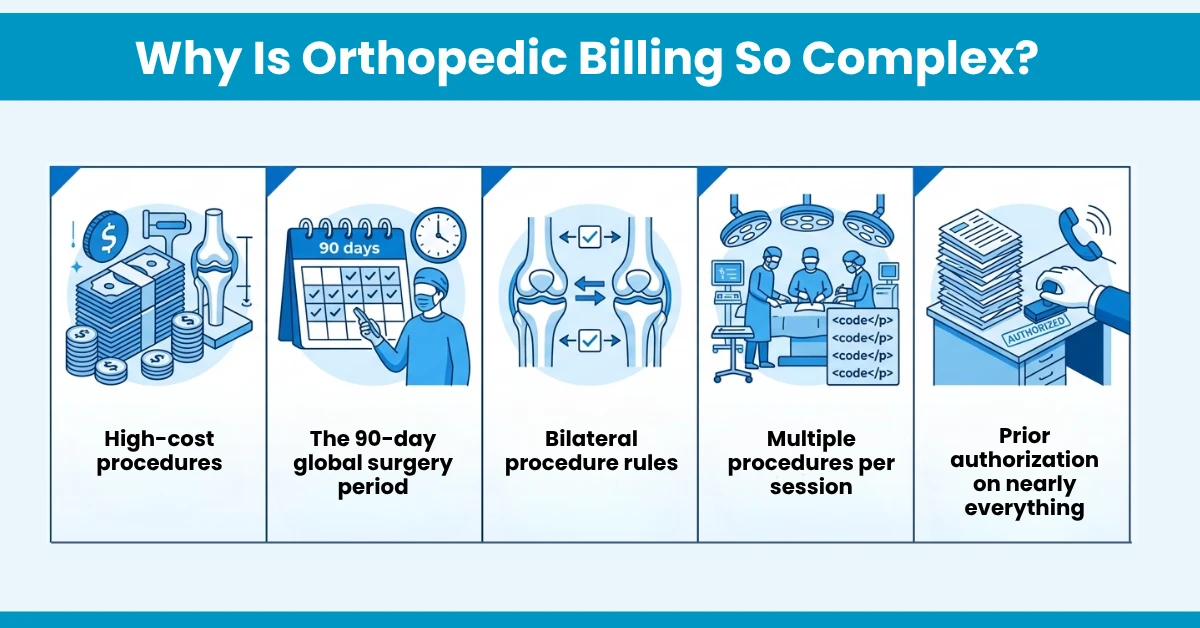
Why Is Orthopedic Billing So Complex


Important:

One incorrect modifier on a bilateral knee procedure silently costs hundreds of dollars per claim. Most in-house teams don’t find this until thousands are already gone.

What Are Common Orthopedic Billing Challenges in 2026?

Orthopedic billing errors mainly occur due to coding and documentation issues.

  • Modifier Errors: Modifiers are the leading cause of orthopedic claim denials.
  • Modifiers -59, -51, -79, and XS/XU are misapplied daily in under-resourced billing teams, leading to bundling errors and revenue loss.
  • Outdated CPT Codes: The AMA updates orthopedic CPT codes every year, especially arthroscopy, spine, and fracture care. One outdated code in the system means guaranteed rejections.
  • Insufficient Clinical Documentation: “Knee pain” doesn’t satisfy medical necessity requirements. Payers require imaging reports, functional severity scores, and failed conservative treatment history, and detailed physician notes. Missing any of these = denial.
  • Payer-Specific Rules: Medicare, Medicaid, Aetna, Cigna, and UnitedHealth all follow different orthopedic billing guidelines. What one payer accepts, another rejects. Managing this without specialty expertise is nearly impossible.

HelloMDs Tip:

HelloMDs AAPC-certified coders review every claim before submission, catching modifier errors, documentation gaps, and payer-rule conflicts before they cost you money.

Where Do Orthopedic Practices Lose Revenue?

This is where most competitors fail to explain clearly.

Hidden revenue leakage areas:

  • Unbilled procedures or add-on codes.
  • Incorrect modifier reimbursement.
  • Denied claims that are never appealed.
  • Eligibility errors at intake.
  • Aging AR over 60-90 days.

Physician Practices show many denied and appeals are the number 1 source of revenue leakage, and many claims are never reworked, leading to permanent revenue loss.

Reality check:

Revenue loss doesn’t come from fewer patients; it comes from missed billing opportunities.

How Does the Orthopedic Medical Billing Process Work?

  • Insurance Verification: Before the patient visit, the billing team verifies active coverage, deductibles, co-pays, and prior authorization status. This single step prevents most downstream denials.
  • Charge Capture and Coding: AAPC-certified coders assign the correct CPT and ICD-10 codes from physician documentation. In orthopedics, this carries the highest financial risk of any step.
  • Clean Claims Submission: Every claim is reviewed for errors before it goes out. Electronic submission reduces manual rejections and speeds up payment cycles.
  • Payment Posting: Payments are matched to claims and posted accurately. Discrepancies are flagged before they age into bigger problems.
  • AR Follow-Up and Denial Appeals: Unpaid or denied claims are tracked and worked on daily. Any account over 60 days is prioritized, because every aging day is revenue at risk.

Important:

Most in-house teams write off denied claims after 90 days. HelloMDs AR Follow-Up pursues every denial through proper appeals, recovering revenue that most practices simply abandon.

What Does Orthopedic Denial Management Look Like?

Orthopedic billing denials are not random; they follow patterns. The best billing companies identify and eliminate those patterns at the root.

Most frequent causes:

  • Missing or expired prior authorization.
  • Incorrect modifier usage (the #1 cause).
  • Improper procedure bundling.
  • Insufficient medical necessity documentation.
  • Patient or insurance data errors at intake.

Effective denial management includes:

  • Identifies the root cause of every denial.
  • Correct documentation, coding, or authorization issues at the source.
  • Resubmits within payer appeal window (typically 60-180 days).
  • Tracks denial patterns to stop repeat errors.

HelloMDs Denial Management finds patterns across your denied claims, corrects them at the source, and drives measurable improvement in your first-pass acceptance rate, without disrupting your clinical workflow.

In-House vs. Outsourced Orthopedic Billing

Factor

In-House Billing

Outsourced Billing

Monthly Cost

High salaries, software, and training

Low % of collections (e.g., 2.95%)

Coder Credentials

Varies with staff turnover

AAPC-certified specialists

Denial Rate

Higher, training gaps, staff changes

Lower, dedicated expert teams

Scalability

Difficult and slow

Grows instantly with your volume

HIPAA Compliance

Managed internally

Fully audited, encrypted, secured

Reporting

Inconsistent

Real-time dashboards, always on

Orthopedic practices that outsource billing consistently see a 15-25% increase in collections within the first 90 days of transitioning to a professional team.

HelloMDs serves orthopedic practices across all 50 U.S. states and territories with billing plans starting at just 2.95% of monthly collections, no setup fees, no long-term lock-in.

How Do You Choose the Best Orthopedic Medical Billing Company?

Not every billing company understands orthopedic coding.

Before choosing, check:

  1. Orthopedic specialty experience (Not general billing).
  2. AAPC-certified coders.
  3. Denial trend reporting.
  4. HIPAA-secure infrastructure.
  5. Transparent flat-rate pricing.
  6. Real-time claim visibility.
  7. Proactive prior authorization support.

The right billing partners doesn’t just process claims; they improve your entire revenue cycle.

HelloMDs Advantage:

Dedicated billing teams, HIPAA-secure submissions, real-time performance reports, and patient call support, all under one roof. Serving orthopedic practices across all 56 U.S. states and territories, from Texas to New York.

Expert Tips To Improve Orthopedic Billing Accuracy

  • Verify insurance before every visit.
  • Audit modifiers monthly.
  • Track denial trends weekly.
  • Use specialty-trained coders.
  • Automate repetitive workflows.

Small process improvements can increase collections by 20% or more.

Conclusion:

Orthopedic medical billing is too high-value and too complex to leave to chance or an untrained team. One missed modifier or skipped prior authorization can wipe out a full surgical fee. The best orthopedic billing companies don’t just submit claims; they protect your entire revenue cycle from intake to payment. Practices that use specialized orthopedic medical billing services improve claim accuracy, reduce denials, and strengthen overall revenue cycle performance.

HelloMDs serves orthopedic practices nationwide with AAPC-certified billing experts, HIPAA-secure systems, and plans starting at 2.95% of monthly collections.
Follow HelloMDs on Facebook and Instagram for weekly billing tips and RCM updates.

Disclaimer:

This content is provided for informational and general revenue-cycle education purposes only and doesn’t constitute medical, legal, or billing compliance advice. No provider-patient relationship is created, and readers are solely responsible for any actions taken based on this information. Some images used in this blog may be AI-generated for illustrative purposes only and may not represent real individuals, facilities, or clinical scenarios.

Frequently Asked Questions

It's the full process of coding orthopedic procedures, fractures, joint replacements, surgeries, and submitting those claims to insurance payers to collect reimbursement.

Because orthopedic billing involves high-value procedures, complex modifier rules, mandatory prior authorizations, and annual CPT code updates, all of which increase denial risk without certified expertise managing the process.

After major surgery, a 90-day global period bundles related follow-up into the surgical fee. Billing separately during this period without the correct modifiers triggers automatic claim denials.

Most companies charge 3%-8% of monthly collections. HelloMDs starts at 2.95% with no setup fees and no long-term commitment required.

Yes, outsourcing is especially beneficial for smaller practices. It eliminates overhead costs, reduces denial rates, and gives you access to AAPC-certified coders without the expense of hiring full-time staff.

Leave a Reply

Your email address will not be published. Required fields are marked *

×

Request a Free Consultation