
You billed the right procedure. You attached the X-rays. You submitted on time. Then the claim came back denied.
That is more common than it should be, because root canal billing codes are tooth-specific, revised every January, and payers scrutinize them closely. A single incorrect code or missing narrative turns a clean claim into a 60-day revenue to hold.
This guide gives dental billers, office managers, and endodontists a fast, clear answer to every CDT root canal code question, with ICD-10 pairings, denial fixes, and a quick-reference table you can use today.
According to the American Dental Association (ADA) CDT guidelines, every dental procedure is assigned a standardized five-character code beginning with “D.” Endodontic procedures fall under the D3000-D3999 range of the Current Dental Terminology system.
Insurance payers use these codes to process claims. Submit the wrong one, and the payer has no obligation to pay, regardless of how well the procedure was performed.
The ADA revises CDT codes every January. In 2026, the ADA released new codes, revised existing descriptions, and deleted outdated ones. Billing software that is not updated by January 1 will automatically generate rejected claims.
Bottom line: Root canal billing codes are the language payers speak. Get the code wrong, and the conversation ends before it starts.
This is the single most important rule in endodontic billing: the code follows the tooth type, not the procedure complexity.
CDT Codes D3310 to D3333 (Initial Root Canal Therapy)
CDT Code | Tooth Type | Common Denial Risk |
D3310 | Anterior (front teeth incisors, canines) | Wrong tooth-to-code mapping. |
D3320 | Premolar/Bicuspid | Missing radiograph attachment. |
D3330 | Molar (3+ canals) | Narrative required; most scrutinized code. |
D3331 | Root canal obstruction, non-surgical | Auto-denied without radiographic proof. |
D3332 | Incomplete therapy; unrestorable tooth | Requires detailed clinical justification. |
D3333 | Internal root repair of perforation defect | Rare; document canal anatomy in full. |
All three primary codes: D3310, D3320, and D3330, cover every appointment needed to complete treatment, including intraoperative X-rays. They never include the final restoration or crown.
Retreatment Codes: D3346, D3347, D3348
When a previously treated root canal fails, do not rebill the initial therapy codes. Payers can verify treatment history, and resubmitting an initial code for a retreatment case often triggers both denial and compliance review.
Use the retreatment series instead:
Billing tip:
If your billing software auto-populates D3330 for molars, add a system check that flags any tooth with prior root canal history before submission.
Many payers now require ICD-10 diagnosis codes alongside CDT codes, even for routine dental claims.
Without them, the claim lacksdocumented medical necessity and will be rejected.
Per the ADA’s official CDT-to-ICD crosswalk, here are the correct pairings:
For Initial Therapy (D3310, D3320, D3330):
For Retreatment (D3346, D3347, D3348):
A clear documentation example that reduces denial risk is:
“Patient presents with irreversible pulpitis in tooth #30 (K04.0). Root canal therapy performed (D3330).” This type of sentence often satisfies medical necessity requirements for most payers.
Every root canal CDT code ends with this phrase and it confuses billing teams daily.
It means this:
The root canal code covers endodontic therapy. The crown and core buildup are always billed separately and must never be bundled into the same claim line.
After root canal therapy, bill these separately:
Each service needs its own claim line, tooth number, date of service, and clinical documentation. Bundling them together is one of the most common, and most preventable endodontic billing errors.
Denials follow patterns. Identify the pattern, and you stop the problem before the claim leaves your office.
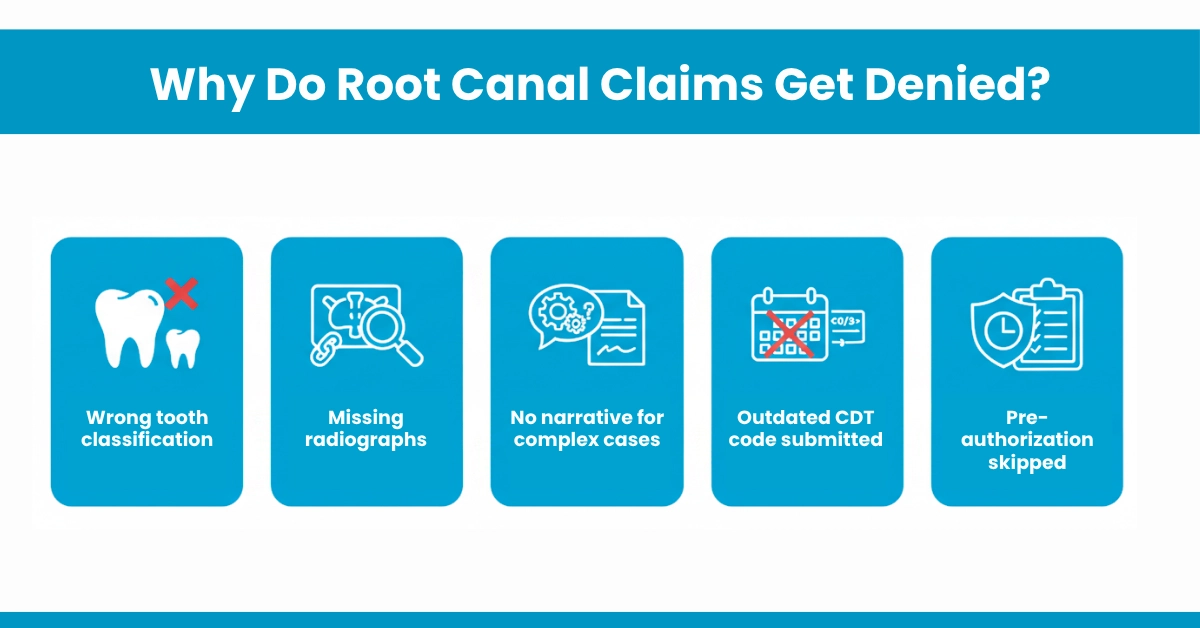
Yes, and skipping this step is one of the most expensive mistakes a dental practice makes.
Many dental plans require prior authorization for:
A claim submitted without required authorization is difficult that is not impossible to overturn, even when the procedure and code are correct.
Always verify before treatment:
Get the authorization number in writing. Document it in the patient record before treatment begins.
This is where a billing partner like HelloMDs removes the risk entirely. Their insurance eligibility and benefits verification service checks endodontic coverage, pre-authorization requirements, deductibles, and plan limitations in real time, before the patient sits in the chair.
Most root canal claim denials are not clinical failures; they are administrative ones.
Wrong code. Missing attachment. Skipped pre-authorization. Claim resubmitted with the same error. These are system problems, and they cost practices thousands in delayed or uncollected revenue every month.
HelloMDs is a full-service medical billing and coding company that solves exactly this. Their AAPC-certified coders handle accurate CDT coding, correct ICD-10 pairing, documentation review, and HIPAA-secure submission and you know the billing plans start at just 2.95% on monthly collections all under one roof.
Whether you run a single endodontic office or a multi-specialty group, HelloMDs builds a solution around your workflow, not a generic template.
Root canal dental codes follow one core rule: the code matches the tooth type, the ICD-10 code matches the diagnosis, and the crown is always a separate claim. Pre-authorization is verified before treatment. Documentation and radiographs are attached at first submission, never after a denial.
Get those steps right, and most root canal claims pay without issue.
If billing is still a problem for your practice, HelloMDs gives you certified coders, denial resolution, and real-time revenue tracking for a fraction of in-house costs. Follow HelloMDs on Facebook and Instagram for weekly billing tips, or reach out today to let the experts handle what they do best, so you can focus entirely on your patients.
The information in this blog is provided for informational purposes only. It doesn’t constitute professional medical, legal or billing advice. It is compiled from multiple billing resources and written in our own words for ease of understanding. HelloMDs is a medical billing company that helps practices reduce denials and improve revenue cycle performance but this content is not guarantee of results. The visuals in this blog are AI generated for illustrative support.