Most dental offices either overbill D9110 and get denied or never bill it at all—leaving real money on the table. The D9110 dental code for palliative (emergency) treatment of dental pain is one of the most misunderstood CDT codes in dental billing.
Payers deny it daily. CDT 2026 tightens no-post-op rules, amplifying denial risks. Front-office teams avoid it out of confusion, meaning dentists treat patients without collecting a cent for the work.
This guide cuts through the confusion. You will learn exactly when D9110 applies, what documentation actually stops denials, and the billing rules most competitors won’t tell you. At HelloMDs, our AAPC-certified billing specialists handle D9110 claims every day.
The D9110 dental code description from the ADA reads: “Palliative (emergency) treatment of dental pain, minor procedure.” It covers hands-on, temporary pain relief when no definitive procedure is performed on the same tooth during the same visit.
It is a per-visit code—not per tooth, and not per material used. The treatment must meet three criteria:
Billing Tip: Many practices default to D0140 (limited exam) during emergency visits, burning through the patient’s two-per-year exam limit. D9110 is a treatment code. It carries zero exam frequency restrictions. Billing it correctly protects your patient’s annual benefits and captures revenue your practice earned.
Use dental code D9110 when you perform a minor, hands-on procedure that relieves pain without completing definitive treatment on the same tooth. Common examples include:
You can bill D9110 alongside a restoration, provided the restoration involves different teeth or areas of the mouth. Most offices assume both codes can never appear on the same claim. That is incorrect. The restriction only applies when both procedures target the same tooth on the same visit. Document the distinction clearly in your clinical note.
Never use D9110 when a more specific CDT code exists. Using it as a catch-all triggers immediate payer scrutiny.
Situation | Correct Code (Not D9110) | Reason |
Abscess drainage | D7510 | Procedure-specific |
Root desensitizing | D9910 | Dedicated code |
Gingival irrigation | D4921 | Medicament-focused |
Post-surgical complication | D9930 | Separate handling |
Enamel smoothing (odontoplasty) | D9971 | cannot bill the same day as D9110 |
Note: The D9110 and D9971 same-day restriction catches many offices off guard. If enamel smoothing is the only procedure performed, D9971 is the correct code.
This is the number one billing error in emergency dental visits:
Yes, the ADA confirms both can appear on the same visit claim. However, not all payers reimburse both. Some pay D0140 and deny D9110; others do the reverse.
Here is a strategic advantage: if your patient has already consumed their two annual exam visits, billing D0140 will auto-deny. Billing D9110 instead sidesteps that restriction entirely because D9110 has no frequency cap.
Attaching the correct ICD-10-CM diagnosis code gives payers the medical justification they need. This alone separates a paid claim from one stuck in pending for weeks.
ICD-10 Code | Diagnosis |
K08.84 | Toothache, unspecified |
K04.0 | Pulpitis |
K04.6 | Periapical abscess without sinus |
K08.89 | Other specified disorders of teeth |
K12.2 | Cellulitis and abscess of the mouth |
HCPCS S9140 | Palliative dental (Medicaid EPSDT) |
When a patient seeks dental pain relief through urgent care, CPT codes apply (e.g., CPT 99213 or 99214). HelloMDs supports Medical Billing & Coding across both CDT and CPT environments, ensuring no revenue falls through the cracks.
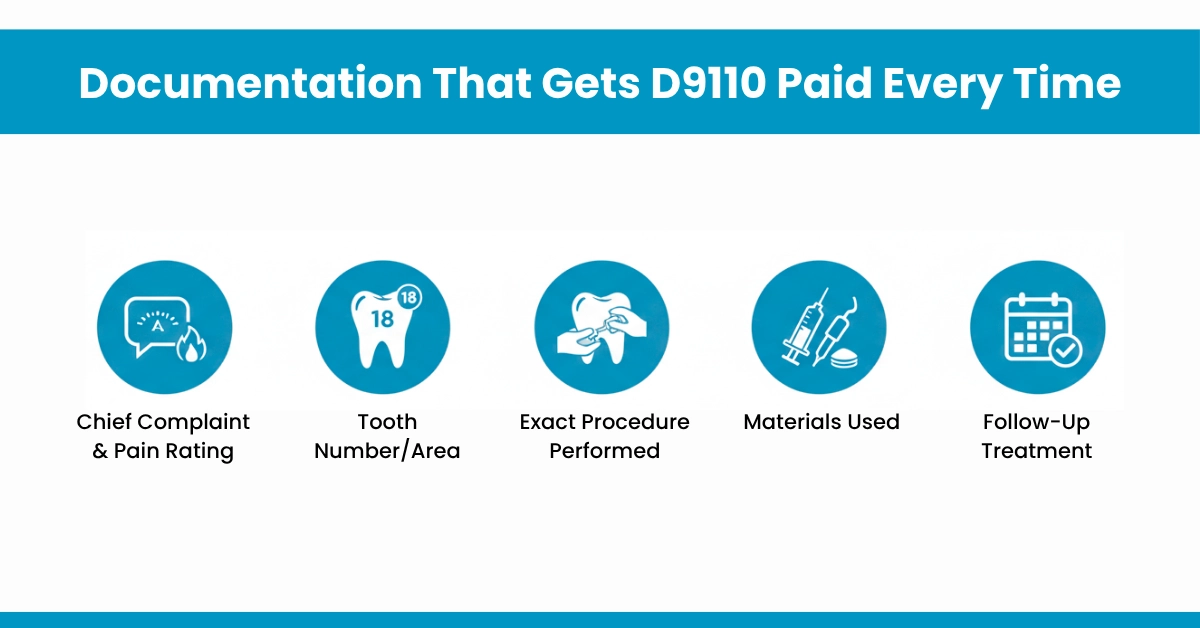
Vague clinical notes are the single biggest cause of D9110 denials. Your documentation must include:
Yes, with conditions. D9110 is not restricted to dentists. A hygienist can perform palliative treatment, but the clinical narrative must specifically describe what the hygienist did. Note: Any scaling performed during that visit is included in the D9110 fee. Billing D4342 additionally for the same visit is incorrect and will trigger an audit flag.
D9110 is denied more often than almost any other CDT code, usually due to documentation gaps. The HelloMDs Denial Management team analyzes every denial at the root cause, corrects the narrative, and resubmits exactly what the payer needs to approve the claim.
If your practice sees 10 emergency patients monthly and skips D9110 out of habit, you may be leaving $500-$900 in monthly reimbursements uncollected. HelloMDs billing plans start at just 2.95% of monthly collections—a fraction of what practices lose by not billing codes correctly.
The D9110 dental code is not complicated, but it is consistently misused, underbilled, and poorly documented. Use it when treatment is hands-on, patient-initiated, and non-definitive. Document tooth numbers, pain scale, and follow-up plan. And never let exam frequency limits stop you from choosing D9110 when it is the better fit. HelloMDs specializes in turning coding confusion into clean, paid claims every time.
Stop leaving emergency visit revenue uncollected. Contact HelloMDs today for a free billing consultation and let our certified team handle D9110 and every other code, the right way.
Follow HelloMDs on Facebook and Instagram for weekly dental billing tips, CDT code updates, and revenue recovery strategies.
This blog is for informational purposes only. For accurate coding, claim submission, and denial resolution, rely on HelloMDs certified medical billing experts. Policies, coverage, and coding rules may vary by insurer and state. Visuals in this blog are AI-generated for informational purposes.