
Your patient’s root canal is done. The patient leaves happy. Then the claim comes back, denied. No explanation. No clear reason. Just a denial code and a lost reimbursement.
Sound familiar? For thousands of dental practices across the U.S., the D3310 dental code is among the most frequently billed and most frequently misbilled codes in endodontics. A missing radiograph, a wrong tooth number, or a skipped ICD-10 code can kill an entire claim in seconds.
This guide breaks it all down simply. You will learn exactly what dental code D3310 means, how much it costs, which diagnosis codes support it, and how to stop losing money on preventable denials, starting today.
D3310 is a CDT (Current Dental Terminology) code by the American Dental Association (ADA). Its official description:
“Endodontic therapy, anterior tooth (excluding final restoration).”
Simply put, it is the billing code for a root canal on a front tooth. The phrase “excluding final restoration” matters. D3310 covers the root canal procedure only, not the crown or filling placed afterward.
Not included: Final crown, core buildup, or any restoration. Bill those separately under D2950 (core buildup) or D2740 (porcelain crown).
D3310 covers anterior teeth only, the front six teeth in both jaws.
Arch | Teeth | Universal Numbers |
Upper (Maxillary) | Central incisors, lateral incisors, canines | #6-11 |
Lower (Mandibular) | Central incisors, lateral incisors, canines | #22-27 |
Choosing the wrong code is the #1 root canal billing error:
Always verify the tooth number in the patient’s chart before selecting a code. One wrong digit costs you the entire reimbursement.
Note: Billing of D3310 Dental Code involves understanding the proper coding, documentation, and claim submission for root canal procedures. Accurate billing ensures smooth reimbursement and avoids denials. For a detailed guide on dental billing workflows and CDT codes, check out this article.
The ADA confirmed a 3-5% fee increase across CDT codes for 2026, including D3310. Update your fee schedule now to avoid underbilling.
Average D3310 Cost in 2026:
Most dental insurance plans cover root canals at 50%-80% of the allowed fee after deductibles. Always verify benefits before treatment to avoid surprise billing.
Geographic pricing affects how much payers reimburse for D3310:
Note: Billing of D3310 Dental Code requires careful documentation to ensure claims are processed correctly and reimbursed without delays. Superbill preparation plays a key role in organizing procedure codes for dental and medical services
A critical step in avoiding claim denials is pairing D3310 with the correct ICD-10 code. Missing an ICD-10 code will result in instant denials.
Always match the code to the patient’s exact clinical diagnosis.
There is no direct HCPCS Level II equivalent for D3310. Most medical payers require CPT/HCPCS codes for medical claims. For trauma or medically necessary cases, D3310 can be cross coded to:
Attach the trauma ICD-10 code (e.g., S02.5XXA), clinical narrative, and radiographs. Most medical payers prefer CPT over CDT codes. Submitting D3310 directly to a medical payer results in immediate rejection.
Never bundle D3310 with D3351, D3352, or D3353, as these are mutually exclusive codes and bundling them will lead to automatic denial.
Many payers require prior authorization for D3310, and skipping this step can often result in a denial. If unsure, always verify if prior authorization is necessary.
Medicaid coverage for D3310 varies by state. Some states restrict treatment based on tooth type or patient age. Always verify your state’s Medicaid dental benefit policy before scheduling treatment. Most plans allow D3310 once per tooth, per lifetime.
For retreatment, use D3346: Anterior root canal retreatment.
Denial Reason | Fix |
Missing radiographs | Attach pre-op and post-op periapical X-rays |
No ICD-10 code | Pair with K04.0, K02.53, or most specific code |
Wrong tooth number | Verify Universal Numbering System |
Wrong code (molar/anterior) | Confirm tooth #6-11 or #22-27 only |
No clinical narrative | Add a brief pulpal diagnosis explanation |
Apexification bundled | Never combine D3310 with D3351–D3353 |
Frequency exceeded | Use D3346 for retreatment cases |
Catching these errors before submission saves weeks of follow-up and protects your monthly collections.
Here is what our in-house medical billers follow.
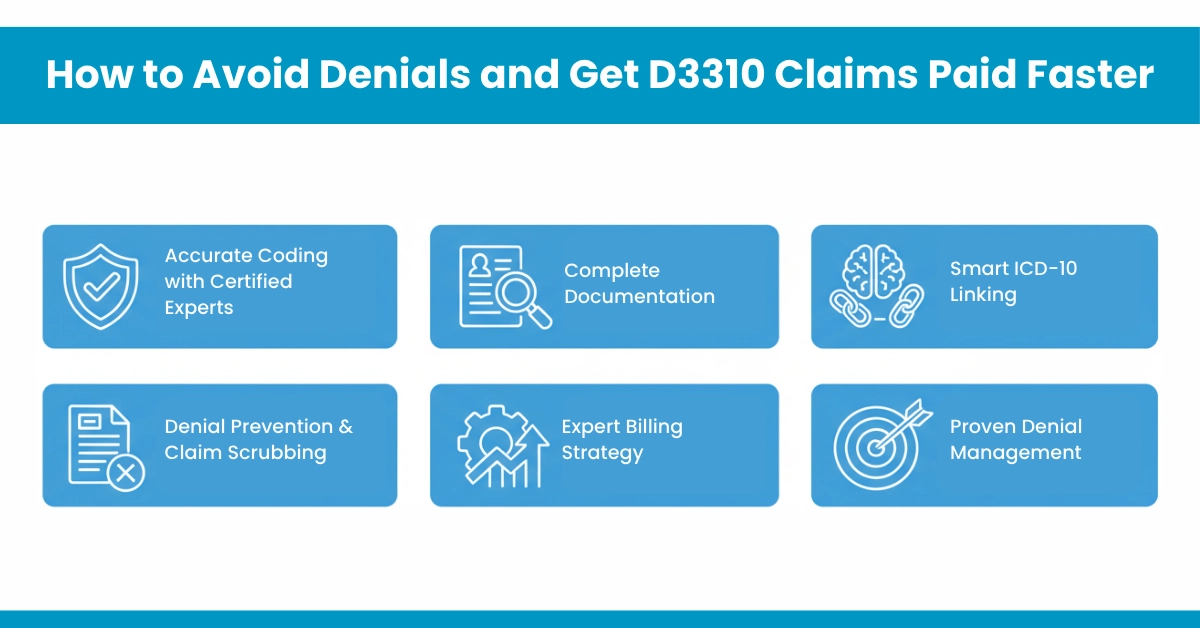
One small error on a D3310 claim can delay payment or cause denial—HelloMDs eliminates that risk. Our AAPC- and CPC-certified billing specialists ensure correct CDT, ICD-10, and CPT coding while verifying payer rules, coverage limits, and billing requirements before submission.
Every claim includes the required tooth number, pulpal diagnosis, radiographs, and detailed clinical narratives to fully support medical necessity and avoid rejections.
We assign and sequence the most relevant diagnosis codes to strengthen claim accuracy and improve first-pass acceptance rates.
Our team identifies bundling issues (like D9930 conflicts) and performs thorough pre-submission QA checks to catch and fix errors before the payer sees the claim.
We apply dual-billing strategies (dental + medical when applicable). If a claim is denied, we identify the exact reason from the EOB, correct errors, resubmit with a strong appeal, and track it until full payment is received.
Hello MDs serves all 56 U.S. states and territories, from Texas and California to New York and Florida. Every submission is HIPAA-secure with real-time performance reporting.
Stop losing money on preventable denials. Consult Hello MDs for a free consultation today and let a certified billing expert handle your dental claims from start to finish.
The D3310 dental code is straightforward in theory, complex in practice. From correct ICD-10 pairing and 2026 fee updates to prior authorisation requirements and CPT cross-coding, every detail directly impacts your reimbursement.
HelloMDs makes the entire process simple, accurate, and stress-free, with certified coders, full denial management, and nationwide coverage. Follow us on Facebook and Instagram for the latest CDT updates and billing insights.
Fee information is based on ADA CDT annual update trends and may vary by payer, state, and provider contract. This content is for informational purposes only. For practice-specific billing guidance, contact Hello MDs directly.