
Many providers lose thousands monthly on one overlooked code. CPT code 99490 is Medicare’s primary procedure code for non-complex Chronic Care Management (CCM) services. Yet poor documentation, missed add-ons, and billing gaps silently drain practice revenue every month.
Do you know 100 patients on CPT 99490 generate $200K+ annually? Most never capture it due to billing failures.
This guide delivers the complete 99490 CPT code description, katest 2026 billing guidelines, reimbursement rates, RPM (Remote Patient Monitoring) and BHI (Behavioral Health Integration) integration rules, and the denial fixes your team needs right now.
CPT 99490 describes non-complex chronic care management services requiring at least 20 minutes of clinical staff time per calendar month. Services are directed by a physician or qualified healthcare professional (QHP) but performed under general supervision.
According to the American Medical Association (AMA), the 99490 CPT code description requires all of the following:
The billing practitioner does not need to be physically present. Clinical staff handle direct services. This flexibility increases program scalability, but it also increases documentation risk if time tracking is inconsistent.
Patient eligibility is the entry point for every CCM 99490 claim. To qualify, a Medicare beneficiary must carry two or more chronic conditions meeting CMS criteria.
Common qualifying diagnoses with ICD-10 codes include:
There is no restricted CMS diagnosis list. Any combination of qualifying chronic conditions makes a patient eligible. Providers should screen their entire Medicare panel proactively. Annual Wellness Visits and E/M encounters are ideal entry points.
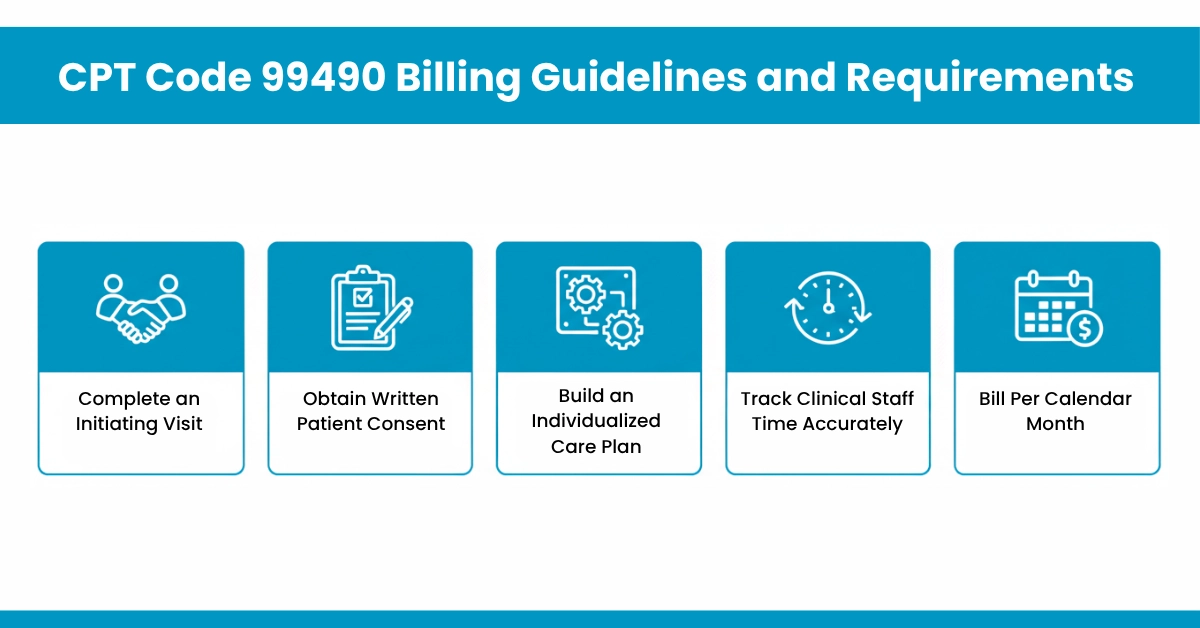
Skipping any step here causes denial. CMS (Centers for Medicare & Medicaid Services) requires this exact sequence for compliant 99490 billing guidelines:
For practices managing Chronic Care Management (CCM) services under CPT 99490, it’s important to coordinate with other non-face-to-face services like Remote Patient Monitoring (RPM). Proper documentation and tracking of time spent for each program ensures compliance and prevents billing errors. Learn more about related CPT codes for RPM for 2026 here.
The 2026 Medicare Physician Fee Schedule increased CCM reimbursement by 9.6%. Here is the complete picture:
Code | Description | National Average |
99490 | Base CCM: 20 min clinical staff | ~$66.13/month |
99439 | Add on each additional 20 min (max ×2) | ~$50.00/unit |
G0506 | Comprehensive care planning add-on | ~$62.00 (once) |
99453 | RPM device setup and patient education | ~$21.71 (once) |
99454 | RPM device supply: 16 + day data transmission | ~$52.11/month |
99457 | RPM first 20 min monitoring/management | ~$51.77/month |
99484 | BHI 20 min behavioral health | ~$48.50/month |
ROI Example: A practice with 100 CCM-eligible patients billing 99490 + 99439 + 99457 monthly generates approximately $16,700+ per month, over $200,000 annually, with compliant documentation. That is the revenue most practices leave uncaptured.
HCPCS G0506 covers comprehensive care planning time during the initiating visit. Most competitors ignore this code entirely. Bill it once per patient; it never expires.
Compatible codes can bill with CCM 99490:
Incompatible codes never bill with 99490 in the same month:
Same-day E/M billing: Many providers ask, “Can I bill 99490 with an E/M visit on the same day?” Yes, but make sure to add Modifier 25 when billing the E/M code on the same day. Without it, payers bundle both claims and deny one automatically.
Medicare Advantage: Many wonder whether Medicare Advantage covers 99490. Most MA plans follow traditional Medicare CCM rules, but coverage policies vary by plan. Always verify eligibility and CCM coverage directly with the MA payer before billing.
Telehealth Advantage: CCM services conducted via telehealth, phone calls, video visits, and patient portal messaging count toward the 20-minute threshold. CMS confirmed this position post-2020 and has maintained it through 2026.
CCM 99490 claims face denial rates that directly inflate AR aging. Here are the real causes:
Denial Cause | Fix |
No documented initiating visit | Bill AWV or E/M first, document CCM discussion explicitly |
Missing or unsigned patient consent | Build consent into the intake workflow before month-one billing |
Time under 20-minute threshold | Use real-time EHR time-tracking tools, never estimate |
Billing during 30-day TCM window | Hold CCM billing until the TCM period closes |
Two providers are billing the same patient | Verify the single-provider rule before every submission |
Generic care plan | Individualize every plan; auditors flag templated content |
Acute condition time miscounted | Train staff to separate CCM and acute care documentation |
Each denial compounds over time. Unresolved denials age into accounts receivable, reducing collections and increasing administrative costs. Practices without a structured denial management workflow lose an average of 11–15% of CCM revenue annually due to underpayments and write-offs.
CPT code 99490 is one of Medicare’s most financially powerful codes for primary and chronic care practices. With 2026 reimbursement at ~$66.13 base, and RPM and BHI add-ons pushing monthly revenue well beyond $160 per patient, a properly managed CCM program transforms practice economics.
The difference between maximum reimbursement and chronic denials comes down entirely to documentation discipline, workflow precision & add-on code strategy.
If your practice is ready to capture full CPT 99490 chronic care management revenue without administrative strain, HelloMDs delivers the certified expertise and nationwide infrastructure to make it happen.
Visit HelloMDs or connect to Facebook and LinkedIn to schedule your free consultation today.
This content is written for educational purposes and not medical or billing advice. Hello MDs is a certified billing company specializing in resolving billing issues and maximizing revenue. Some images in this blog are AI-generated and used for visual purposes only.