
Every healthcare provider works hard to deliver quality care. But when billing processes break down, that hard work stops translating into revenue. A single missed eligibility check, one incorrect CPT code, or an unresolved denial can silently drain hundreds of dollars per claim.
Do you know that U.S. providers lose an estimated $262 billion annually to avoidable billing errors and claim denials? Most of the loss is preventable, but only when every step in the process works correctly.
Understanding the 13 steps of revenue cycle management gives every practice the clarity to close those gaps, protect cash flow, and ensure every service rendered gets fully reimbursed. Let’s walk through each of the 13 steps of RCM and show how best-in-class workflows ensure financial health.
Revenue cycle management is the complete financial process that healthcare organizations use to manage every patient account, from the first point of contact through final payment collection.
According to the American Medical Association (AMA), billing inefficiencies represent the single largest source of preventable revenue loss in U.S. healthcare. The purpose of revenue cycle management is to ensure that every service a provider delivers gets accurately documented, correctly coded, properly billed, and fully reimbursed on time.
The importance of revenue cycle management in medical billing extends beyond finances. It directly impacts compliance standing, operational efficiency, and the ability of a practice to invest in better patient care. When the revenue cycle performs well, everything else in the practice runs more smoothly.
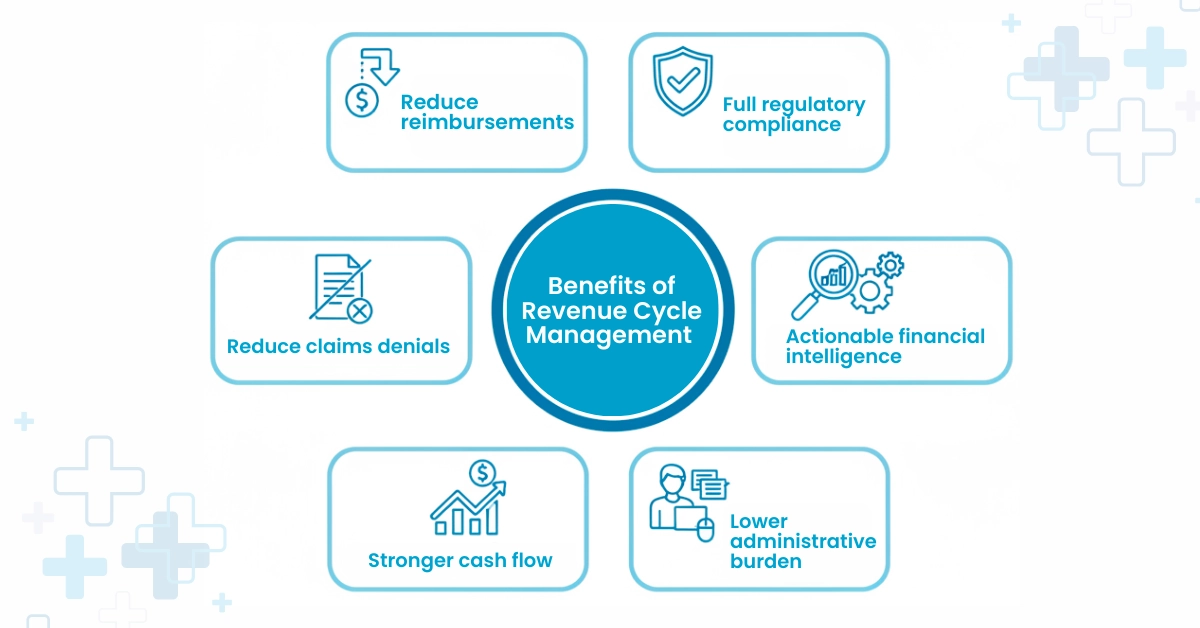
This surprises many providers; RCM begins before the patient arrives. The cycle starts at pre-registration, the moment a patient schedules an appointment. Every step from that point forward, verification, authorization, documentation, coding, billing, and collections form one connected chain.
The revenue cycle ends only when the account reaches a zero balance. That means insurance payment is posted, adjustments are applied, and any remaining patient balance is either collected or appropriately resolved.
Understanding this full scope is what separates practices with strong cash flow from those constantly chasing unpaid claims.
This includes full name, date of birth, address, insurance carrier, member ID, group number, and reason for visit.
Accurate pre-registration eliminates the most common source of downstream billing errors. Every mistake caught here costs nothing to fix. Every mistake missed here can cost the claim entirely.
It starts with confirming the patient’s active insurance coverage co-pay amounts, deductibles, out-of-pocket maximums, and any plan exclusions before the visit takes place.
Real-time eligibility checks are a core feature of any effective revenue cycle management system.
HelloMDs Insurance Eligibility Verification service verifies all coverage details upfront, preventing front-end denials before a single claim is submitted.
Certain procedures require written payer approval before they are performed. Skipping this step results in automatic denials regardless of medical necessity or documentation quality.
CPT codes that most frequently require prior authorization include 99213-99215 (evaluation and management) and 27447 (total knee arthroplasty). Securing authorization protects provider revenue and prevents interruptions to patient care.
At check-in, front desk staff verify all pre-collected data, confirm current insurance cards, collect co-pays, and obtain signed consents. Errors identified at this stage cost far less to correct than errors discovered after claim submission.
Providers document every clinical encounter through EHR systems. Strong, complete documentation drives accurate revenue cycle point charge entry and ensures all billable services are captured without exception.
EHR and revenue cycle management are now fully integrated in modern medical practices. Incomplete documentation leads directly to downcoded claims and avoidable revenue loss.
Certified coders translate clinical documentation into CPT and ICD-10-CM codes. This step carries some of the highest financial risk in the entire medical billing revenue cycle, one coding error can trigger a denial or a compliance audit.
The Centers for Medicare & Medicaid Services (CMS) enforces strict adherence to ICD-10 and CPT guidelines. HelloMDs employs AAPC-certified coders who minimize coding errors and consistently improve first-pass claim acceptance rates across all specialties.
Charge entry means accurately inputting all coded procedures, diagnoses, dates of service, and payer details into the billing system. Every field must precisely match payer-specific requirements.
Charge entry errors rank among the leading causes of preventable claim rejections.
Hello MDs’s Charge Entry Services eliminate these mistakes before claims ever leave the practice.
The billing team submits clean claims electronically to the appropriate payer, commercial insurer, Medicare, Medicaid, or other carrier. Timely, accurate submission directly reduces payment cycle times and administrative rework.
Healthcare revenue cycle reporting at this stage tracks submission volumes, real-time rejection rates, and payer-specific denial trends that guide continuous improvement.
Payment posting records all incoming payments, contractual adjustments, and patient responsibility balances after the payer processes and remits funds. This step provides essential visibility into reimbursement accuracy and payer payment behavior.
Accurate payment posting consistently surfaces underpayments, a significant revenue gap that many practices never detect without this step-in place.
Denied claims do not have to become lost revenue. Effective denial management identifies denial root causes, corrects errors, and resubmits claims quickly and accurately.
The most common denial reasons include:
HelloMDs Denial Management team resolves denials before they impact collections, analyzes denial patterns across payers, and resubmits corrected claims with precision.
AR follow-up tracks every unpaid claim aging beyond 30, 60, and 90 days. Accounts Receivable management service prevents revenue from silently converting into uncollectable write-offs.
Lab revenue cycle management and specialty practices especially benefit from disciplined AR monitoring, given the complexity of their payer contracts and extended reimbursement timelines.
After insurance processes its portion, the remaining patient balances must be collected efficiently and respectfully. Clear billing statements, flexible payment options, and timely follow-up improve collection rates without damaging patient relationships.
Patient-friendly collection processes also strengthen long-term revenue cycle recovery outcomes across the practice.
The last step in the revenue cycle is performance measurement and analysis. Revenue cycle reporting tracks every critical KPI, denial rates, days in AR, net collection rates, first-pass resolution rates, and clean claim percentages.
The 13 steps of revenue cycle management form one connected chain. Each step builds on the last. One weak link, like poor verification or coding, creates silent financial gaps that grow fast.
No practice manages this alone perfectly. Partner with billing experts for flawless execution from pre-registration to analytics. HelloMDs RCM healthcare services cover every stage nationwide. AAPC-certified teams handle eligibility, denial management, payment posting, and AR.
Disclaimer:
This article provides general information only. CPT codes, ICD-10-CM codes, and payer requirements are subject to change. Always verify current coding guidelines with the AMA, CMS, and your specific payer contracts. Consult HelloMDs medical billing professional for practice-specific billing and compliance guidance.