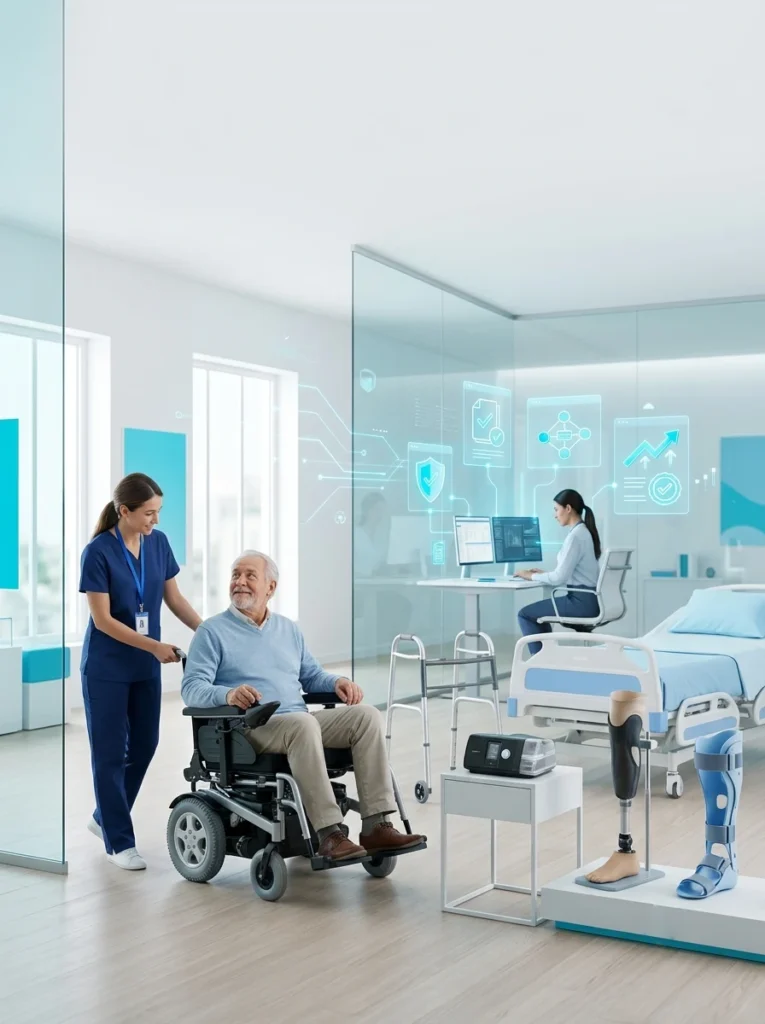
Stop chasing unpaid claims and focus on equipment delivery. Our experts fix your cash flow with precise coding, aggressive denial management, or missing paperwork.
Schedule a consultation
Every power wheelchair, CPAP machine, and hospital bed shipped this year runs a longer gauntlet before payment clears. CMS grew its Required Prior Authorization List to 74 HCPCS codes this April, DMEPOS suppliers now face yearly reaccreditation instead of every three years, and Medicare Advantage plans run claims through automated review before a person looks at them.
HelloMDs bills exclusively for DME, HME, and O&P suppliers, coders who know HCPCS Level II codes and DME MAC rules the way a cardiology coder knows CPT, with a 99% first-pass rate across fifteen-plus years.
Four issues sit behind most of this year’s denials and delayed payments for equipment suppliers.
Expanding Prior Authorization Lists - CMS grew its Required Prior Authorization List to 74 HCPCS codes in April 2026, so items that shipped freely last year now wait on payer sign-off.
Automated Claim Review - Medicare Advantage plans increasingly run DME claims through automated review before a person sees them, denying first and leaving suppliers to prove necessity after the fact.
Annual Reaccreditation - CMS moved DMEPOS (Durable Medical Equipment, Prosthetics, Orthotics, and Supplies) accreditation from a three-year cycle to a yearly one in 2026, so paperwork that used to happen occasionally now happens every twelve months.
Rental Recertification Gaps - CPAP compliance data and oxygen recertification windows lapse quietly. Durable medical equipment RCM stops the moment a deadline passes.
Each claim below matches the codes and payer rules specific to the item shipped.
Coders assign the correct Level II code, E0601 for CPAP, E1390 for oxygen concentrators, K0001-K0004 for wheelchairs, pair it with the right ICD-10 code, and apply the correct modifier: KX, RT/LT, or NU/RR.
Requests go out for power wheelchairs, PAP devices, and anything on CMS's 74-code Required Prior Authorization List, then get followed up with the payer directly.
Rejected claims get sorted by reason, same-or-similar equipment on file, a missing Standard Written Order, thin medical necessity notes, then corrected and resubmitted or formally appealed.
Oxygen and CPAP compliance windows, capped rental periods, and reauthorization deadlines get logged and flagged early, so rental income doesn't lapse quietly.
Every DMEPOS supplier now needs reaccreditation every year instead of every three. Our team handles the documentation required to keep a supplier number active.
Every coder on staff holds AAPC certification and trains specifically on DMEPOS rules, not general CPT-only billing.
Fifteen-plus years billing exclusively for equipment suppliers means our coders have seen almost every denial pattern DME throws at a claim.
Billing coverage across all 50 states and U.S. territories, with state-specific payer rules applied to every claim.
Claim status, denial trends, and collections show up on a live dashboard, not a monthly PDF.
Plans start at 2.95% of monthly collections, so cost moves with what actually gets paid.
01
Clean claims move through DME MAC review without sitting in a queue over missing paperwork.
02
Coding and modifiers get checked against payer rules before submission, not after a rejection notice.
03
Rental recertification and reauthorization deadlines get tracked, so payments keep arriving on schedule.
04
No billing staff to hire, train, or replace when someone leaves mid-quarter.
05
Coders trained on DMEPOS rules keep documentation clean long before an audit ever asks for it.
| Challenges | How We Handle it |
|---|---|
| Same-or-similar denials | We document prior equipment history and changed medical needs before the claim goes out, not after a denial arrives. |
| Missing written orders | A valid Standard Written Order gets confirmed on file before submission, every time. |
| Prior auth delays | Dedicated staff submit and follow up on requests directly with the payer instead of waiting for a portal update. |
| CPAP/oxygen reauthorization | Compliance windows and recertification deadlines get tracked, so rental payments continue without a gap. |
| Medicare Advantage rule variance | Coders check each plan's specific coverage criteria instead of applying traditional Medicare rules by default. |
| Slow reimbursement cycles | Claims get scrubbed for errors before submission and followed up within days, not weeks. |
The feedback and experiences shared by our clients inspire us to continually improve, innovate, and deliver smarter solutions. Here’s what healthcare professionals are saying about their experience with Hello MDs and why you can trust on us by knowing their experiences.
We were losing oxygen rental income every month from missed recertification dates. HelloMDs had every deadline logged within two billing cycles, and the lapses stopped.
Stop chasing denials after they happen. A free audit shows exactly where DME claims are stalling, no obligation, no long-term contract required to start.
DME billing means coding, submitting, and collecting payment for durable medical equipment, wheelchairs, CPAP machines, and oxygen equipment, using HCPCS Level II codes rather than CPT codes, submitted on a CMS-1500 form under Medicare Part B and DME MAC rules.

Most trace back to missing documentation: No Standard Written Order on file, medical necessity notes that don't match the HCPCS code billed, or a same-or-similar item already on record. Expired prior authorizations and lapsed rental recertification cause most of the rest.
Yes, for items on CMS's Required Prior Authorization List, expanded to 74 HCPCS codes in April 2026, including power wheelchairs and certain orthoses. Suppliers with a 90%-plus affirmation rate can qualify for an exemption.
Pricing usually runs as a percentage of monthly collections rather than a flat fee, so cost tracks with what actually gets paid. HelloMDs plans start at 2.95% of collections.