
CPT COdes

CPT Code 91200: Billing, Reimbursement, Modifiers & Denials

Home / CPT Code 91200

CPT code 91200 is a code that gets rejected more often than most practices are aware of and can result in lost revenue quickly. The CPT code for liver elastography using mechanically induced shear waves (i.e. FibroScan) without real-time B-mode ultrasound imaging is 91200 (CPT code).

Claims payment for medical testing is typically based on three criteria: complete and accurate documentation of the testing, correct application of modifiers, if necessary, and an appropriate diagnosis codes for the testing performed. This article covers the complete CPT code 91200 medical billing for transient elastography testing of the liver.

What Is CPT Code 91200? (Description & Clinical Procedure)

CPT Code 91200 is a diagnostic gastroenterology procedure that the AMA groups with the other tests. The CPT code 91200 refers to a liver transient elastography test. This test uses a probe to send a mechanical pulse to the liver and then measure and determine the speed of the shear wave.

How does the test work in the clinic?

A device is used in the clinic by placing a probe on the right lower rib cage of a patient. Low frequency pulses are rapidly fired through the probe and the time taken for each pulse to travel through the liver tissue is measured with sensors.

  • Faster waves mean stiffer tissue which correlates with fibrosis.
  • Lower frequency waves correspond to a soft and healthy liver.

Values are expressed in kilopascals (kPa) or in m/s. Most recent ultrasound devices for liver fibrosis measurement also calculate a Controlled Attenuation Parameter (CAP) value during the measurement and display it immediately. The liver fat content can thus be estimated during the same session.

CPT Code 91200 vs 76981 vs 76705: Key Coding Differences

Billers mix these three up all the time, and it’s easy to see why. A FibroScan CPT code claim can look a lot like a general abdominal ultrasound on paper, but the services are different.

Billing Parameter

CPT Code 91200

CPT Code 76981

CPT Code 76705

Official Name

Liver elastography, mechanically induced shear wave

Ultrasound, elastography parenchyma

Ultrasound, abdominal limited

Imaging Component

No B-mode real-time imaging

Performed with real-time 2D ultrasound

Full B-mode diagnostic imaging

Primary Clinical Use

Noninvasive assessment of diffuse liver stiffness

Stiffness evaluation within an ultrasound exam

Anatomic view of the liver, gallbladder, or ducts

Equipment

FibroScan-type hardware (VCTE)

Diagnostic ultrasound with elastography software

Standard diagnostic B-scan ultrasound

Don’t bundle these without a reason. The National Correct Coding Initiative (NCCI) has edits aimed squarely at this. If you ran a standard transient elastography test with no anatomical imaging, bill 91200 by itself. Falsely billing an abdominal ultrasound code is one of the fastest ways to have a claim denied.

CPT Code 91200 Billing and Reimbursement Guidelines

CPT code 91200 billing is influenced by where the scan is performed and who owns the machine. The following CPT code 91200 billing information from two facts:
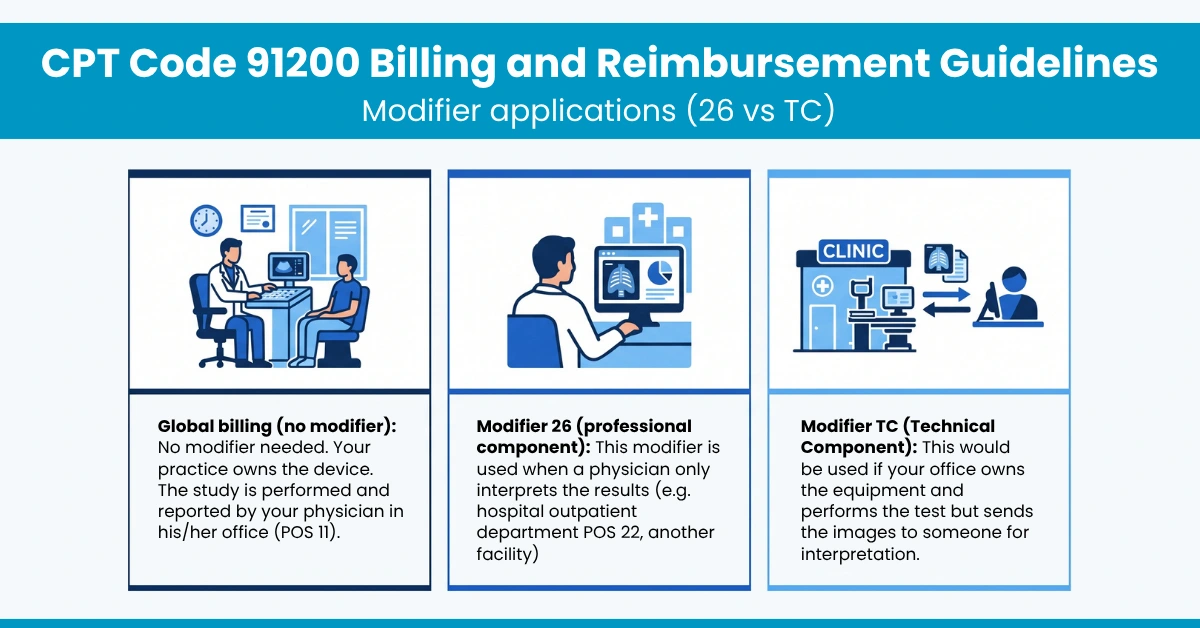
Modifier applications (26 vs TC)

  • Global billing (no modifier): No modifier needed. Your practice owns the device. The study is performed and reported by your physician in his/her office (POS 11).
  • Modifier 26 (professional component): This modifier is used when a physician only interprets the results (e.g. hospital outpatient department POS 22, another facility)
  • Modifier TC (Technical Component): This would be used if your office owns the equipment and performs the test but sends the images to someone for interpretation.

CPT Code 91200 Billing and Reimbursement Guidelines

Medicare and commercial reimbursement trends

Medicare’s global payment for CPT code 91200 has been around $33.73, though geographic adjustments shift the final number. Check the current figure in the CMS Physician Fee Schedule before you budget around it. Commercial payers such as Aetna, Cigna, and UnitedHealthcare often pay more for this liver elastography CPT code, usually when prior authorization is in place.

If the physician also performs a separate E/M visit the same day, put Modifier 25 on the E/M code, and make sure the note actually supports a distinct service.

Documentation Requirements & Medically Necessary

Clean CPT code 91200 coding starts with solid chart notes. Auditors look hard at CPT code 91200 documentation requirements before a payer releases funds. Each record should include:

  • A signed physician order stating the clinical reason for the test
  • Evidence of at least 10 valid shear wave measurements
  • The final median value in kPa, along with the IQR/median ratio
  • A signed interpretation report tying the numbers to an estimated fibrosis stage

Approved ICD-10 diagnosis codes

Pairing 91200 with a routine screening code is a fast route to rejection. The claim needs a diagnosis that establishes CPT code 91200 medical necessity:

  • B18.2: Chronic viral hepatitis C
  • K76.0: Fatty (change of) liver, not elsewhere classified
  • K75.81: Nonalcoholic steatohepatitis (NASH/MASH)
  • K74.0: Hepatic fibrosis
  • K74.60: Unspecified cirrhosis of liver

Payer policies differ, so check each carrier’s coverage policy for accepted diagnoses.
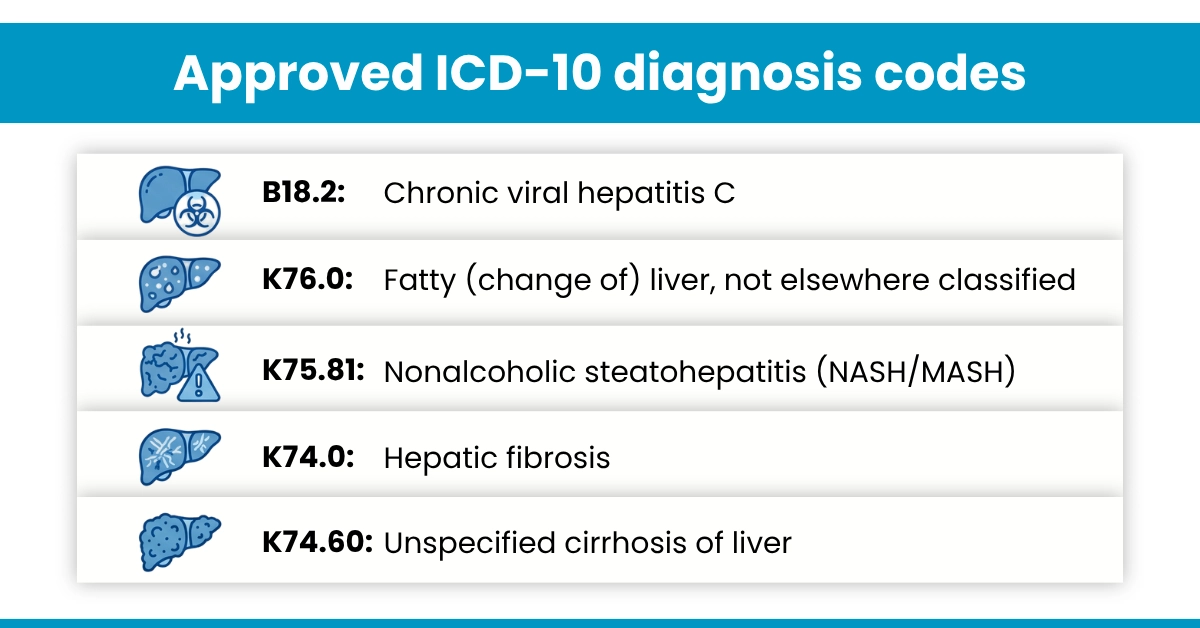
Approved ICD-10 diagnosis codes

Top CPT Code 91200 Denial Reasons & How to Avoid Them

CPT code 91200 transient elastography denials are caused by a few of the same problems. Addressing these early can help to keep your A/R in check.

  1. Missing component modifier: Billing the outpatient hospital billing globally will result in an immediate CPT Code 91200 claim denial due to the hospital billing the technical portion of the encounter. Physician will need to report with Modifier 26 in order to receive proper reimbursement for the read.
  2. No prior authorization. Many commercial payers require approval before elastography. If the claim goes out without an authorization number, expect a denial. Some can be fixed with a retro-authorization or an appeal, but it’s far easier to get approval up front.
  3. Frequency limits: Most payers consider two axial plain film scans per year sufficient for a patient’s follow up. A third axial plain film scan within a short time frame (e.g. within several months) requires documentation of significant change (e.g. rapid development, initiation of new therapy).

Building in clearinghouse rules to flag for things such as missing

Your best defense is a set of rules for the clearinghouse scrubbing that identifies missing modifiers, questionable ICD-10 code pairs, and missing authorizations before the claim is released from your office.

Add your own proof point here: a real denial pattern your coders have seen on 91200, or a before/after example with anonymized numbers. This is the single biggest thing that makes the page read as human and rank as original.

Outsource Your Gastroenterology Billing to HelloMDs

Coding shouldn’t pull your team away from patients. Our AAPC-certified coders handle revenue cycle management for GI practices, including denials, authorizations, and clean-claim follow-through, so revenue stops leaking.

Want to see where your clinic is losing money? Schedule a meeting for a free billing audit.

Disclaimer:

This guide is for educational and informational purposes only. Medical billing policies and coding guidelines change frequently. Always consult official AMA CPT manuals, CMS regulations, and specific payer policies

Frequently Asked Questions

Traditional Medicare Part B usually doesn’t, as long as the diagnosis supports medical necessity under your MAC’s coverage rules. Medicare Advantage and commercial plans are a different story, and plenty of them want an authorization on file before the scan is scheduled. Check with each plan before the patient comes in.

Modifier 53 (discontinued procedure) is the usual choice when the scan is started and then has to stop, for example because the patient is uncomfortable or body habitus prevents valid readings. Document why you stopped and how many valid measurements you got. Some payers won’t pay for a scan that never reached 10 valid measurements, so look at their policy first. Facilities billing hospital outpatient claims typically use 73 or 74 instead.

Yes, the code isn’t limited by age. What matters is whether the payer sees medical necessity, so the chart should spell out the reason, such as monitoring metabolic-related liver disease, biliary atresia, or liver injury from a medication. Coverage for children varies quite a bit between plans.

Add Modifier 76 if the same physician repeats the scan, or Modifier 77 if a different physician does. That tells the payer the second scan wasn’t a duplicate submission. Expect scrutiny, since most payers allow one unit per day. A repeat caused by a technical problem on the first attempt is often not payable, so your notes need to show why the second scan was medically necessary.

Leave a Reply

Your email address will not be published. Required fields are marked *

CPT Code 91200 serves as the standardized medical code used to report liver transient elastography performed without real-time B-mode ultrasound imaging. Medical practices often experience claim denials or underpayment for transient elastography (commonly known as a FibroScan procedure) due to improper modifier usage, misaligned diagnosis codes, or unbundling errors. Understanding how to properly bill CPT Code 91200 ensures full compliance, optimal reimbursement, and a streamlined revenue cycle for gastroenterology and hepatology practices.

What Is CPT Code 91200? Clinical Overview and Mechanics

CPT Code 91200 is defined by the American Medical Association (AMA) as liver elastography, mechanically induced shear wave, without imaging. This diagnostic test evaluates liver stiffness noninvasively, helping clinicians assess hepatic fibrosis and cirrhosis without requiring an invasive liver biopsy.

During the clinical examination, a specialized probe is positioned against the patient’s right lower intercostal space. The device emits a low-frequency mechanical vibration (50 Hz) that generates a shear wave propagating through the liver tissue. Ultrasound sensors track the speed of this shear wave as it travels through the hepatic parenchyma.

  • Faster Shear Wave Velocity: Indicates stiffer liver tissue, correlating with higher stages of hepatic fibrosis or advanced cirrhosis.
  • Slower Shear Wave Velocity: Indicates soft, healthy liver parenchyma with minimal to no fibrotic tissue accumulation.

Results are calculated and displayed in kilopascals (kPa), ranging typically from 1.5 kPa to 75 kPa. Modern elastography platforms also calculate a Controlled Attenuation Parameter (CAP) score, which measures ultrasound attenuation to quantify hepatic steatosis (fat accumulation) during the same diagnostic session.

this billing code vs 76981 vs 76705: Key Coding Differences

Billing staff frequently confuse CPT Code 91200 with other diagnostic ultrasound codes. Selecting the wrong code can trigger National Correct Coding Initiative (NCCI) edits and lead to immediate claim rejections. The table below outlines the critical distinctions among these diagnostic codes:

Billing Parameterthis billing codeCPT Code 76981CPT Code 76705
Official Long TitleLiver elastography, mechanically induced shear waveUltrasound, elastography, parenchyma (e.g., organ)Ultrasound, abdominal, real-time with image documentation; limited
Imaging RequirementNo real-time B-mode ultrasound imagingRequires concurrent real-time 2D ultrasound visualizationFull anatomical diagnostic B-mode imaging
Primary Diagnostic PurposeNoninvasive measurement of liver stiffness (fibrosis/steatosis)Targeted parenchymal stiffness assessment within a broader ultrasound examAnatomical evaluation of liver, gallbladder, or biliary tree
Hardware UtilizedVibration-Controlled Transient Elastography (VCTE / FibroScan)Standard diagnostic ultrasound with elastography software moduleStandard diagnostic B-scan ultrasound system

Submitting a claim for abdominal ultrasound when only transient elastography was performed constitutes improper billing. Practices must ensure equipment capabilities and clinical intent dictate code selection.

this billing code Billing and Reimbursement Guidelines

Reimbursement for CPT Code 91200 depends heavily on the place of service (POS), equipment ownership, and correct modifier appendance. Payers recognize global, professional, and technical components for this diagnostic test.

Applying Component Modifiers Correctly

  • Global Billing (No Modifier): Reported when the physician owns the equipment and performs both the technical acquisition and clinical interpretation within an independent clinic setting (POS 11).
  • Modifier 26 (Professional Component): Appended when the physician interprets the scan and authors the diagnostic report, but the test was conducted in a hospital outpatient department (POS 22) or facility owning the equipment.
  • Modifier TC (Technical Component): Appended by the facility or practice that owns the elastography equipment and performs the test, but does not provide the physician interpretation.

If an Evaluation and Management (E/M) service is delivered on the exact same day as transient elastography, append Modifier 25 to the E/M code. Documentation must clearly show that the E/M service was significant, separately identifiable, and above and beyond the standard pre- and post-procedure care associated with this billing code.

Medicare and Commercial Payer Guidelines

Medicare Administrative Contractors (MACs) establish local coverage determinations (LCDs) governing reimbursement rates for transient elastography. Allowable amounts can be verified via the official CMS Physician Fee Schedule. Commercial insurance carriers, including Aetna, Cigna, and UnitedHealthcare, frequently require prior authorization and specific medical necessity criteria prior to approving this billing code reimbursement.

Also read: Explore our complete guide on Main Accounting Reports for Small Businesses.

Mandatory Documentation Requirements for this billing code

To withstand post-payment payer audits, clinical documentation must thoroughly support medical necessity. Chart records for CPT Code 91200 must explicitly include the following elements:

  • A formal, signed physician order detailing the specific clinical indication for liver elastography.
  • Documentation demonstrating at least 10 valid shear wave measurement acquisitions.
  • The median liver stiffness value expressed in kilopascals (kPa), alongside the Interquartile Range (IQR)/median ratio (which should ideally remain below 30% for data validity).
  • A separate, signed interpretation report translating kPa values into an estimated Metavir fibrosis stage (F0-F4).

Approved ICD-10 Diagnosis Codes for this billing code

Attaching non-covered or routine screening diagnosis codes to CPT Code 91200 claims results in automatic claim denials. High-probability ICD-10 codes supporting medical necessity include:

  • B18.2: Chronic viral hepatitis C
  • B18.1: Chronic viral hepatitis B without delta-agent
  • K76.0: Fatty (change of) liver, not elsewhere classified (NAFLD)
  • K75.81: Nonalcoholic steatohepatitis (NASH / MASH)
  • K74.0: Hepatic fibrosis
  • K74.60: Unspecified cirrhosis of liver
  • K70.30: Alcoholic cirrhosis of liver without ascites

Top this billing code Denial Reasons and Prevention Strategies

Avoiding common billing traps keeps accounts receivable (A/R) low and maintains constant practice cash flow. Key denial reasons for CPT Code 91200 include:

  1. Omission of Component Modifiers: Billing global services in a hospital facility (POS 22) leads to immediate denials because the hospital bills the technical portion separately. Physicians must append Modifier 26 in facility settings.
  2. Lack of Prior Authorization: Many managed care and commercial plans strictly require pre-certification. Ensure front-desk authorization workflows capture approval numbers before patient appointments.
  3. Frequency Limit Exceeded: Payers typically limit noninvasive liver elastography to once per 12-month period. Repeat testing within shorter windows requires documented acute changes in clinical status or therapy response.
  4. Insufficient Valid Measurements: If body habitus prevents acquiring 10 valid measurements, append Modifier 53 (discontinued procedure) and document the technical limitations thoroughly.
Visual Walkthrough: this billing code In-Depth Analysis

Frequently Asked Questions

Does Medicare require prior authorization for CPT 91200?

Traditional Medicare Part B generally does not require prior authorization for CPT Code 91200, provided an approved ICD-10 code demonstrating medical necessity is billed. However, Medicare Advantage plans and private commercial payers frequently enforce prior authorization requirements before coverage is granted.

What modifier should be used if transient elastography is incomplete?

Use Modifier 53 (discontinued procedure) if the physician elects to terminate the elastography scan due to patient discomfort or anatomical body habitus limitations. Documentation must describe the reason for discontinuation and report the number of successful measurements obtained.

Can pediatric patients be billed using this billing code?

Yes, pediatric practices can bill CPT Code 91200 when evaluating pediatric liver disorders, such as nonalcoholic fatty liver disease, biliary atresia, or drug-induced liver injury. Medical necessity guidelines established by the specific payer must be met.

How should a repeat FibroScan on the same date be billed?

If a repeat scan is clinically necessary on the same calendar date by the same practitioner, append Modifier 76 (repeat procedure by same physician). If conducted by a different practitioner, append Modifier 77. The medical record must clearly state the clinical necessity for repeating the diagnostic test.

×

Request a Free Consultation