
Most billing teams send a statement, then wait, then write off the balance. That cycle is draining U.S. medical practices of billions every year. In U.S. healthcare, patients now rank as the third-largest payer group, just behind Medicare and Medicaid. Yet, 63% of all medical debt is never recovered.
The root cause? Poor communication, not patient intent. Many people search for “how to write a collection letter for medical billing free” because their current letters are either too aggressive, too vague, or legally non-compliant. This guide solves all three problems at once.
You will get free, ready-to-use collection letter templates, information, step-by-step writing guidance, CPT and ICD-10 code references, email templates competitors skip, and full 2026 compliance guidance.
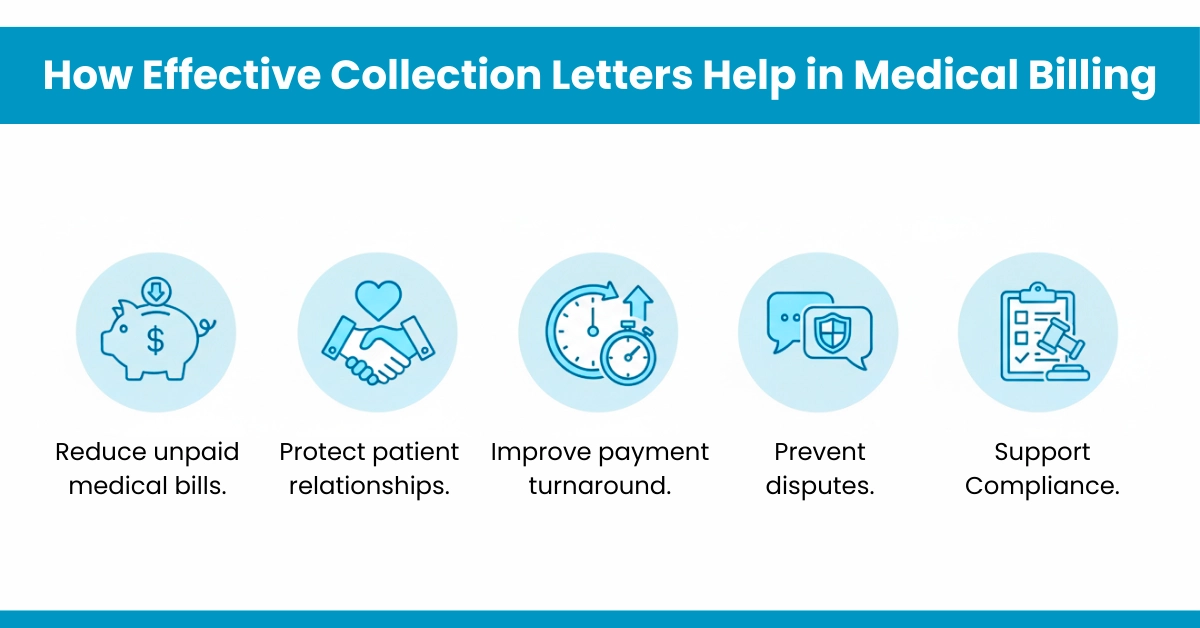
A medical billing collection letter is a formal written notice sent to patients with an outstanding balance. It is not a threat. It is a structured, HIPAA-compliant reminder designed to recover revenue while protecting the patient relationship.
Unlike general debt collection notices, medical billing correspondence carries more responsibility. The patient received clinical care, and that context demands empathy alongside firmness.
A well-written collection letter states the balance clearly, explains payment options, and gives a specific deadline. It avoids accusatory language. Above all, it stays compliant with the Fair Debt Collection Practices Act (FDCPA) and HIPAA regulations.
The medical practice today struggles with under-collection. A 2024 report of Kodiak Solutions study of over 1,850 hospitals found that most providers collect only 47.8% of what patients owe them. Meanwhile, the Peterson-KFF Health System Tracker reports that 41% of U.S. adults carry medical debt, despite 90% holding some form of insurance.
The gap is not willingness, it is communication. A structured, patient-friendly billing letter closes that gap.
Hello MDs’ AR Follow-Up & Collections services use systematic, tech-driven workflows to track every unpaid claim and escalate strategically, without damaging patient trust.
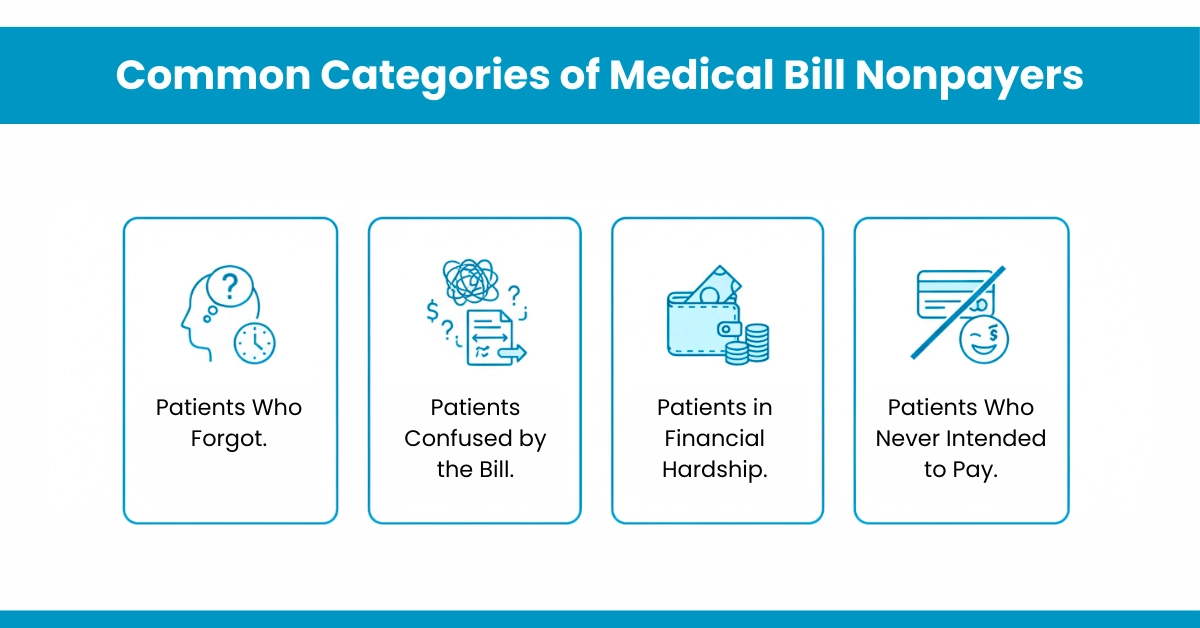
Before sending any collection letter, identify which patient type you are addressing. Tailoring tone and timing improves results and preserves goodwill.
It is very common. Early-stage delinquencies are often due to oversight.
Solution: Friendly reminders and soft outreach are effective.
This type is also common in healthcare billing.
Solution: Clear itemized statements and explanation of benefits (EOB) reduce disputes.
Financial stress is a major factor in unpaid medical bills.
Solution: Payment plans and financial assistance improve recovery rates.
This is a smaller percentage, but it does exist.
Solution: Requires structured escalation and possible agency referral.
Points 1, 2, and 3 deserve a softer touch, and point 4 requires formal escalation.
Here are ready-to-use templates you can adopt for your practice.
Tone: Warm and informative
[Practice Name] | Billing Department Date: [MM/DD/YYYY]
Dear [Patient Name],
This is a friendly reminder that your balance of $[Amount] from your visit on [Date] remains outstanding. Your payment was due on [Due Date].
We offer the following payment options:
Please neglect this notice if you have already sent payment. Contact our billing team with any questions.
Sincerely, [Billing Department] | [Practice Name]
Common CPT codes: 99213 (established patient visit, moderate complexity) | 99214 (moderate-high complexity) Common ICD-10 codes: Z00.00 (general adult exam) | I10 (essential hypertension).
Tone: Firm and solution-focused
[Practice Name] | PAST DUE NOTICE Date: [MM/DD/YYYY]
Dear [Patient Name],
Your balance of $[Amount] is now past due. We have not received payment or a response to our previous notice.
We understand that medical bills can create financial hardship. Contact us before [New Due Date] to arrange a payment plan.
Pay online at [URL] or call [Phone Number] today.
Sincerely, [Billing Department] | [Practice Name]
Common CPT codes: 93000 (electrocardiogram with interpretation) | 71046 (chest X-ray, two views) Common ICD-10 codes: E11.9 (type 2 diabetes, uncomplicated) | M54.5 (low back pain)
Tone: Urgent, professional, no threatening language
[Practice Name] | FINAL NOTICE Date: [MM/DD/YYYY]
Dear [Patient Name],
This is your final notice for an outstanding balance of $[Amount]. Your account is now [X] days past due.
If we do not receive payment or contact by [Final Date], this account may be referred to a third-party collections agency.
Please call [Phone Number] or pay online at [URL] immediately. We remain committed to finding a workable solution for you.
Sincerely, [Billing Department] | [Practice Name]
Common CPT code: 99215 (high-complexity E&M visit) Common ICD-10 code: J44.1 (COPD with acute exacerbation).
Compliance Note: Avoid words like “delinquent,” “final warning,” or all-caps threats. Both FDCPA and HIPAA restrict aggressive or misleading language in medical billing correspondence.
According to InstaMed, 70% of consumers still receive medical bills by mail, but only 9% want to pay by paper check. Additionally, 85% of millennials would use a mobile app to pay medical bills.
Subject: Quick Note About Your Balance: [Practice Name]
Dear [Patient Name], Your balance of $[Amount] with [Practice Name] is still outstanding. Paying online is fast and secure: [Payment Link] Questions? Reply here or call [Phone]. [Billing Team]
Subject: Action Required: Outstanding Balance [Practice Name]
Dear [Patient Name], Your payment of $[Amount], due on [Date], has not been received. Please pay at [Link] or call [Phone] to set up a payment plan. [Billing Department]
HIPAA Reminder: All patient billing emails must use encrypted, HIPAA-secure platforms. HelloMDs processes all billing communications through HIPAA-compliant systems, protecting patient data at every step.
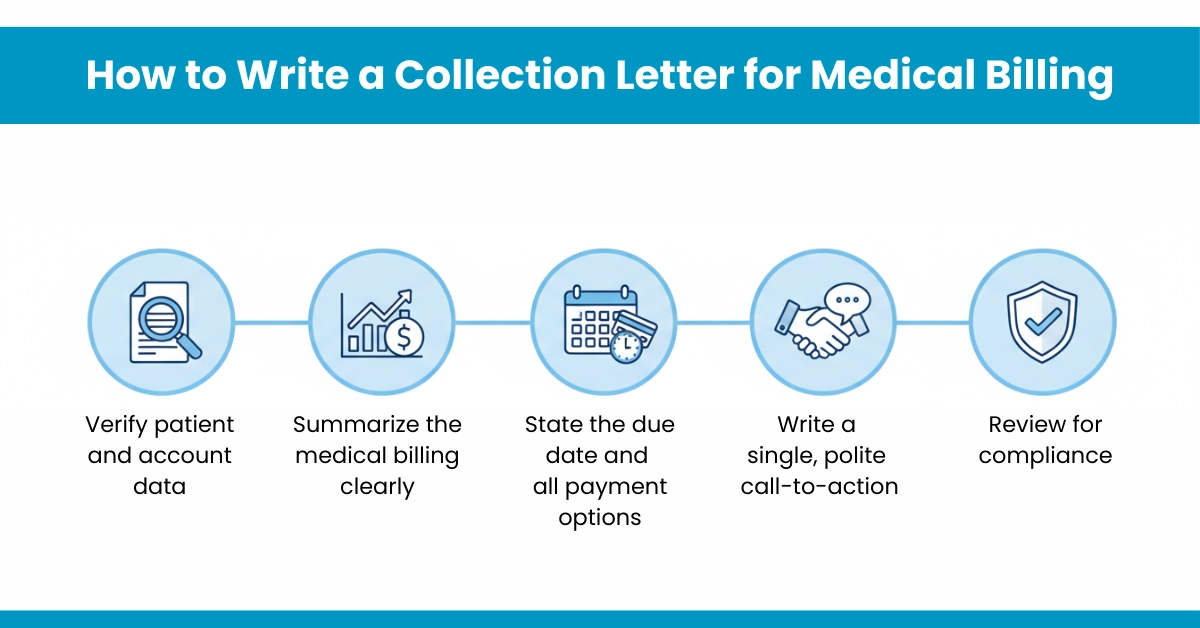
Many billing teams wonder: How do I write a collection letter that recovers revenue without crossing legal lines?
Follow these steps:
Practices using HelloMDs Medical Billing and Coding services benefit from systematic follow-up, denial resolution, and patient balance management, nationwide, from Texas to New York and across all 56 U.S. states and territories.
A medical collection letter is not just a billing notice. It is an essential tool in your revenue cycle. When crafted thoughtfully and compliant with FDCPA and HIPAA standards, these letters significantly improve payment rates and also protect patient relationships.
Use the templates, strategies, and compliance tips above to refine your billing follow-up and reduce write-offs
Disclaimer
The collection letter templates and billing guidance in this article are for general informational and educational purposes only and are not legal, financial, or compliance advice. HelloMDs is a professional medical billing and revenue cycle management company and does not provide legal counsel. Some images in this blog are AI-generated just to give you an idea.