
A missed filing window is one of the fastest ways a home health agency loses revenue it already earned. Medicare retired the old Request for Anticipated Payment (RAP) process in 2022 and replaced it with the Notice of Admission (NOA), a stricter, one-time filing with its own 5-day clock and penalty math. Billing teams still mix the two up, especially when training new staff or correcting older claims.
This guide covers NOA vs RAP, the exact home health NOA filing deadline, the late-filing penalty math, and the codes that keep a claim clean. HelloMDs bills home health claims across all 56 U.S. states and territories.
The Notice of Admission (NOA) is a one-time, no-pay notice that establishes a Medicare home health period of care. RAP was its predecessor, an upfront, partial-payment request filed for every 30 days. CMS retired RAP for periods starting on or after January 1, 2022, replacing it with the NOA under the Patient-Driven Groupings Model (PDGM).
NOA (current) | RAP (retired) | |
Applies to | Jan 1, 2022 forward | Through Dec 31, 2021 |
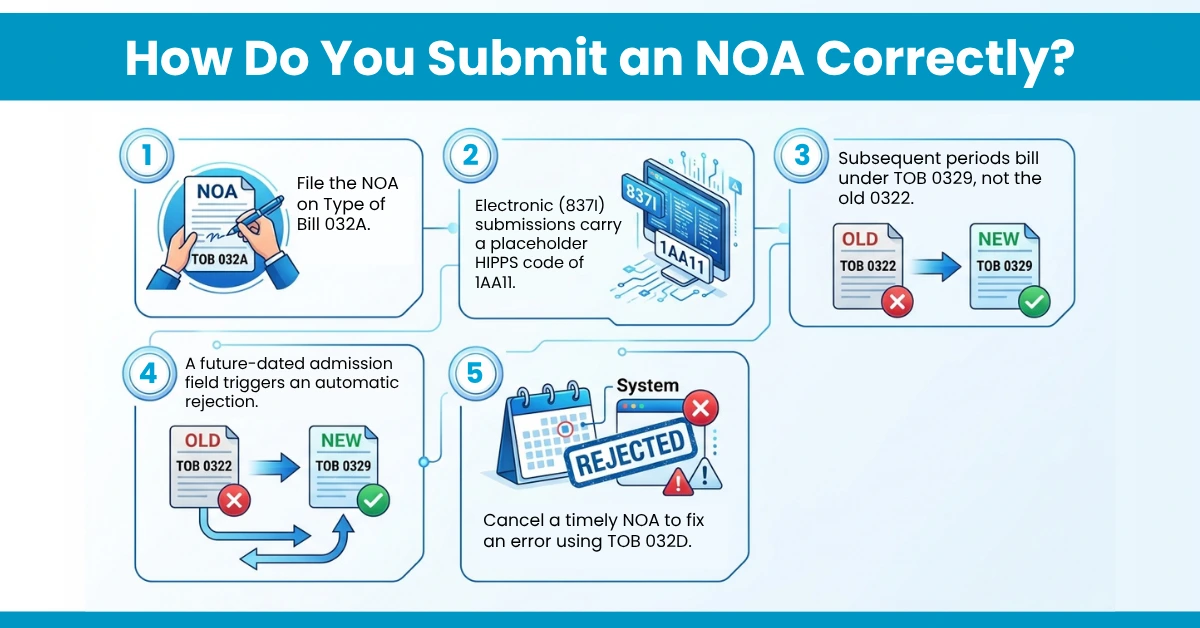
Type of Bill | 032A | 0322 |
Filing frequency | Once per admission | Every 30 days |
Upfront payment | None | Partial, phased to $0 by 2021 |
Filing deadline | 5 calendar days from SOC | 5 calendar days from SOC (final years) |
Late penalty | 1/30th of payment per day late | Same structure in RAP’s final year |
RAP is gone for new admissions, but agencies still reference it when auditing legacy claims or training new billers.
Agencies must submit the NOA within 5 calendar days of the start of care (SOC) date, counting from the day after SOC. Medicare requires only one NOA per admission; it covers every contiguous 30-day period until discharge, unlike RAP’s per-period filing.
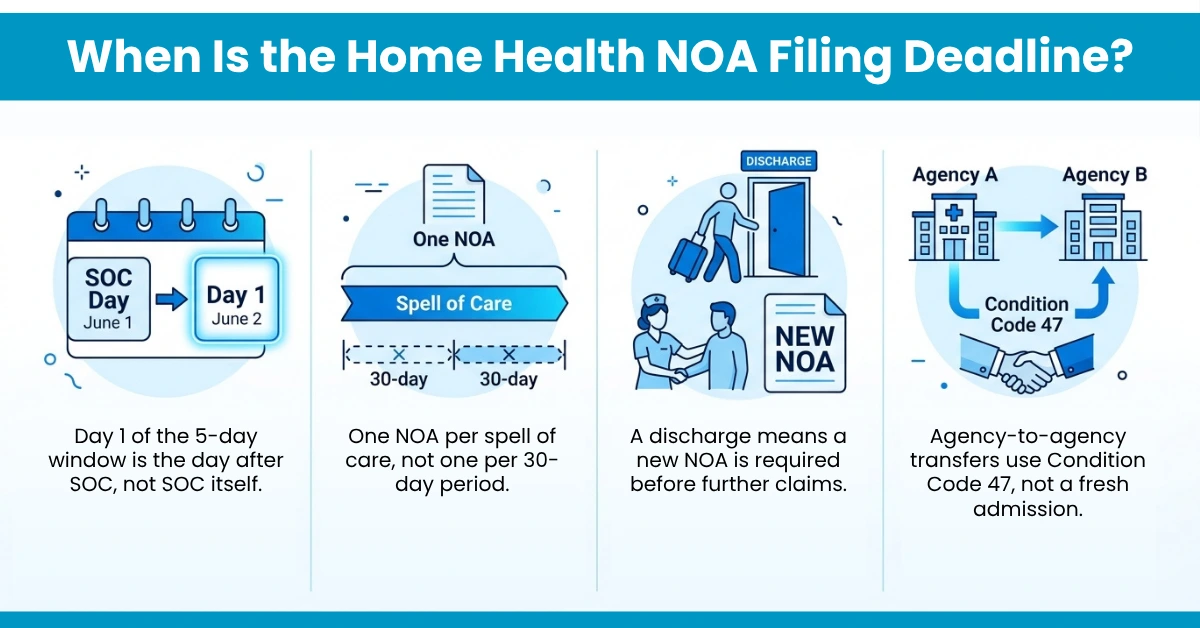
A late NOA cuts the 30-day period payment by 1/30th for every calendar day between the SOC date and the date the agency actually submits the NOA, not just the days past the 5-day window.
For example, CMS set the CY2026 national standardized 30-day payment rate at $2,038.22 before wage-index and case-mix adjustments. An NOA filed 8 days after SOC 3 days past the deadline cuts that period’s payment by 8/30, or roughly $543, before any other adjustment applies. That reduction is standard provider liability. It isn’t appealable; it’s only exception-eligible.
CMS allows four narrow exceptions to the late-filing penalty. None are automatic; the agency has to request one on the claim itself, not through a formal appeal.
To request one, append modifier KX to the HIPPS code on the revenue code 0023 line and explain why in the claim’s remarks field.
An NOA can only go out once two things happen: the agency completes the initial visit establishing SOC, and a physician or allowed practitioner has given a written or verbal order for services. Agencies file it via EDI, Direct Data Entry (DDE), or mail to their Medicare Administrative Contractor (MAC).
Home health billing runs on HCPCS Level II G-codes paired with revenue codes, not standard E/M CPT codes, a detail that trips up billers coming from physician-office work. ICD-10-CM codes drive medical necessity and the PDGM case-mix group on OASIS and the claim that follows the NOA.
Discipline codes (15-minute increments):
Physician-side (billed by the referring provider): G0180 initial certification, G0179 recertification after 60+ days, G0181 care plan oversight, 30+ minutes a month.
Common principal ICD-10-CM diagnoses: I50.9 (heart failure), E11.9 (type 2 diabetes, uncomplicated), J44.9 (COPD), each must match the primary reason for care on OASIS, not a general history code.
CMS finalized a net 1.3% aggregate payment reduction for home health in CY2026, a -1.023% permanent PDGM adjustment plus a -3.0% temporary one. With margins tighter, a late NOA penalty or coding mismatch costs more this year than in years with room to absorb it.
HelloMDs home health Billing team tracks NOA deadlines against SOC dates, pairs HCPCS and revenue codes correctly, and follows every claim through denial management and AR recovery. Clients across our specialties see a 99% first-pass claim ratio and roughly a 15% drop in denial rates, margin that matters now that Medicare has trimmed the rate.
RAP is gone, but the discipline it demanded isn’t. The NOA leaves less room for error: One filing, one 5-day window, and a penalty that starts accruing the moment that window closes. Getting the Type of Bill, revenue codes, and HCPCS pairings right the first time protects revenue that’s harder to earn under CY2026 rates. Schedule a free consultation with HelloMDs home health team to audit your NOA workflow before your next admission.