
A biller opens a chart, sees “type 2 diabetes,” no mention of kidneys, nerves, or eyes, and reaches for E11.9 out of habit. That reflex used to be safe. FY2026 changed two things at once: the National Center for Health Statistics split off a new code for diabetes in remission, and CMS finished phasing in a risk-adjustment model that scores E11.9 differently than it did two years back.
HelloMDs codes diabetes charts across endocrinology, family practice, and internal medicine every week. Here’s what E11.9 covers now, what changed, and where the denials keep coming from.
E11.9 is the ICD-10-CM code for type 2 diabetes mellitus without complications, a confirmed type 2 diabetes diagnosis where the chart records no nephropathy, neuropathy, retinopathy, or circulatory involvement. It sits inside category E11, in the endocrine and metabolic chapter, and it’s billable in office and outpatient visits.
E11.9 applies only when nothing else is charted. Once a note documents hyperglycemia, nephropathy, neuropathy, or a vascular complication, a more specific E11 code takes over, and a specific complication code can’t ride alongside the unspecified E11.9 on the same encounter; a payer reads that pairing as contradictory.
Code | Covers | Chart Needs |
E11.9 | No complications | Nothing else documented |
E11.65 | With hyperglycemia | Elevated glucose, treated |
E11.21 | With nephropathy | Kidney involvement |
E11.40 | With neuropathy | Nerve involvement |
E11.A | No complications, in remission | Remission stated directly (new FY2026) |
FY2026, effective October 1, 2025, added E11.A for type 2 diabetes without complications in remission, replacing the old workaround of billing plain E11.9 for a remission note. A strong A1c alone doesn’t earn E11.A; the provider has to write “remission,” or an equivalent statement, in the assessment first.
Yes. Under the CMS-HCC V28 model, fully phased in for payment year 2026, E11.9 maps to HCC 38, Diabetes without Chronic Complications, while any documented complication maps to the higher-weighted HCC 37. A chart supporting both categories only counts the higher one toward the patient’s risk score.
Payers want proof the absence of complications was actually checked, not assumed. “Type 2 diabetes, continue metformin,” with nothing else, invites a medical-necessity denial.
A clean example:
“Type 2 diabetes mellitus, well-controlled on metformin 1000 mg BID. A1c 6.8% (5/2026). No retinopathy, nephropathy, or neuropathy on exam. Continue current regimen, recheck A1c in 3 months.” That’s what separates a clean E11.9 claim from a denial.
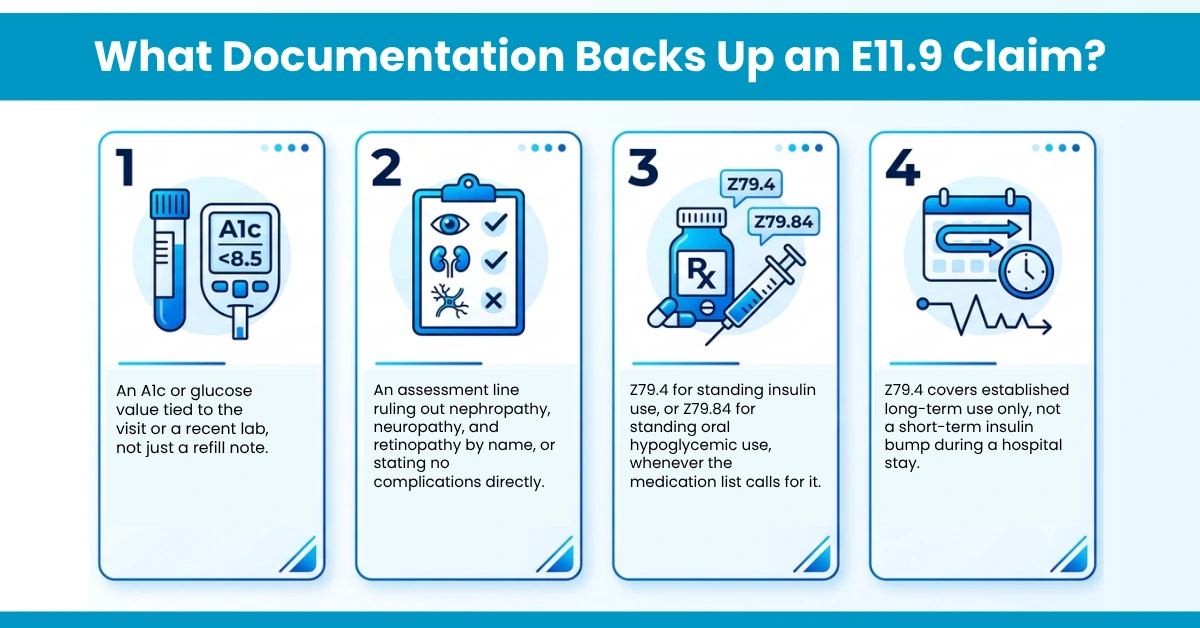
Most E11.9 claims travel with an office-visit code and a lab code, sometimes joined by diabetes education, CGM, or chronic-care codes.
Three habits account for most of the diabetes denials. HelloMDs untangles: A missing Z-code, a thin assessment line, and a visit level that outpaces the note.
HelloMDs coders check the E11.9 (or E11.A) call, the Z-codes, and the visit level against the note before the claim goes out, across endocrinology, family practice, and internal medicine.
Diabetes moves through more charts than almost any other diagnosis in primary care and endocrinology, a small coding habit repeated across hundreds of visits either leaves money on the table or draws audit attention. HelloMDs AAPC-certified coders check diabetes charts, specialty by specialty, catch the E11.9-versus-E11.A-versus-complication call before a claim goes out, and handle the appeal if a payer pushes back anyway. Send over a quarter’s worth of diabetes denials and see exactly where the pattern breaks.
This piece covers general FY2026 coding patterns, not compliance or legal advice, check current CMS and AMA guidance before coding a specific claim, and loop in your compliance lead for payer-specific questions.