
If your practice keeps getting 76700 claims denied, or you’re unsure whether the exam you performed qualifies as “complete,” you’re not alone. This is one of the most frequently billed radiology codes in the U.S., and also one of the most frequently miscoded. One wrong modifier, one missing organ in the report, and you’re looking at a denial, a resubmission, and delayed revenue.
This guide cuts through the confusion. Whether you’re a radiologist, a billing coordinator, or a practice manager dealing with claim rejections, everything you need is here, including what most other guides skip: the diabetic patient connection, the 2026 payer rule changes, and the documentation language that actually prevents downcoding.
CPT 76700 describes a complete abdominal ultrasound performed in real time with image documentation. It falls under the Diagnostic Ultrasound Procedures of the Abdomen and Retroperitoneum, maintained by the American Medical Association.
To bill this code correctly, the report must evaluate and document:
If even one structure is missing from the report without a documented reason, the claim can’t be billed as 76700. It becomes a limited exam under CPT 76705 and that difference in reimbursement adds up fast across a high-volume practice.
What 76700 Doesn’t Include
This trips up a lot of billers. CPT 76700 excludes:
Those fall under separate codes. Assuming 76700 covers the retroperitoneum is one of the most common causes of downcoding audits.
Here’s the real difference:
CPT Code | Study Type | When to Use |
76700 | Complete abdominal ultrasound | All 8 organ groups were evaluated and documented |
76705 | Limited abdominal ultrasound | One organ, one quadrant, or focused follow-up only |
76706 | AAA screening ultrasound | Medicare covers aortic aneurysm screening only |
76770 | Complete retroperitoneal ultrasound | Retroperitoneal structures only |
76775 | Limited retroperitoneal ultrasound | Focused retroperitoneal structure |
If a retroperitoneal ultrasound is expanded mid-exam to include abdominal organs, you bill 76700, not both 76770 and 76700. Billing both is a bundling violation.
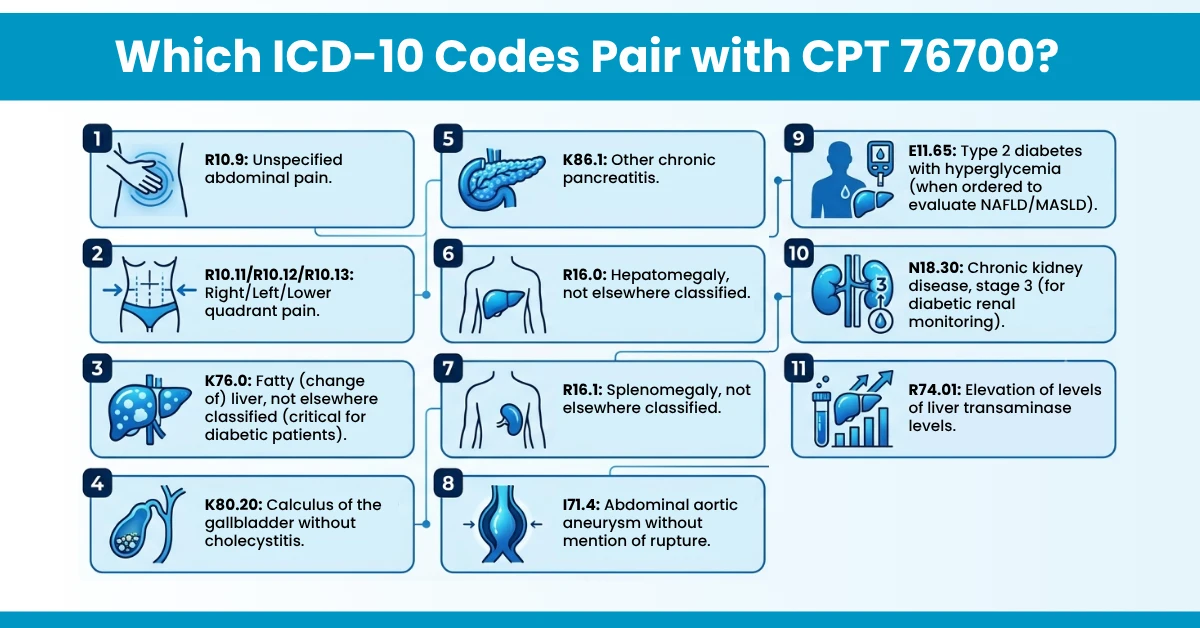
Medical necessity lives or dies on the ICD-10 code match. Payers use claim editors to compare your CPT code against the diagnosis code on the order. A mismatch is an automatic denial.
Common ICD-10 codes for CPT 76700:
Always verify the ICD-10 code against the actual physician order. If the order says “abdominal pain” but you bill E11.65, the claim will be denied for a medical necessity mismatch, even if the diabetes is clinically relevant.
Patients with Type 2 diabetes have a significantly higher prevalence of non-alcoholic fatty liver disease (NAFLD), now reclassified in 2024 as MASLD (Metabolic Dysfunction-Associated Steatotic Liver Disease). Studies estimate that 55-75% of diabetic patients have some degree of hepatic steatosis. Many endocrinologists and internal medicine physicians routinely order complete abdominal ultrasounds for these patients as part of metabolic monitoring.
What Billers Need to Know:
Practices managing a high volume of diabetic or endocrinology patients benefit significantly from proactive eligibility verification and prior authorization workflows.
HelloMDs insurance eligibility verification and prior authorization services handle this before the appointment, which means zero-surprise denials on exam day.
Getting modifiers wrong on 76700 is one of the fastest ways to create a billing headache. Here’s what each modifier means in practice:
The Global Billing Rule:
If your practice owns the machine and your physician performs and interprets the exam, bill 76700 with no modifiers. This bills the global service. Adding Modifier 26 when you own everything is an error that makes it look like you’re only billing for interpretation, cutting your reimbursement in half.
Payer scrutiny on 76700 claims has intensified this year. Appeal success rates sit between 40–60%, which means preventing denials is far more valuable than fighting them.
Top denial triggers:
2026-specific update:
AI-assisted ultrasound interpretation. Several commercial payers are now specifying that AI interpretation alone doesn’t qualify for professional component (Modifier 26) billing. A radiologist-authored, signed report is still required. This is a new compliance layer that practices using AI reading tools need to address now.
If denials are consuming your billing team’s time, HelloMDs denial management services identify the root cause, correct the error, and resubmit, with a 15% lower denial rate than the industry average.
This is the documentation standard that separates a clean claim from a denial:
A report that says “abdominal ultrasound performed, findings as above” with a vague summary is not sufficient for 76700. That claim will be reviewed and likely downgraded.
CPT code 76700 is not complicated, but it is unforgiving. Every organ must be documented. Every modifier must match your billing arrangement. Every ICD-10 code must reflect the physician’s clinical intent on the date of service.
For diabetic patient panels, high-volume radiology practices, and any provider navigating 2026’s stricter payer environment, the margin for error is shrinking. One missing sentence in a report, one wrong modifier, one undocumented repeat indication, and the revenue disappears into the denial queue.
HelloMDs helps practices get 76700 claims right the first time. Our AAPC-certified coders, denial management team, and prior authorization specialists handle the details so your clinical team doesn’t have to. If you want more guidelines and updates, follow us on Instagram and Facebook.
This content is shared for informational purposes only and should not be treated as official medical, legal, or billing advice. Always verify coding and payer guidelines before claim submission. Some visuals in this blog were creatively produced using AI-assisted tools to make complex billing topics easier to understand.