
Your last medical billing company missed claims, ignored denials, and left money on the table. You’re not alone. Doctors lose thousands every month to billing partners who cut corners or hide behind vague promises. According to the CAQH Index, U.S. practices waste an average of $86 per claim on rework caused by billing errors.
We run a billing company ourselves, so we know what separates honest teams from smooth talkers. These seven checks will show you how to pick the right medical billing services partner, and avoid the mistakes that drain your revenue.
A real billing company manages your entire revenue cycle, not just claim submission. Core services your medical billing company evaluation must confirm:
Many companies say they handle everything but only push basic claims. When you ask about denial appeals, they charge extra. Get the full list in writing before you sign.
Ask about revenue cycle management services, do they fix recurring revenue leaks or just submit claims and wait? The right medical billing services for physicians go beyond data entry.
Every specialty has different billing rules. A company that bills family practice well might fail at cardiology.
Why medical billing specialty experience matters:
Ask for three things: case studies from your specialty, sample monthly reports, and references from doctors in your field. HelloMDs publishes real results, like recovering $400K in aged AR for a family practice, because proof matters more than promises.
A company that knows your specialty shares these within 48 hours. A company that makes excuses doesn’t have what you need.
The right company shares stats without hesitation. Demand these five medical billing performance metrics before signing:
|
Metric |
Industry Average (MGMA) |
Good |
What HelloMDs Delivers |
Demand |
|
Clean Claim Rate |
85-90% |
90-95% |
99% first-pass |
95%+ |
|
Denial Rate |
10-15% |
5-10% |
15% reduction |
Under 5% |
|
Days in AR |
40-50 |
30-40 |
Tracked weekly |
Under 30 |
|
Collection Rate |
90-94% |
95-97% |
97% first-pay |
97%+ |
|
Old AR Recovery |
Varies |
20-30% |
30%+ or no fee |
Written guarantee |
A company can cherry-pick one good month and claim 97% clean claim rate. Always ask for six months of trend data. Watch your medical billing clean claim rate, medical billing denial rate, and medical billing days in A/R every month not just at contract signing.
Set Service Level Agreements with consequences for missed targets. CMS MAC guidelines define proper claim formatting rules your billing company must follow.
Medical billing company pricing varies widely. The cheapest option almost always costs you more.
Three models dominate the market:
Pricing ranges from HBMA and MGMA DataDive reports. BLS reports the median medical records specialist salary at $45K-$65K plus benefits.
The trap: hidden medical billing company fees. Ask about setup costs, onboarding charges, termination penalties, and extra charges for denial appeals. Many advertise 4% of collections but charge extra for everything beyond basic submission.
When evaluating medical billing service cost, look at the total picture. A company charging 4% that lets denials pile up costs far more than a 7% company that fights every rejected claim. One ignored $5,000 claim wipes out your savings from the lower rate.
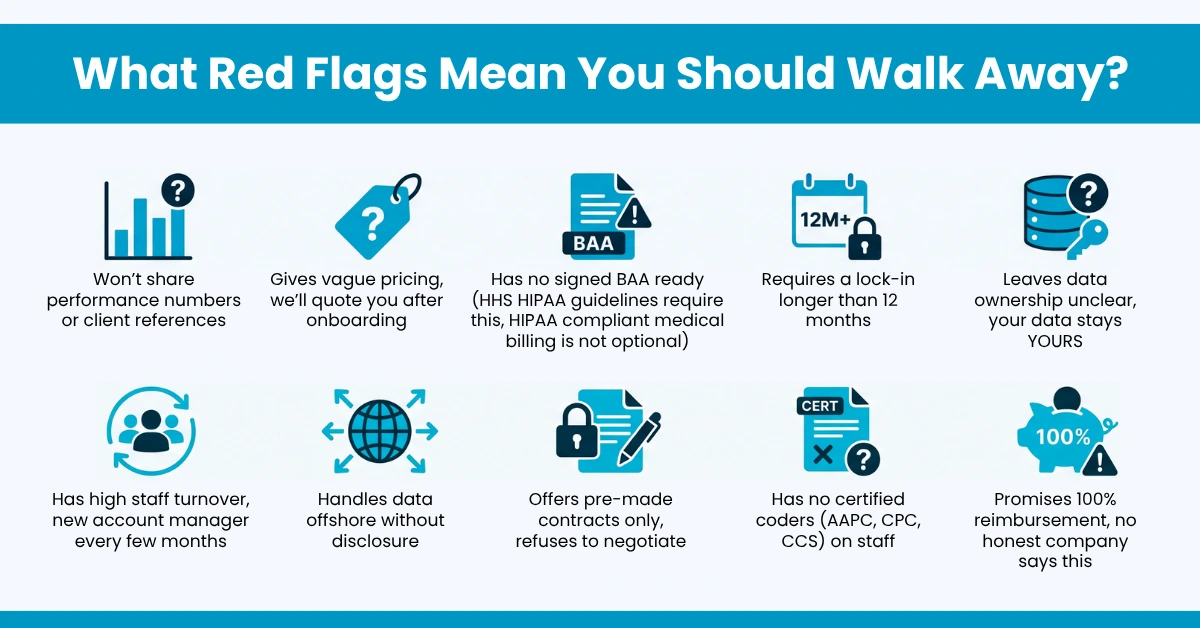
These medical billing company red flags mean the company will cost you money instead of saving it.
Walk away if the company:
Read medical billing contract terms carefully. Check the exit fee, notice period (30-90 days is standard), and early termination penalties. Some companies make it easy to sign but nearly impossible to leave.
A company that only talks and never asks about your practice doesn’t care about your results. These are the questions to ask a medical billing company and the ones they should ask you.
Nobody tells you what onboarding actually looks like. Here’s a realistic medical billing company checklist for your first three months:
Your new team signs a BAA, gets secure access to your PM system, and runs a full audit. HelloMDs generates 30+ financial reports in 5 business days showing exactly where revenue leaks. You see denial patterns, aging claims, and billing bottlenecks mapped out.
Claims flow through the new system. You get your first monthly report with what to look for in a medical billing company, clean claim rates, denial breakdowns, collection totals. The team begins working old AR.
Billing runs smoothly. Trends show up: denial rates dropping, days in AR shrinking, collections climbing. Your first quarterly review measures whether the company meets their SLA promises.
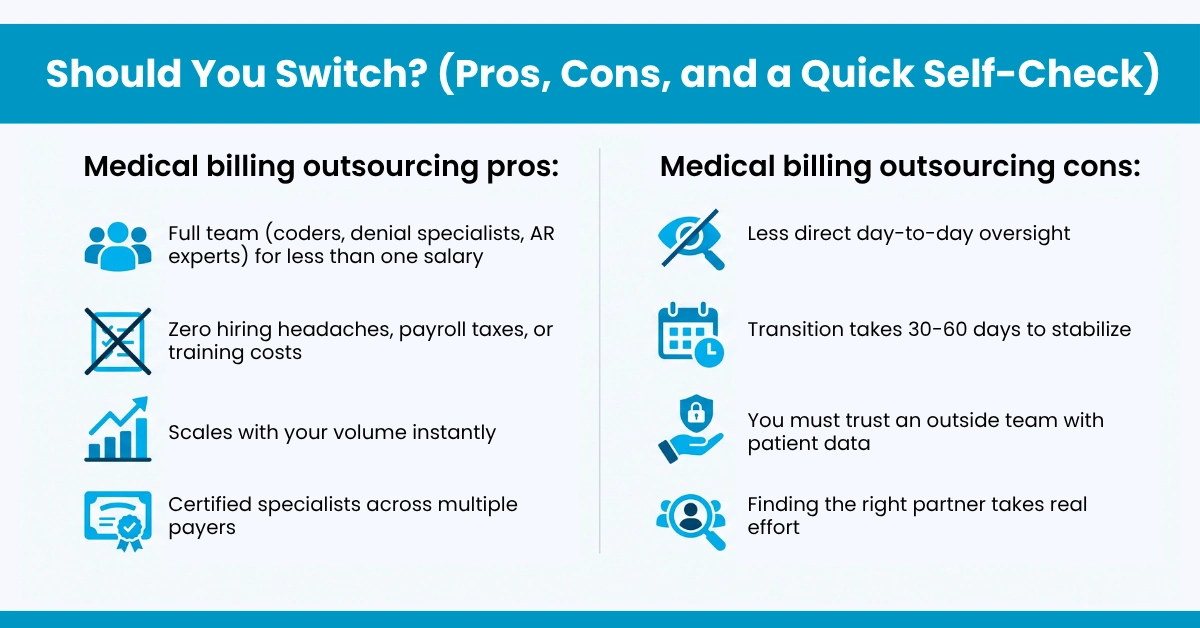
Outsourced medical billing works for most practices, but not every situation fits.
Medical billing outsourcing pros:
If 3 or more answers are no, start evaluating medical billing services for small practices or larger outsourced medical billing options. The right partner lets your team focus on patients instead of insurance paperwork.
How to choose a medical billing company comes down to proof. The right partner shows certified staff, real numbers, clear pricing, and fair contracts before you even ask. Skip the smooth talkers.
Your next steps should be: Score your current billing company against the 7 checks above, If they fail 3 or more, shortlist 3 new companies and send them the questions from this article and Ask each company for a free audit, compare what they find.
Talk to HelloMDs, ask us for our numbers and book a free practice audit.
Follow us on Facebook and Instagram for weekly billing tips.
This article references CMS.gov MAC guidelines, HHS.gov HIPAA requirements, CAQH Index data, HBMA industry reports, MGMA benchmarking data, BLS salary data, and verified HelloMDs performance data. We used AI tools for research, editing, and formatting. All analysis comes from 15 years of direct medical billing experience. Images are AI-generated.