
The CMS 2024 supplemental improper-payment report reveals a 25.2% improper payment rate for glucose monitors. This translates to $278.5 million in mismanaged revenue. 67.6% of these failures occur because no documentation was on file. Another 26.6% stems from insufficient records.
HCPCS code A4239 is a documentation-heavy requirement. If your practice faces “unbundling” rejections or a CERT audit, your process likely misses specific Medicare Administrative Contractor (MAC) triggers. At HelloMDs, our AAPC-certified coders solve these gaps for suppliers across Texas, Florida, California, and nationwide. We focus on securing your revenue cycle and stopping the denial cycle.
HCPCS code A4239 is the supply allowance for a non-adjunctive, non-implanted continuous glucose monitor (CGM). This code represents a global monthly allowance. One month of supplies equals one unit of service.
You cannot bill for individual parts of the system separately. According to PDAC, A4239 includes:
Billing for test strips or lancets on the same date as A4239 will cause an “unbundling” denial. Our DME billing services team flags these items to ensure your claims stay clean.
Choosing the wrong supply code leads to immediate medical necessity denials. The difference lies in how the patient uses the device for treatment.
Billing Feature | A4238 (Adjunctive) | A4239 (Non-Adjunctive) |
Primary Use | Verify with fingerstick | Direct treatment decisions |
Device Hardware | E2102 (Receiver) | E2103 (Receiver) |
BGM Test Strips | Billed separately | Bundled into A4239 |
Medicare Modifier | KX or KS | KX, KS, and CG |
Unbundling is a frequent reason for A4239 claim denial. Because the monthly allowance covers everything needed to run the CGM, separate claims for sensors or transmitters are rejected.
A conflict occurs at the retail pharmacy. If a patient picks up test strips using their insurance at a drug store, your Medicare Part B claim for the A4239 allowance may be denied. The NCCI edits see the “strip allowance” as already used. HelloMDs manages these conflicts by verifying patient history before submission. This maintains our 99% first-pass ratio.
Medicare allows a maximum of three units of service per 90 days. Billers often fail the “carry-forward” math when sensors come in 10-day or 14-day kits.
The 14-Day Kit Example:
If you ship three 14-day sensor kits, you have provided a 42-day supply.
Submit only one unit per 30-day period. Billing multiple units based on the number of boxes shipped causes immediate rejections. Our payment posting team tracks these dates to ensure you never bill too early.
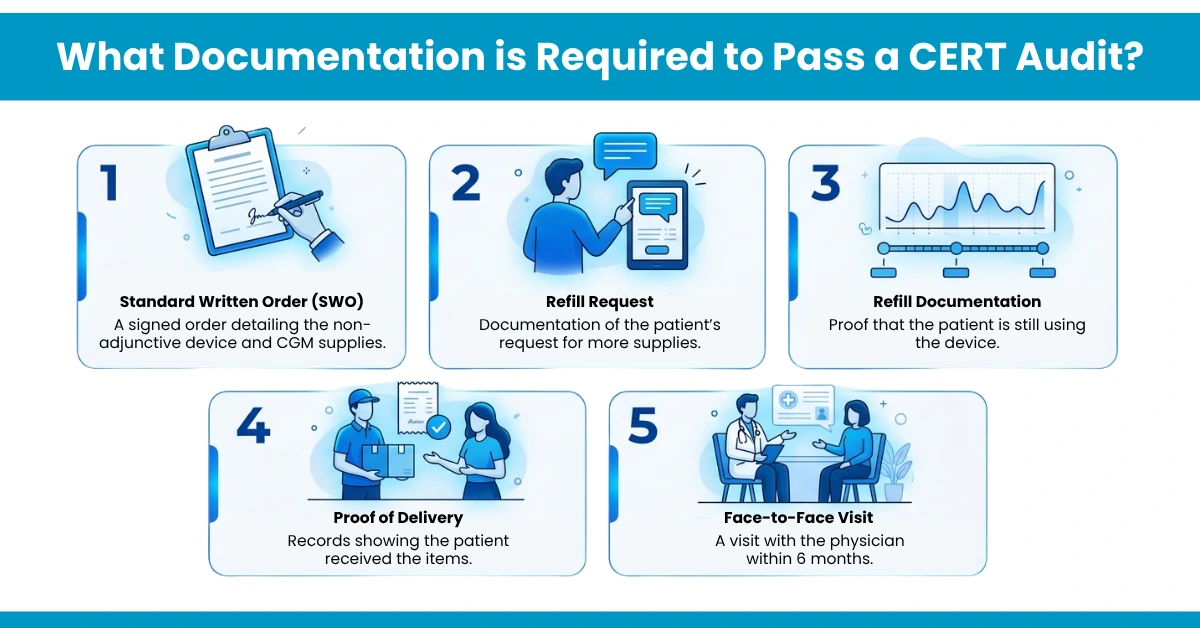
As of April 2026, medical records must be ready before you submit the claim. Failure to provide audit documentation results in revenue.
The following items must be on file:
Supplier standards also require you to keep these records for seven years. HelloMDs performs a utilization review on your files to ensure they meet these high standards.
To qualify for reimbursement, you must use specific diagnosis codes (Type 1 or Type 2 Diabetes) and append the correct modifiers.
Without these modifiers, your ERA (Electronic Remittance Advice) will show a denial for medical necessity.
When you receive your EOB (Explanation of Benefits), you may see several Common Denial Codes:
HelloMDs specializes in denial management. We analyze your ERA to find the root cause of these codes and resubmit claims with the correct narratives.
Managing HCPCS code A4239 requires exact math and strict documentation. Errors in carry-forward units or bundled supplies lead to lost revenue and audit risks. HelloMDs provides the expertise needed to secure your DME claims.
Stop losing revenue to avoidable denials. Our AAPC-certified experts help you increase collections and maintain compliance. Check your current claim accuracy. See how our RCM healthcare services fix your billing cycle. Follow us on Facebook and LinkedIn for the latest DME updates.
This guide is for informational purposes only. Billing codes, Medicare LCDs, and payer policies change frequently. Always consult the official CMS or MAC guidelines for your specific region before submitting claims. HelloMDs isn’t responsible for claim denials, payment determinations, audit findings, or compliance outcomes resulting from reliance on this information.