
A denied TSH claim rarely comes from ordering the wrong test. It comes from a coding step that looked routine and got skipped. CPT code 84443 is one of the most-billed lab codes in any practice that touches thyroid care, and that familiarity is exactly why small errors slip through: a diagnosis code too vague to prove medical necessity, a repeat draw that ran past a payer’s frequency limit, a reflex panel billed with the wrong pairing.
This guide breaks down 84443 and the codes it travels with: Free T4, free T3, thyroid antibodies, imaging, biopsy, and the ICD-10 codes that back them up, along with the specific rules that cause denials.
CPT code 84443 reports one lab test: Measuring thyroid-stimulating hormone (TSH) in a patient’s blood. It’s the standard first-line test for hypothyroidism, hyperthyroidism, and monitoring thyroid replacement therapy, filed under Pathology and Laboratory, Chemistry Procedures.
A few details that change how the claim gets paid:
TSH is the screening test, but a full thyroid workup pulls in several adjacent codes, each billed separately even when a lab groups them under one order name.
A few pairing rules matter more than the codes themselves:
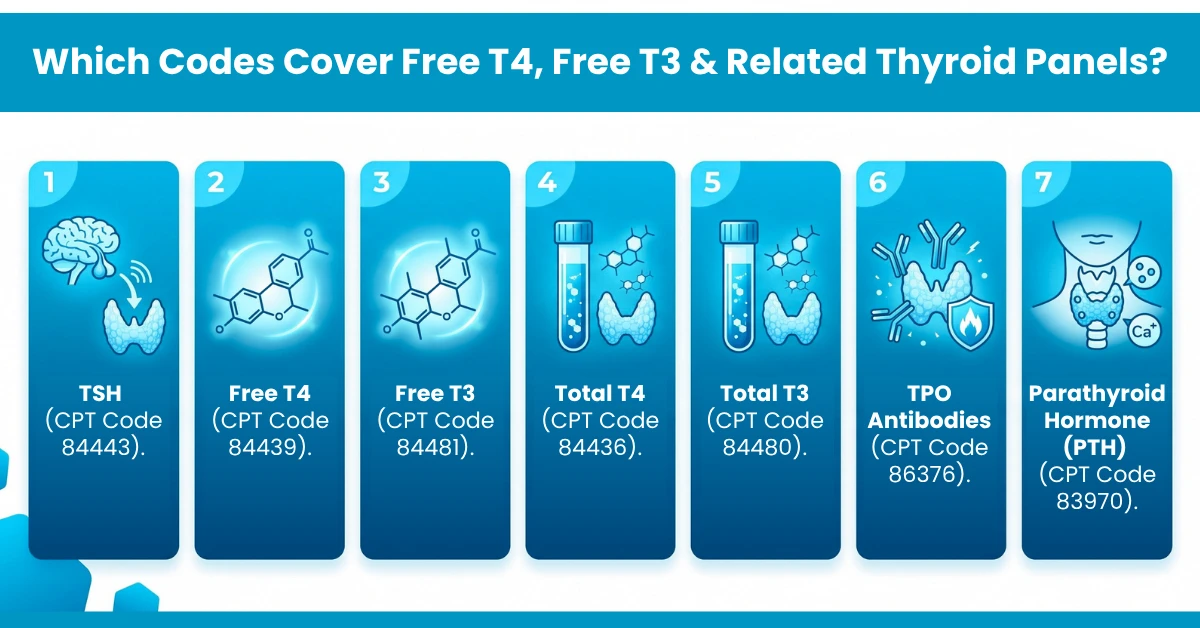
Many labs run a reflex protocol: TSH goes first, and if the result falls outside a set range, commonly below roughly 0.30 or above roughly 5.33 µIU/mL, though the exact cutoff is lab-specific, Free T4 gets added automatically, and both codes get billed.
Pros:
Cons:
CPT 76536 covers a thyroid ultrasound. It’s real-time imaging of the soft tissues of the head and neck, thyroid, parathyroid, and parotid glands with images saved to the record.
It’s a single code. Some billing tools list a separate “76537” for a limited or follow-up scan, but that split doesn’t appear in AAPC’s code set or in payer coverage policies; 76536 covers both a full exam and a focused follow-up on a known nodule. Worth double-checking against the current AMA code book before that distinction goes into a claim.
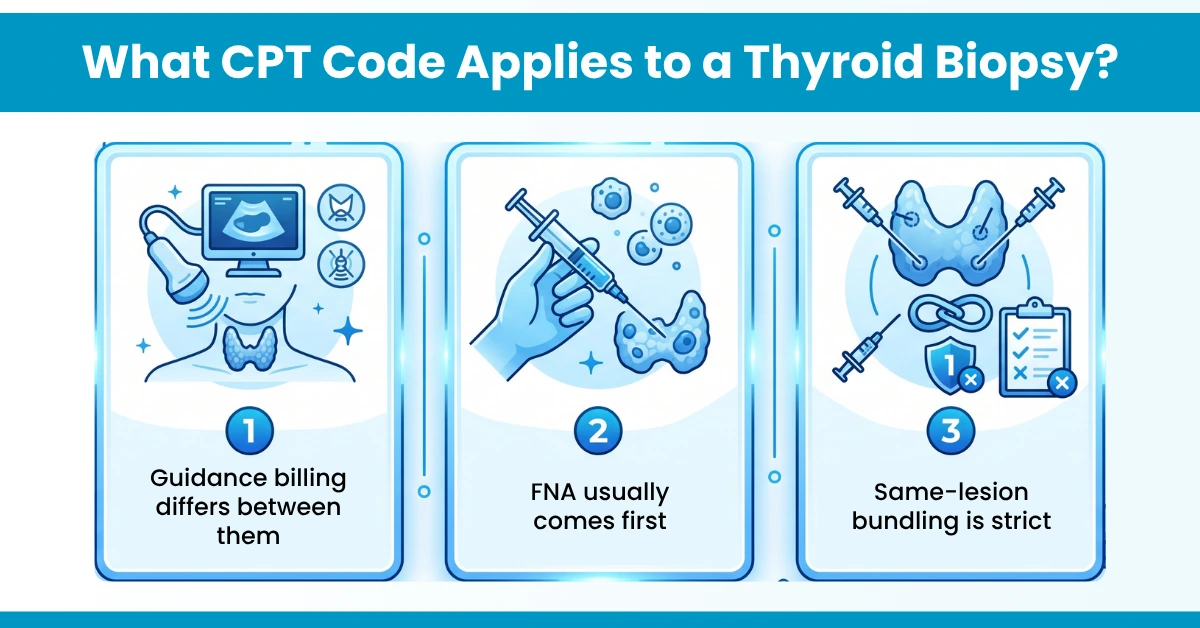
Coverage depends on medical necessity: A palpable mass, an abnormal thyroid lab result, or monitoring a known nodule typically qualify. A scan with no documented reason behind it is a common denial. If the same visit includes an ultrasound-guided biopsy, the guidance component (76942) bills separately from 76536; one covers the diagnostic scan, the other covers the procedure.
Two codes cover a thyroid biopsy, and the difference is the needle type. Fine needle aspiration with ultrasound guidance bills as 10005 for the first nodule and 10006 for each additional nodule; a core needle biopsy bills as 60100.
The right ICD-10 code depends on whether a diagnosis has already been confirmed. R94.6 (abnormal results of thyroid function studies) applies before a specific condition is confirmed. E03.9 (hypothyroidism, unspecified) or E05.90 (hyperthyroidism/thyrotoxicosis, unspecified) apply once the labs and symptoms support an actual diagnosis.
This is the single most common gap coders run into: Billing R94.6 after the chart already documents a confirmed hypothyroidism diagnosis. Once E03.9 applies, R94.6 shouldn’t carry the claim anymore.
Documentation needs to support whichever code gets used. A TSH value alone rarely counts on its own; the note should tie the number to a symptom, a monitoring reason, or a confirmed diagnosis. AAPC’s R94.6 reference is a useful bookmark for this exact distinction, since payers audit it more than most practices expect.
Yes, Z13.29 (encounter for screening for other suspected endocrine disorder) applies when a patient has no thyroid symptoms and no prior diagnosis, and the test is ordered as a preventive check.
Z13.29 only fits a true screening visit. If the patient reports fatigue, weight change, or another thyroid-related symptom, that symptom code should lead the claim instead. Some payers process wellness-visit thyroid testing differently from a symptom-driven order, so the diagnosis on file needs to match what actually happened in the visit, not just what got tested.
A gold-top serum separator tube (SST) is the standard collection tube for a TSH draw. Some labs also accept a green-top (lithium heparin) tube when serum isn’t available.
The sample needs to clot, get centrifuged, and stay refrigerated until it reaches the lab. A rejected or hemolyzed specimen means a redraw, which can trigger the frequency-limit issue covered earlier in this guide if it happens more than once in a short window. Getting this step right at the draw station is a quieter way to protect the claim than any coding fix downstream.
Most of what denies a TSH claim isn’t the test itself. It’s a frequency rule, a bundling edit, or a diagnosis code that doesn’t quite match the chart. None of that needs a coding overhaul to fix; it needs a team that catches the pattern before the claim goes out.
If thyroid panel denials keep showing up in your aging report, HelloMDs denial management team can run a free billing review and show exactly where the pattern starts.