
Your chest CT is done, and no contrast was used. Now the billing begins, and that’s exactly where most radiology claims break down. Whether you’re a provider, coder, or patient trying to understand an EOB, CPT code 71250 governs this entire imaging service. Getting it right protects your revenue. Getting it wrong triggers denials that take weeks to resolve.
CPT code 71250 is defined by the AMA as “Computed tomography, thorax, diagnostic; without contrast material.” It covers a complete cross-sectional CT acquisition of the lungs, mediastinum, pleural spaces, chest wall, and surrounding thoracic structures, performed without any intravenous contrast agent. It is used across inpatient, hospital outpatient, ASC, and freestanding imaging center settings.
CPT 71250 represents a diagnostic CT scan of the chest without contrast material. It produces detailed cross-sectional images of thoracic anatomy.
It includes evaluation of:
Key clinical clarification:
High-Resolution CT (HRCT) used for interstitial lung disease has no separate CPT code. If no contrast is used, you still report 71250; the acquisition protocol does not change the code.
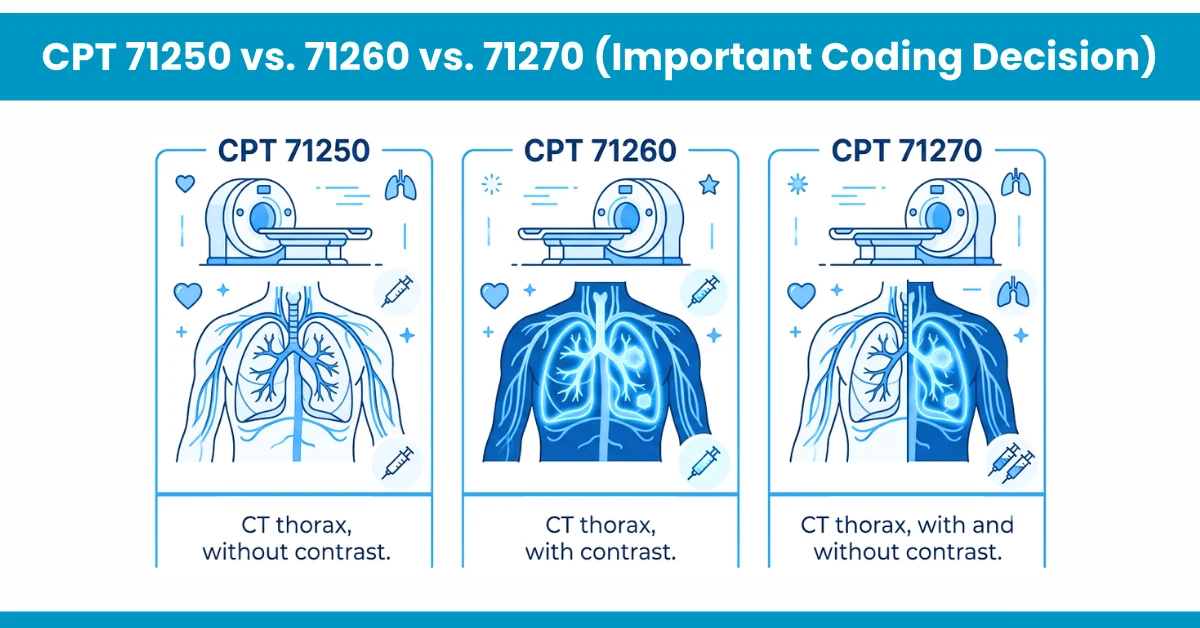
These three codes are mutually exclusive within the same imaging session and differ solely by contrast status:
Important rule:
If contrast is administered, billing 71250 is a coding error that triggers corrected claim requests or outright denial. The radiology report must explicitly state “without IV contrast” for the code to survive payer audit.
This is one of the most overlooked but clinically important areas in radiology billing.
Patients with:
They are often not eligible for iodinated contrast imaging due to the risk of kidney damage.
Relevant ICD-10 Codes:
|
ICD-10 Code |
Description |
|
E11.22 |
Type 2 diabetes with diabetic chronic kidney disease. |
|
E11.29 |
Type 2 diabetes with other diabetic kidney complications. |
|
N18.3 |
Chronic kidney disease, stage 3. |
|
N18.4 |
Chronic kidney disease, stage 4. |
|
N18.6 |
End-stage renal disease. |
|
E11.9 |
Type 2 diabetes mellitus without complications. |
|
J18.9 |
Pneumonia, unspecified. |
|
R91.1 |
Solitary pulmonary nodule. |
|
J84.10 |
Pulmonary fibrosis, unspecified. |
Metformin documentation note
If a future scan involves contrast (71260/71270), Metformin may require temporary discontinuation due to lactic acidosis risk. Proper documentation helps avoid payer confusion during retrospective review.
HelloMDs endocrinology billing services and medical coding services are built around exactly these nuances, coding accurately for high-risk patient populations where one missed detail triggers a denial.
Radiology practices use this code across a wide range of diagnostic scenarios:
Important Screening distinction:
For Medicare lung cancer screening, use:
Using the wrong code leads to automatic denial because screening and diagnostic CT fall under separate benefit rules.
Understanding adjacent HCPCS codes helps coders avoid misapplication and strengthens claims accuracy:
Knowing why these HCPCS codes do not apply to 71250 is as important as knowing which codes do. Accidental pairing of Q9967 or A9698 with a 71250 claim signals a documentation mismatch and invites payer scrutiny.
Modifiers provide the billing context payers require, especially for component billing:
Global billing applies when one entity provides both the scan and the interpretation, common in office settings (POS 11). In hospital outpatient settings (POS 22), the facility and physician bill separately.
Most CPT 71250 denials are preventable:
HelloMDs’ denial management services catch these issues before submission, not after. Our team’s 99% first-pass ratio reflects front-end coding accuracy across radiology and diagnostic imaging claims.
The answer depends entirely on the payer.
Key rule:
Even when prior authorization is not required, medical necessity documentation is always required. Medicare can deny a chest CT claim that lacks a clear clinical justification in the ordering provider’s notes, regardless of whether a PA was obtained.
HelloMDs prior authorization services manage payer-specific requirements across all 56 U.S. states and territories, removing this administrative burden from your clinical staff.
The 2026 CMS Physician Fee Schedule applied an efficiency adjustment to non-time-based diagnostic codes, affecting 71250’s
RVU values:
These are approximate national averages. Actual payments vary by Geographic Practice Cost Index (GPCI), place of service, facility vs. non-facility designation, and OPPS vs. MPFS payment systems. Commercial insurers typically contract at 120–160% of Medicare baseline. Practices in Advanced APMs may see higher rates under the 2026 Dual Conversion Factor structure.
Healthcare billing in 2026 is becoming more automated and strict.
Key trends:
This means documentation quality now directly impacts reimbursement speed.
These trends make front-end accuracy, correct codes, tight documentation, and proactive prior authorization more important than ever. HelloMDs RCM healthcare services and diagnostic radiology billing teams are built to stay ahead of these changes, not react to them.
CPT code 71250 is straightforward by definition but complex in execution. Accurate non-contrast chest CT billing requires the right code, the right ICD-10 pairing, the right modifiers, air-tight documentation, and awareness of which HCPCS codes apply, or deliberately do not apply. For diabetic patients and those with renal disease, it is also a clinically critical distinction, not just a billing one.
If your practice is experiencing denials on chest CT claims or your documentation workflows aren’t keeping pace with 2026 payer scrutiny, HelloMDs is ready to help. From medical coding services and denial management to full revenue cycle management, our AAPC-certified team handles it end-to-end.
Follow us on Facebook and Instagram for billing updates.
We’ve written this guide to help you understand CPT 71250 in a simple way. However, billing rules and insurance policies can change, so always double-check with official CPT manuals, CMS updates, or your billing expert before using this information for claims. Images/visuals are AI-generated or for illustration only and may not reflect real-life accuracy.