
A clean claim today can turn into a denied claim on October 28, 2026, not because your coding changed, but because CMS changed the rules underneath it. The Centers for Medicare & Medicaid Services has added eight HCPCS codes, covering wheelchairs, spinal orthoses, upper-extremity orthoses, and pressure-relief beds, to its Required Prior Authorization List and Required Face-to-Face Encounter and WOPD List. If your practice or DME operation bills any of these codes, here’s exactly what changed, when it takes effect, and how to keep claims moving.
CMS updated its DMEPOS prior authorization program twice in 2026: Once effective April 13, and again effective October 28. Both updates add codes to the Required Prior Authorization List and the Required Face-to-Face Encounter and Written Order Prior to Delivery (WOPD) List, and CMS also finalized a new exemption process for high-performing suppliers.
These lists are part of a broader framework called the CMS Master List, established under 42 CFR 414.234, to flag DME items with a history of fraud, overuse, or improper payments. The October wave is the larger change for most orthotic and mobility-device suppliers; six codes now apply nationwide, and two more begin a phased, state-by-state rollout.
The Master List is CMS’s full library of DMEPOS codes that could be subject to prior authorization or F2F/WOPD requirements; it’s a watch list, not an active requirement on its own. The Required Prior Authorization List and Required Face-to-Face Encounter and WOPD List are the two narrower lists that pull specific codes off the Master List and make the requirement mandatory.
A code can sit on the Master List for years without ever triggering a requirement. Confusing the two is one of the more common DME prior authorization documentation gaps that HelloMDs finds during new-client billing audits. A team checks the wrong list and misses a requirement that’s already active. As of mid-2026, the Master List holds more than 500 items; only a fraction require prior authorization or WOPD at any given time.
For items on the Required Face-to-Face Encounter and WOPD List, the treating practitioner must document an in-person encounter with the beneficiary within the six months before the written order, and the supplier must have that complete order in hand before delivering the item. This applies on top of, not instead of, prior authorization for codes on both lists.
The practitioner who performs the encounter doesn’t have to be the one who signs the order but whoever signs it must confirm the encounter happened inside that six-month window and keep documentation on file. Office visits billed under CPT 99202-99215 are the most common way practices document this encounter. A missing or late-dated WOPD is a medical necessity denial waiting to happen, even when the prior authorization itself was approved.
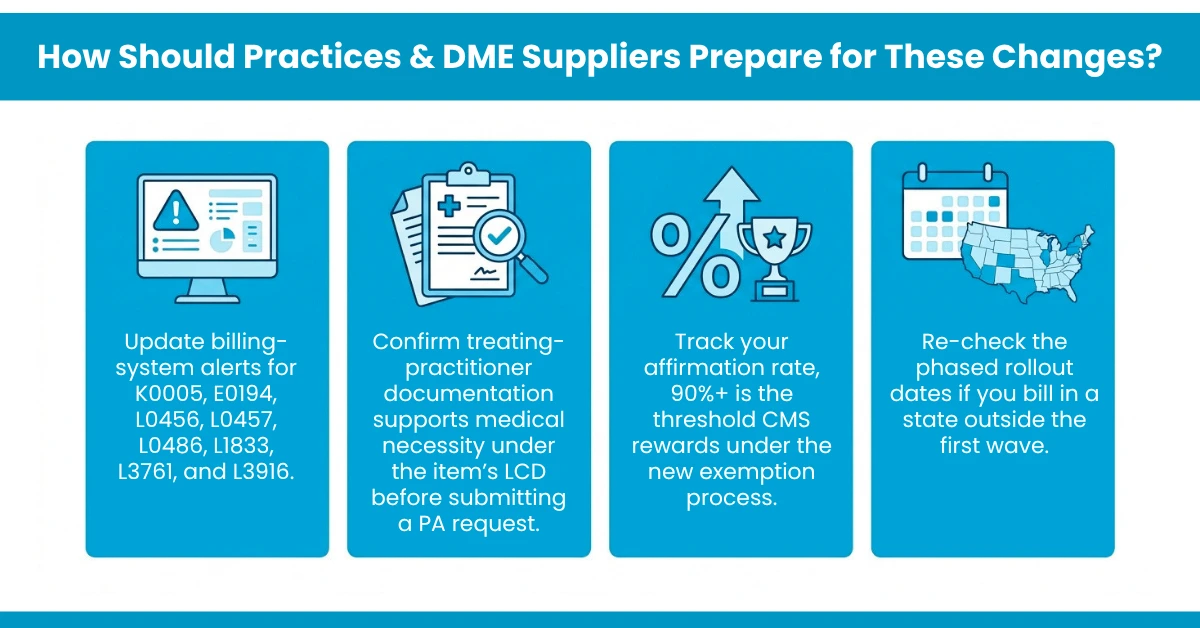
Six codes require both prior authorization and a face-to-face WOPD nationwide starting October 28, 2026: K0005, E0194, L0456, L0457, L0486, and L1833. Two more: L3761 and L3916 are beginning a phased rollout the same day in New York, Michigan, Florida, and California.
HCPCS Code | Item | Requirement | Effective Date |
K0005 | Ultra-lightweight manual wheelchair | PA + Face-to-Face/WOPD | 10/28/2026, nationwide |
E0194 | Air fluidized bed | PA + Face-to-Face/WOPD | 10/28/2026, nationwide |
L0456 | TLSO, flexible, prefabricated (customized) | PA + Face-to-Face/WOPD | 10/28/2026, nationwide |
L0457 | TLSO, flexible, prefabricated (off-the-shelf) | PA + Face-to-Face/WOPD | 10/28/2026, nationwide |
L0486 | TLSO, triplanar control, custom-fabricated | PA + Face-to-Face/WOPD | 10/28/2026, nationwide |
L1833 | Knee orthosis, adjustable, prefabricated (off-the-shelf) | PA + Face-to-Face/WOPD | 10/28/2026, nationwide |
L3761 | Elbow orthosis, adjustable locking joint (off-the-shelf) | PA + Face-to-Face/WOPD | 10/28/26 (NY, MI, FL, CA) → nationwide 4/26/2027 |
L3916 | Wrist-hand orthosis, nontorsion joint (off-the-shelf) | PA + Face-to-Face/WOPD | 10/28/26 (NY, MI, FL, CA) → nationwide 4/26/2027 |
L3761 and L3916 add a second wave: Pennsylvania, Massachusetts, Ohio, Illinois, Texas, Georgia, Arkansas, and Oregon, on January 26, 2027, before going nationwide that April.
Medical necessity documentation should map to each item’s Local Coverage Determination. As a starting point, qualifying diagnoses generally fall under: mobility-limiting conditions (ICD-10 G80-G83, M17-M19) for K0005; spinal instability or deformity (M43, M48, S32) for the TLSO codes; joint or fracture diagnoses (M25, S52, S62) for L3761/L3916; and Stage 3-4 pressure injury (L89, by site and stage) for E0194. Confirm the exact code against the current LCD before submitting.
Yes, under CMS-1828-F, finalized December 2, 2025, DME suppliers with a provisional affirmation rate of 90% or higher can qualify for a prior authorization exemption on eligible codes. CMS notifies qualifying suppliers through the DME MAC, and the first exemption cycle begins June 1, 2026, renewing annually.
Exemption isn’t automatic or permanent; suppliers can opt out, and CMS can withdraw exemption status with at least 60 days’ notice if performance drops. For most practices, the more realistic path to fewer denials is a documentation process that hits a high affirmation rate in the first place, which comes down to clean coding and complete WOPD files.
Start by flagging the eight codes above in your EMR or billing system, so no claim goes out for a date of service on or after October 28, 2026 without a prior authorization and WOPD on file. Then audit any patient already scheduled for one of these items to confirm the encounter and order both fall inside the six-month window.
HelloMDs’ DME accreditation and denial management teams build updates like these into client billing systems directly, so practices aren’t tracking Federal Register notices on top of patient care.
Eight codes changing at once is exactly the kind of update that slips past a busy front office. HelloMDs’ AAPC-certified coders, the same team behind our 99% first-pass claim ratio, track every Required Prior Authorization List and WOPD List change and build it into your claims before it costs you a denial.
Schedule a free billing audit and see where your DME claims stand ahead of October 28.
This article reflects CMS guidance as of August 2026 and is for informational purposes only; it isn’t legal or compliance advice. Confirm code-specific requirements with your MAC or compliance officer before submitting claims.