
Aetna won dismissal of the claims against it in the Zelis repricing antitrust case on September 30, 2026. For healthcare providers, the bigger concern is how insurance companies and third-party vendors calculate out-of-network payments and what to do when a payment seems too low.
The ruling does not prove that every repricing arrangement is unlawful, and it does not mean providers are automatically owed more money. But it highlights why practices need a reliable way to check payments and investigate possible medical billing underpayments.
Healthcare providers sued Zelis and several insurers, alleging that certain repricing arrangements helped reduce payments for out-of-network services.
On September 30, U.S. District Judge Brian E. Murphy dismissed the claims against Aetna. The court found that the latest complaint did not adequately show that Aetna used the specific Zelis tools at issue or plausibly connect Aetna to the alleged conspiracy.
This was a decision about whether the complaint made a sufficient legal case against Aetna. It was not a finding that every allegation in the wider lawsuit was false. The order also allowed plaintiffs to seek permission to amend their complaint.
You can read the federal court’s September 30 order for the court’s reasoning.
Insurance claim repricing happens when an insurer or a third-party vendor reviews a billed charge and calculates or recommends a different payment amount. The process can involve repricing companies or third-party administrators, depending on the payer’s arrangements.
In this case, the providers alleged that certain third-party claims repricing arrangements reduced out-of-network reimbursement unfairly. These remain allegations in the broader dispute, not proof that all repricing is improper.
A lower payment does not automatically mean an insurer has underpaid a claim. The correct amount depends on the applicable contract, plan terms, reimbursement method, and relevant legal requirements. Providers should check those details before deciding whether to challenge a payment.
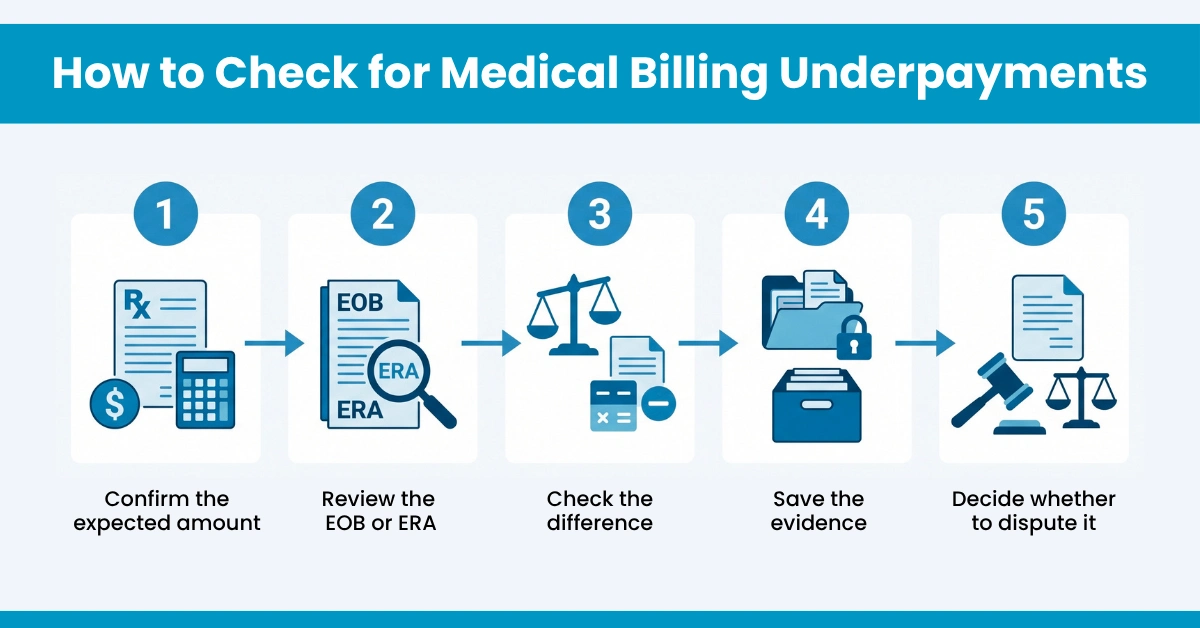
When a payment looks lower than expected, start by comparing what the practice believes it should receive with what the insurer actually paid.
Use this checklist:
Accurate payment posting helps billing teams record insurer payments, reconcile adjustments, and flag discrepancies that need further review.
Situation | What it means |
Claim denial | The insurer has refused payment, and the reason needs to be reviewed. |
Possible underpayment | The payment appears lower than the amount supported by the applicable reimbursement terms. |
Contractual adjustment | The practice reduces the charge according to the applicable contract or other valid requirement. |
This distinction matters. A payment reduction may be correct, so teams should verify the reimbursement terms before treating the difference as recoverable revenue.
Consider a simple example: a practice expects $800 under its applicable reimbursement arrangement but receives $620. The $180 difference is a reason to investigate not proof that the insurer owes the practice $180.
The billing team should review the remittance details, confirm the payment basis, and contact the payer or submit a dispute if the evidence supports it. It should also record the outcome so the same issue can be identified if it happens again.
Avoid three common mistakes:
If the issue involves a denial or a disputed claim, a structured denial management process can help teams investigate the reason, organize supporting records, and manage follow-up.
The Aetna decision does not automatically change reimbursement rules or give providers a new right to recover money. Its practical lesson is simpler, practices should understand how they are paid and investigate unexplained differences instead of assuming that every reduction is correct or that every reduction is unlawful.
Consistent payment reviews, clear documentation, and timely follow-up can help practices identify underpaid medical claims and decide which cases warrant further action. Tracking repeated discrepancies by payer, service, and adjustment reason may also help billing managers spot patterns that deserve attention.
For practices that need help reviewing payments and following up on outstanding balances, HelloMDs provides medical accounts receivable services.
The next step for providers is straightforward: check the reimbursement terms, compare them with the actual payment, document any difference, and challenge it only when the evidence supports doing so.
We researched this article using the court order, Georgetown Law’s Health Care Litigation Tracker, Becker’s Payer Issues, and Law360. Legal claims are based on these sources. We used limited AI assistance for research and content enhancement. Images are AI-generated.