
A quote can look cheap and still cost you more than you budgeted. So the real question isn’t only how much a medical billing company charge. It’s what that number covers, what gets billed on top, and whether your collections actually improve.
Most practices start with the percentage. Makes sense. But it’s one piece of the picture.
Four common setups:
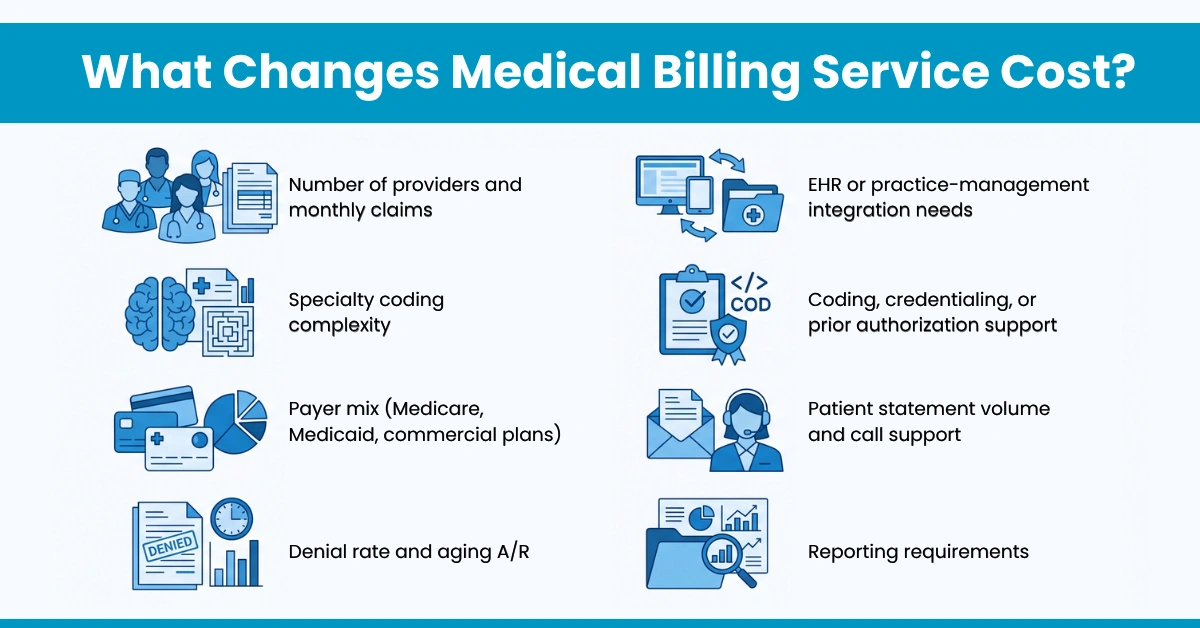
Public pricing guides tend to put full-service outsourced billing between 4% and 10%. Where you land in that range, in terms of medical billing company pricing, comes down to your specialty, claim volume, payer mix, how many denials you’re already sitting on, and what’s in the package.
Cheap isn’t always cheap. Say one vendor quotes 4% and then adds charges for patient statements, credentialing, software, appeals, and cleanup of old A/R. A second vendor quotes 6% and includes every bit of that. The second one may well be your lower medical billing company cost. You won’t know from the headline.
Billing companies lean on a few medical billing pricing models, and they don’t fit every practice equally. Here’s the medical billing fee structure side by side.
|
Pricing model |
How it works |
Best fit |
What to ask |
|
Medical billing percentage of collections |
The company keeps an agreed share of whatever gets collected. |
Practices that want costs to move with revenue. |
Is the percentage taken from net collections, gross charges, insurance payments, or patient payments? |
|
Per claim medical billing fee |
You pay a set amount for every claim submitted or processed. |
High-volume practices with predictable claim counts. |
Do corrected, denied, secondary, and appealed claims cost extra? |
|
Flat fee medical billing |
One fixed amount each month. |
Practices with steady volume and a clear scope. |
Does the contract cap claims, providers, or follow-up work? |
|
Hybrid model |
A base fee plus a percentage or per-claim charge. |
Growing practices that want steadier spending. |
How is the final monthly charge worked out? |
With percentage based medical billing, the vendor only wins when you win. That’s a fair setup. The catch is the word collections, which the contract defines, not you. A medical billing company percentage of 5% on gross charges can end up costing more than 6% on net collections. Odd, but true.
Per-claim pricing makes budgeting easy. It also hides something. If the vendor earns the same whether a claim pays or gets kicked back, what pushes them to chase the denial? Ask how they treat resubmissions, appeals, and underpayments. Ask before signing.
There’s no official national rate, by the way. Published guides from software platforms and billing companies show wide ranges, and Tebra’s medical billing cost guide says the same: pricing moves with specialty, claim volume, payer mix, and how much work is included.
A small family practice with clean claims and steady patient flow might only need claim submission, payment posting, and A/R follow-up. Cardiology, orthopedics, behavioral health, home health? Different story. You’re looking at heavier coding support, prior authorization work, modifier review, payer follow-up, and a steady stream of appeals.
What usually moves the average cost of medical billing services:
Use the average medical billing company fees you see online to get oriented. Then get a quote built around your own numbers.
|
Service |
Question to ask the billing company |
|
Is coverage checked before every visit, or only when we ask? |
|
|
Coding and charge entry |
Does the fee include coding review, modifier checks, and charge entry? |
|
Claim scrubbing |
Who catches payer edits before a claim leaves your system? |
|
How are ERAs, EOBs, adjustments, and denials posted, and who checks that work? |
|
|
Are corrections, appeals, and root-cause analysis part of the deal? |
|
|
Who actually works claims sitting at 60, 90, and 120+ days? |
|
|
Patient billing |
Will your team send statements, take patient calls, and set up payment plans? |
|
Reporting |
Can we see denial, collections, clean-claim, and A/R reports, and how often? |
Eligibility, coding, posting, denials, A/R. Each one changes what lands in your bank account, and this guide on types of medical billing shows how.
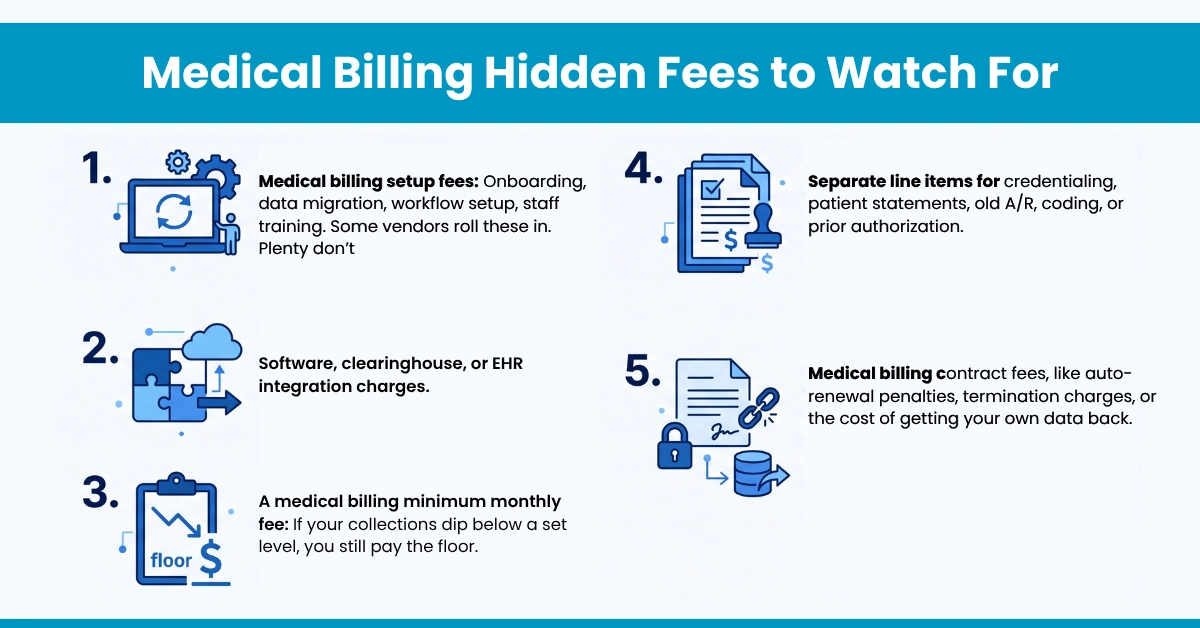
That advertised rate? It’s rarely the whole bill. Ask for every medical billing hidden fee in writing, itemized, before you sign anything.
Here’s where medical billing additional fees usually hide:
One more thing. Any vendor touching protected health information needs real HIPAA safeguards and a signed Business Associate Agreement. No exceptions. HHS explains the business associate role in billing and claims administration in its official guidance.
Don’t compare on percentage alone. Compare the all-in number.
Effective Billing Rate = Total Annual Billing Cost ÷ Total Annual Collections
Picture a practice collecting $100,000 a month. A vendor quotes 5%, so $5,000. Fine. Then come the extras: $500 for software, $400 for patient statements, $1,500 for onboarding, and appeal fees on top. Suddenly that 5% isn’t 5% anymore.
That’s the clearest way to see the cost of outsourcing medical billing. Add every projected charge, divide by expected collections, and you’ve got a figure you can actually use for medical billing outsourcing pricing.
Run the same math on in-house. Salary, benefits, payroll taxes, software, training, turnover, management time, and who covers when someone calls in sick. The Bureau of Labor Statistics posts wage data for medical records specialists in its Occupational Outlook Handbook. Treat it as context. It’s not a universal biller salary.
Depends on the practice. But if denials keep climbing, A/R keeps aging, turnover keeps breaking your claim flow, or nobody on staff knows the billing quirks of your specialty, is medical billing outsourcing worth the cost? Often, yes.
Same goes when your team spends the day chasing unpaid claims instead of helping patients. Or when a single person runs all of billing and there’s no backup if they leave.
In-house still works for some groups, though. A seasoned team, clean workflows, good reporting, and enough volume to justify dedicated staff can make it a smart choice. Home health agencies can weigh the tradeoffs in this HelloMDs guide to in-house vs. outsourced home health billing costs.
HelloMDs doesn’t run copy-and-paste accounts. A useful quote should reflect your specialty, payer mix, claim volume, A/R condition, denial patterns, and the services you need.
HelloMDs currently states that plans start at 2.95% of monthly collections. Whatever final quote you get, it should spell out what that rate includes, what it leaves out, and how the team supports your billing workflow.
A low rate isn’t what makes a good billing partner. Look for one that explains its fees, shows you what you’re getting, works the unpaid claims, and gives you clear reporting. To explore billing, coding, denial management, A/R follow-up, and RCM support, visit HelloMDs.
This article provides general educational information about medical billing pricing. Actual fees, reimbursement rules, payer requirements, and service scope vary by specialty, claim volume, payer mix, location, and contract terms. Consult qualified billing, legal, compliance, or financial professionals before making business decisions.