
RCM

RCM Company Selection Guide 2026: Choose the Right Partner

Home / RCM Company Selection Guide

If your practice loses $50,000 to $100,000 every year because of denied claims and slow payments, you need to rethink your RCM company selection. The truth is that most medical practices struggle with a 20-30% denial rate and wait 60-90 days just to get paid. This doesn’t have to be your reality. Here’s how to pick an RCM company that actually fixes these problems for good. This guide is built on real experience helping practices just like yours improve their financial health.

The Real Cost of a Bad RCM Company Selection Decision

Let’s look at the numbers. When your revenue cycle management is not working, money leaks out of your practice in ways you might not even realize:

Problem

Industry Standard

What It Costs You

High denial rate

20-30% of all claims

$20,000 to $50,000 per month in unpaid claims

Slow payments

60-90 days in A/R

$10,000 to $30,000 per month in delayed cash flow

Billing mistakes

10-15% of claims

$10,000 to $20,000 per month in corrections

Hidden fees

4-8% of collections

$5,000 to $15,000 per year in unexpected expenses

For a practice billing $200,000 a month, improving your clean claim rate by just 1% means an extra $2,000 to $5,000 in revenue every month. That’s not small change, that’s the difference between struggling and thriving.

Source: MGMA 2026 Revenue Cycle Management Report

What to Look for in an RCM Company: The 5 Non-Negotiables

When evaluating an RCM company, focus on these five critical factors:

What to Look For

Why It Matters

Industry Standard

How to Check

Clean claim rate

Shows how many claims get paid first try

Around 85%

Ask for specialty-specific numbers

Days in A/R

How quickly you’ll get paid

60-90 days

Request their average for your practice size

Denial resolution time

How fast they fix problems

5-14 days

Ask for their service level agreement

Pricing transparency

Whether you’ll face surprise fees

4-8% + setup costs

Get a full price breakdown in writing

Contract flexibility

Whether you’re locked in long-term

1-3 year contracts

Read the termination clause carefully

If a company can’t provide clear, direct answers on these points, they’re not the right fit for your RCM company. Learn how medical billing services can transform your revenue cycle today.

How to Evaluate an RCM Company: A Simple 3-Step Process

Step 1: Assess Your Current Performance

Before you can improve, you need to understand where you stand. Pull your numbers for the last three months and calculate:

  • Your denial rate: (Number of denied claims ÷ Total claims submitted) × 100
  • Your average days in A/R: (Total value of outstanding claims ÷ Average daily charges)
  • Your top denial codes: Which ones keep appearing?

Here’s how most practices compare to where they should be:

Metric

Where You Probably Are

Where You Should Be

Denial rate

20-30%

Under 10%

Days in A/R

60-90

Under 45

Clean claim rate

80-85%

Over 90%

If your numbers are worse than they should be column, you’re leaving money on the table. A good RCM company should help you reach these targets within 90 days.

Step 2: Define Your Must-Haves

Every practice has different needs. Here’s what most successful practices prioritize to choose RCM company:

  1. A clean claim rate of at least 90%
  2. Days in A/R under 45
  3. Denial resolution in under 72 hours
  4. Clear, upfront pricing with no hidden fees
  5. A flexible contract that lets you exit if needed
  6. Experience with your specific specialty
  7. Dedicated support that knows your practice
  8. Seamless EHR integration

Step 3: Ask the Right Questions

When talking to potential partners, don’t just listen to their pitch. Ask these five critical questions for selecting RCM company:

  1. What’s your clean claim rate for practices in my specialty?
  2. What’s your average days in A/R for practices my size?
  3. How quickly do you resolve denied claims?
  4. What exactly does your pricing include? Are there additional fees?
  5. Can I speak to a current client in my specialty?

Discover how denial management services can directly impact your clean claim rate and revenue.

The RCM Performance Metrics That Really Matter

Not all numbers are equal. When evaluating an RCM company, focus on these five performance metrics:

1. Clean claim rate

This is the percentage of claims paid on the first submission. The industry average is around 85%. For a practice billing $200,000 a month, each 1% improvement means $2,000-$5,000 more in revenue.

2. Days in accounts receivable (A/R)

This tells you how long it takes to get paid. Most practices wait 60-90 days. The best RCM companies can reduce this to 30-45 days.

3. Denial rate

This shows the percentage of claims rejected. The industry average is 20-30%. Every 1% reduction saves $1,000-$3,000 monthly.

4. Net collection rate

This indicates what percentage of owed money you actually collect. Most practices achieve 95-98%. The top performers hit 98-99%.

5. Denial resolution time

This measures how quickly a company fixes and resubmits denied claims. The industry average is 5-14 days. The best do it in 48 hours or less.
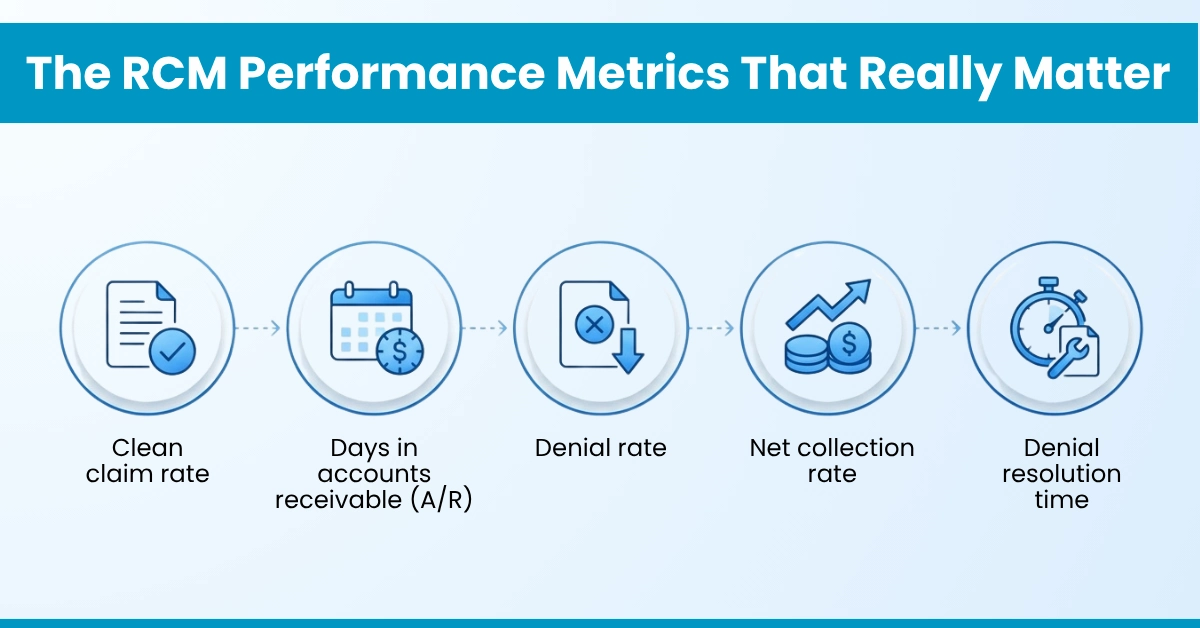
The RCM Performance Metrics That Really Matter

RCM Pricing and Contracts: What You Need to Watch For

RCM companies use different pricing models. Here’s how they compare:

Pricing Model

How It Works

The Good

The Bad

Percentage of collections

% of what they collect

Costs scale with your revenue

Can get expensive as you grow

Per-claim fee

Fixed fee per claim

Predictable costs

May encourage volume over quality

Flat monthly fee

Fixed monthly rate

Easy budgeting

Doesn’t scale with your practice

Watch out for these red flags in RCM contracts:

  • Long-term commitments (over one year)
  • Hidden fees (setup costs, minimums, etc.)
  • No performance guarantees
  • No clear termination clause

Compliance and Technology: The Non-Negotiables for RCM Company Selection

HIPAA Compliance

This isn’t optional. Violations can cost $100-$50,000 per incident. Ensure your RCM company has:

  • A signed Business Associate Agreement
  • Data encryption (at rest and in transit)
  • Audit-ready processes
  • Regular HIPAA training for staff

Source: HHS HIPAA Guidelines

EHR Integration

Your RCM company must work seamlessly with your existing system. Otherwise, you’ll waste time on manual data entry. Look for:

  • Direct integration with your EHR
  • No manual data entry
  • Real-time synchronization

Automation and Technology
The best RCM companies use technology to reduce errors and speed up processes:

  • Automated claim scrubbing
  • Real-time eligibility verification (using 270/271 transactions)
  • Denial prediction tools

The 5 RCM Company Selection Mistakes That Cost Practices Big Money

Over the years, I’ve seen practices make the same costly mistakes when choosing an RCM company. Here are the five most expensive ones:
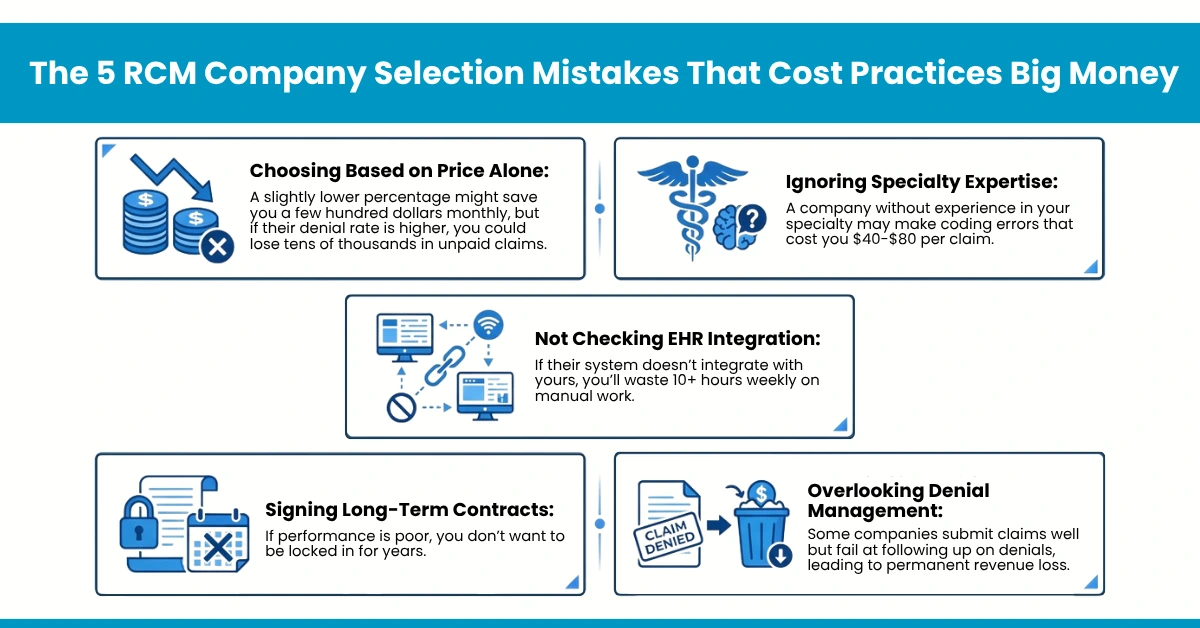
  1. Choosing Based on Price Alone: A slightly lower percentage might save you a few hundred dollars monthly, but if their denial rate is higher, you could lose tens of thousands in unpaid claims.
  2. Ignoring Specialty Expertise: A company without experience in your specialty may make coding errors that cost you $40-$80 per claim.
  3. Not Checking EHR Integration: If their system doesn’t integrate with yours, you’ll waste 10+ hours weekly on manual work.
  4. Signing Long-Term Contracts: If performance is poor, you don’t want to be locked in for years.
  5. Overlooking Denial Management: Some companies submit claims well but fail at following up on denials, leading to permanent revenue loss.

The 5 RCM Company Selection Mistakes That Cost Practices Big Money

Conclusion

Now that you know what to look for, start by evaluating your current revenue cycle management performance. Use the metrics and framework in this guide to compare potential partners. Ask the tough questions, and don’t settle for vague answers.

The right RCM company can transform your practice’s financial health. The wrong one can cost you dearly.

Disclaimer:

This guide is for informational purposes only. All data is sourced from MGMA, CMS, and HHS. AI assisted with research, editing, and writing. All images are AI-generated for illustration purposes.

Frequently Asked Questions

The best fit offers transparent pricing, flexible contracts, dedicated support, specialty expertise, and a proven clean claim rate.

Most charge either a percentage of collections (2-8%), a per-claim fee ($3-$10), or a flat monthly rate ($500-$5,000). For a $200,000 practice, 4% costs $8,000/month, while 2.95% costs $5,900, saving $2,100/month.

You’ll see reduced denials and faster submissions within 30 days. Improved cash flow appears in 60-90 days, with a 20-30% revenue increase after six months.

Look for clear terms (month-to-month or short-term), no hidden fees, performance guarantees, and a reasonable termination clause (30 days or less).

Leave a Reply

Your email address will not be published. Required fields are marked *

RCM Company Selection Guide 2026: Choose the Right Partner

An RCM Company is the backbone of your medical practice’s financial health, yet many providers settle for subpar performance that drains their bottom line. If your practice loses $50,000 to $100,000 every year because of denied claims and slow payments, you need to rethink your current strategy. The truth is that most medical practices struggle with a 20-30% denial rate and wait 60-90 days just to get paid. This doesn’t have to be your reality. Here’s how to pick an RCM company that actually fixes these problems for good. This guide is built on real experience helping practices just like yours improve their financial health.

The Real Cost of a Bad RCM Company Selection Decision

Let’s look at the numbers. When your revenue cycle management is not working, money leaks out of your practice in ways you might not even realize. For a practice billing $200,000 a month, improving your clean claim rate by just 1% means an extra $2,000 to $5,000 in revenue every month. That’s not small change; that’s the difference between struggling and thriving.

According to the Medical Group Management Association (MGMA), maintaining high operational standards is the primary differentiator between profitable practices and those facing insolvency. When you choose an this procedure, you are essentially outsourcing your cash flow management to an external entity, making the selection process a high-stakes business decision.

What to Look for in an this procedure: The 5 Non-Negotiables

When evaluating an RCM company, focus on these five critical factors to ensure you are getting the best value for your investment:

  • Clean claim rate: This shows how many claims get paid on the first try. Aim for a provider that consistently hits 90% or higher.
  • Days in A/R: This metric dictates how quickly you’ll get paid. The industry standard is 60-90 days, but top-tier partners keep this under 45 days.
  • Denial resolution time: How fast do they fix problems? A professional partner should resolve issues within 5-14 days.
  • Pricing transparency: Avoid hidden fees by demanding a full price breakdown in writing.
  • Contract flexibility: Avoid being locked into long-term, multi-year contracts that prevent you from switching if performance dips.

If a company can’t provide clear, direct answers on these points, they’re not the right fit for your practice. Learn how medical billing services can transform your revenue cycle today.

How to Evaluate an this procedure: A Simple 3-Step Process

Step 1: Assess Your Current Performance

Before you can improve, you need to understand where you stand. Pull your numbers for the last three months and calculate your denial rate, average days in A/R, and identify your top denial codes. If your numbers are worse than the industry benchmarks, you are leaving significant money on the table.

Step 2: Define Your Must-Haves

Every practice has different needs. Successful practices prioritize specific requirements when they choose an this procedure. These include seamless EHR integration, dedicated account support, and deep experience within your specific medical specialty.

Step 3: Ask the Right Questions

When talking to potential partners, don’t just listen to their pitch. Ask for their clean claim rate for practices in your specific specialty and request to speak to a current client. Transparency is the hallmark of a high-quality this procedure.

The RCM Performance Metrics That Really Matter

Not all numbers are equal. When evaluating an this procedure, focus on these five performance metrics to gauge their effectiveness:

  1. Clean claim rate: The percentage of claims paid on the first submission.
  2. Days in accounts receivable (A/R): The average time it takes to receive payment.
  3. Denial rate: The percentage of claims rejected by payers.
  4. Net collection rate: The percentage of owed money you actually collect.
  5. Denial resolution time: The speed at which a company fixes and resubmits denied claims.

RCM Pricing and Contracts: What You Need to Watch For

RCM companies use different pricing models, including percentage of collections, per-claim fees, or flat monthly rates. Each has pros and cons. Watch out for red flags in RCM contracts such as long-term commitments, hidden setup costs, and a lack of performance guarantees. Always ensure your contract includes a clear termination clause.

Also read: Explore our complete guide on RPM Services for Physician Practices.

Compliance and Technology: The Non-Negotiables

HIPAA compliance is non-negotiable. Violations can cost your practice between $100 and $50,000 per incident. Ensure your this procedure has a signed Business Associate Agreement, robust data encryption, and regular staff training. Furthermore, your partner must offer seamless EHR integration to prevent manual data entry errors. The best RCM companies leverage automation for claim scrubbing and real-time eligibility verification.

The 5 this procedure Selection Mistakes That Cost Practices Big Money

Over the years, I’ve seen practices make the same costly mistakes when choosing an RCM company. First, choosing based on price alone often leads to higher denial rates. Second, ignoring specialty expertise can lead to coding errors. Third, failing to verify EHR integration creates massive administrative burdens. Fourth, signing long-term contracts traps you in poor service. Finally, overlooking denial management processes leads to permanent revenue loss.

Conclusion

Now that you know what to look for, start by evaluating your current revenue cycle management performance. Use the metrics and framework in this guide to compare potential partners. Ask the tough questions, and don’t settle for vague answers. The right this procedure can transform your practice’s financial health, while the wrong one can cost you dearly.

Visual Walkthrough: this procedure In-Depth Analysis

Frequently Asked Questions

What’s the best RCM company for small practices?
The best fit offers transparent pricing, flexible contracts, dedicated support, specialty expertise, and a proven clean claim rate.

How much does an this procedure cost?
Most charge either a percentage of collections (2-8%), a per-claim fee ($3-$10), or a flat monthly rate ($500-$5,000).

How long does it take to see results from an this procedure?
You’ll see reduced denials and faster submissions within 30 days. Improved cash flow appears in 60-90 days, with a 20-30% revenue increase after six months.

What should I look for in an RCM contract?
Look for clear terms (month-to-month or short-term), no hidden fees, performance guarantees, and a reasonable termination clause (30 days or less).

×

Request a Free Consultation