If you’re coding for cognitive assessment and care plan services, you need to know about the significant changes that came into effect on Jan 15, 2026. The CMS has expanded the list of ICD-10 codes for dementia that support medical necessity for CPT 99483, giving healthcare providers more specific options to document severity levels, behavioral manifestations, and underlying causes of cognitive impairment.
This update directly impacts how you bill for cognitive assessment care plan billing and can make the difference between claim approval and denial. This guide breaks down what’s new, why it matters for your practice revenue cycle, and how to implement these changes accurately for denial prevention and CMS billing compliance.
CMS R7 Update in Dementia Coding: What Changes You Expect
The 2026 R7 update brings greater specificity for documenting dementia. Previously, code options were limited for severity and behavioral symptoms. Now you can fully reflect patient’s clinical condition.
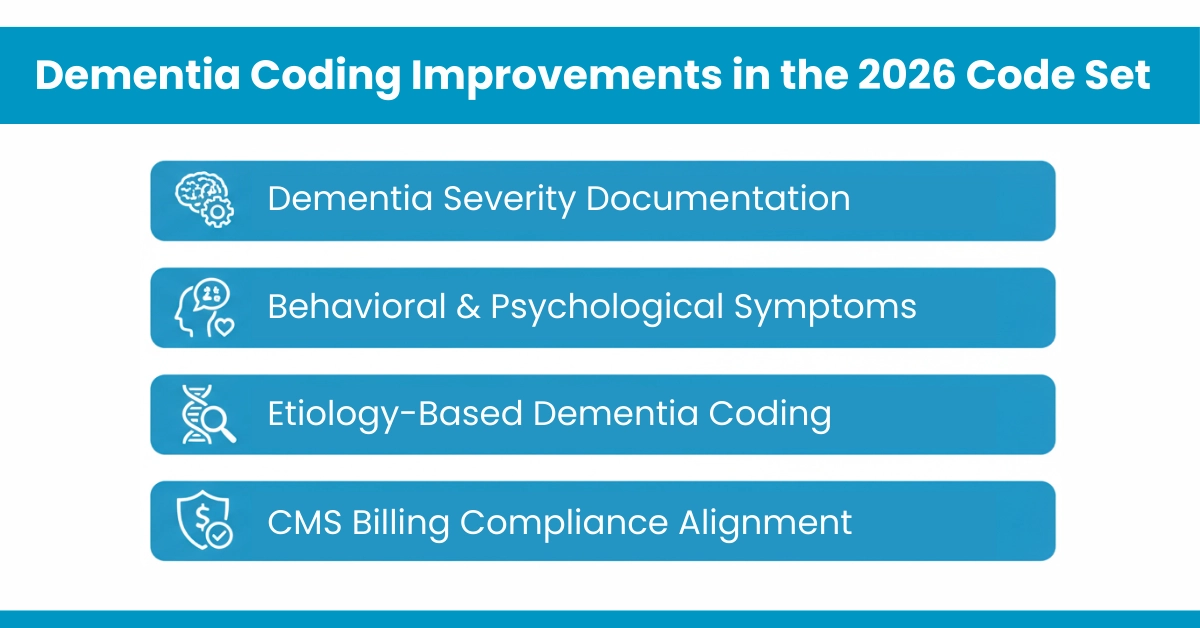
Key Improvements in the 2026 Code Set
Dementia Severity Documentation: Dementia can now be clearly coded as mild, moderate, or severe, aligning with clinical progression.
Behavioral & Psychological Symptoms: Codes specify agitation, psychosis, mood disturbance, anxiety, and other behavioral changes.
Etiology-Based Dementia Coding: New categories support multiple etiology dementia codes, improving accuracy in complex cases.
CMS Billing Compliance Alignment: Updates follow the ICD-10-CM Official Guidelines for Coding and Reporting, reinforcing “code to the highest level of specificity.â€
This added precision strengthens medical necessity documentation, especially for time-intensive services like CPT 99483.
Reminder: While dementia coding focuses on cognitive disorders and care planning, understanding the broader ICD-10 framework is essential for accurate documentation and billing. For example, ICD-10 coding principles for conditions like leukocytosis can help providers ensure compliance and precision across all diagnoses. Learn more about these coding fundamentals in our ICD-10 Leukocytosis guide.
New Payable Dementia ICD-10 Codes List: Effective on April 15
The following CMS payable dementia codes are recognized to support cognitive care plan services and CPT 99483 billing from the 2025 updates (applicable through 2026)
Unspecified Dementia (Severe):
F03.92: Unspecified dementia, severe, with psychotic disturbance
F03.93: Unspecified dementia, unspecified severity, with mood disturbance
F03.94: Unspecified dementia, severe, with anxiety
Major Neurocognitive Disorder (Multiple Etiologies (A Series: Mild)):
F03.A0: Mild, without behavioral/psychotic/mood/anxiety disturbance
F03.A11: Mild, with agitation
F03.A18: Mild, with other behavioral disturbance
F03.A2: Mild, with psychotic disturbance
F03.A3: Mild, with mood disturbance
F03.A4: Mild, with anxiety
Major Neurocognitive Disorder (Multiple Etiologies (B Series: Moderate)):
F03.B0: Moderate, without behavioral/psychotic/mood/anxiety disturbance
F03.B11: Moderate, with agitation
F03.B18: Moderate, with other behavioral disturbance
F03.B2: Moderate, with psychotic disturbance
F03.B3: Moderate, with mood disturbance
F03.B4: Moderate, with anxiety
Major Neurocognitive Disorder (Multiple Etiologies (C Series: Severe)):
F03.C0: Severe, without behavioral/psychotic/mood/anxiety disturbance
F03.C11: Severe, with agitation
F03.C18: Severe, with other behavioral disturbance
F03.C2: Severe, with psychotic disturbance
F03.C3: Severe, with mood disturbance
F03.C4: Severe, with anxiety
These multiple etiology dementia codes close a long-standing documentation gap for patients whose cognitive decline stems from more than one underlying cause.
Alzheimer’s vs Vascular Dementia Coding Guidelines
Understanding the relationship between different dementia types and their ICD-10 codes (2026) is essential for accurate coding. Let’s clarify the specific requirements for two of the most common presentations.
Alzheimer’s Disease Coding Requirements:
Dual coding is mandatory to capture both the underlying disease and the dementia manifestation. This isn’t optional, it’s a requirement for ICD-10 accuracy:
1. First, code the Alzheimer’s disease itself using the appropriate G30 code:
G30.0: Alzheimer’s disease with early onset.
G30.1: Alzheimer’s disease with late onset.
G30.8: Other Alzheimer’s disease.
G30.9: Alzheimer’s disease, unspecified.
2. Then, code the dementia manifestation using the F02 series:
F02.80: Dementia in other diseases classified elsewhere, without behavioral disturbance.
F02.81: Dementia in other diseases classified elsewhere, with behavioral disturbance.
F02.A0 through F02.C4: Specific severity and symptom combinations.
Vascular Dementia Coding Requirements:
Vascular dementia also requires careful attention to coding guidelines. When coding for vascular dementia, you’ll use the F01 series of codes, but there’s an additional requirement: you must also code the underlying vascular condition causing the dementia.
Start with the appropriate F01 code based on severity and symptoms:
F01.50 through F01.54: Unspecified severity with various manifestations
F01.A0 through F01.A4: Mild vascular dementia with various manifestations
F01.B0 through F01.B4: Moderate vascular dementia with various manifestations
F01.C0 through F01.C4: Severe vascular dementia with various manifestations
Then add an additional code for the underlying vascular condition, such as:
I67.2: Cerebral atherosclerosis
I63.xx: Cerebral infarction (specific to location and type)
I69.xx: Sequelae of cerebrovascular disease
I65.xx or I66.xx: Occlusion and stenosis of cerebral arteries
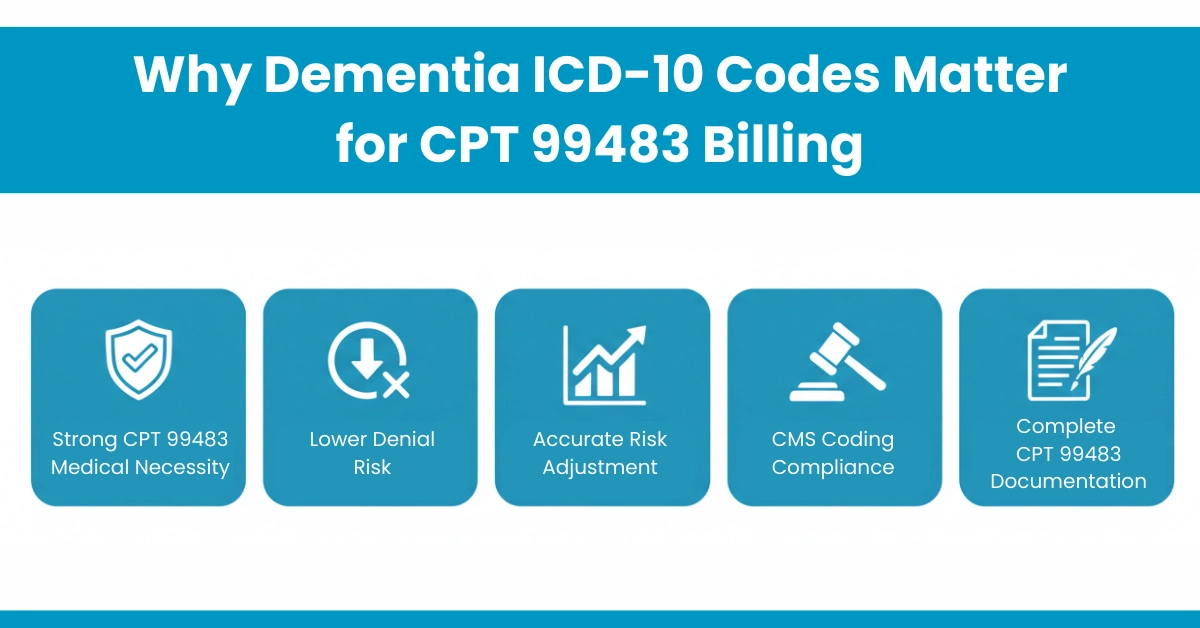
Why Dementia ICD-10 Codes Matter for CPT 99483 Billing
CPT 99483 covers a comprehensive cognitive assessment and care plan, typically requiring around 50 minutes and an independent historian. Proper documentation and code selection are essential for successful reimbursement.
The expanded code set matters for several critical reasons:
Strong CPT 99483 Medical Necessity: Accurate dementia ICD-10 coding clearly supports the medical necessity required for CPT 99483. Payers can easily match documented severity and behaviors with the service provided.
Lower Denial Risk: Lack of diagnosis specificity is a leading cause of dementia-related claim denials. The expanded codes reduce ambiguity and support cleaner, payable claims.
Accurate Risk Adjustment: Detailed ICD-10 specificity directly impacts risk scores in Medicare Advantage and value-based care. Proper coding helps align reimbursement with true patient complexity.
CMS Coding Compliance: CMS requires coding to the highest level of detail supported by documentation. Using updated dementia codes helps reduce audit exposure and compliance issues.
Complete CPT 99483 Documentation: Each CPT 99483 service must include nine required assessment and care planning elements. Accurate documentation strengthens claim support and ensures consistent reimbursement.
At Hello MDs, our experts guide providers through medical billing audits, ensuring each CPT 99483 claim reflects precise etiology-based dementia coding.
Common Coding Mistakes to Avoid
Even with expanded code options, certain errors can still trigger denials or compliance issues. Here are the most critical mistakes to avoid when coding for CMS dementia coding update scenarios:
Missing the Second Alzheimer’s Code: Alzheimer’s coding requires both G30 and F02 codes. Using only one can lead to rejected claims, since the F02 captures the dementia manifestation.
Incorrect Code Sequencing: Always code the underlying condition first, then the manifestation. For Alzheimer’s dementia, G30.x comes before F02.x. Reversing this order can trigger automated denials.
Not Using Full Specificity: If documentation shows severity or behavioral issues, use the correct detailed code. For example, severe dementia with agitation should be coded with the C-series code rather than an unspecified code.
Omitting the Vascular Condition Code: For vascular dementia (F01.x), include the code for the underlying vascular cause (like cerebral infarction). Skipping this step fails ICD-10 specificity rules.
Using Outdated Codes: Avoid older, less specific codes if documentation supports detailed coding. For moderate dementia with mood disturbance, use F03.B3 instead of a generic unspecified code.
Weak Documentation: Codes must match the clinical record. If coding “severe†dementia or agitation, the notes must document functional decline or behavioral symptoms.
Billing CPT 99483 Too Often: CMS allows CPT 99483 only once every 180 days per patient per provider. Billing more frequently can result in denials for exceeding frequency limits.
Practical checklist for a CPT 99483 visit (quick)
Capture the independent historian’s name and relationship.
Document cognitive testing results (raw scores).
Document functional limitations and safety concerns.
Record neuropsychiatric/behavioral symptoms (agitation, psychosis, anxiety).
Sequence etiology (G30/I63/etc.) then dementia manifestation (F02/F01/F03 series) as applicable.
Store evidence in the chart to support the chosen F03 subcode.
Conclusion:
The New Dementia ICD-10 Codes for CPT 99483 give coders and clinicians better tools to document severity, behavior, and etiology, all of which strengthen medical necessity for the CPT 99483 cognitive assessment and care planning service. Update your templates, train coders on etiology/manifestation sequencing, and use pre-submission checks to convert these coding updates into fewer denials and more reliable revenue capture. If you’d like, Hello MDs can run a tailored audit and update plan for your EHR and billing workflows to make the transition smoother.
This content is for informational purposes only and is not intended as medical or billing advice. Always verify codes with official ICD-10 guidelines or certified professionals. Some images are AI-generated or provided for illustrative purposes.
CPT 99483 covers cognitive assessment and care plan services, including evaluation, functional assessment, safety, caregiver review, and care planning.
CMS recognizes Alzheimer’s, vascular dementia, major neurocognitive disorder, and other dementia types with documented severity as covered diagnoses for 99483.
A cognitive assessment includes history, functional evaluation, behavioral review, medication reconciliation, safety, caregiver assessment, care plan, advance planning, and referrals.