
Wondering how to start a medical practice? Pick a legal structure, fund a business plan, get licensed and credentialed, then wire up compliance, billing, and your EHR. Starting a medical practice has one catch most physicians miss. Rent starts months before revenue does. The steps below follow the order that protects your cash.
How to start your own medical practice sounds like one project. It’s five, all at once: entity, funding, payers, compliance, and the build-out. When starting a medical practice, your real finish line is your first clean payment, not opening day, and payer enrollment decides when that lands.
Before opening a medical practice, plenty of physicians hand provider credentialing and enrollment to specialists, just to get that clock ticking early.
What is private practice? A medical private practice is physician-owned, not hospital-owned, and it’s getting rarer. AMA survey data puts 42.2% of physicians in private practice in 2024, down from 60.1% in 2012.
Can doctors start their own business? Yes, within state entity rules (PC, PLLC). If you’re sorting out how to open a private practice, your main routes are:
A medical practice business plan doesn’t need forty pages. It needs numbers: patient mix, services, staffing, and a monthly cash-flow forecast. For building a medical practice, run this test. Model first payments arriving at month 3, 5, and 7. If the plan only survives month 3, it isn’t ready. Every medical practice startup should pass it. Understanding how the medical billing process works helps you build that forecast honestly.
Legal considerations when starting a medical practice begin with state law. Always. To open a medical practice, many states apply the corporate practice of medicine (CPOM) doctrine, which generally requires physicians to own the clinical entity. Review CPOM rules before accepting any investor or management agreement. Ask first, sign second.
Medical practice set up starts with the space. Planning how to open a medical clinic or how to open a clinic? Weigh patient access, nearby referral sources, ADA accessibility, zoning, and IT needs. One practical point: credentialing applications ask for a practice address. Settle the location early.
How much does it cost to start a medical practice? It depends. Estimates for medical practice startup costs run from roughly $70,000 for lean primary care to several hundred thousand dollars once working capital is included. The same range answers how much does it cost to open a medical clinic.
|
Cost area |
Budget for |
|
Space and insurance |
Lease, build-out, malpractice |
|
Equipment and IT |
Exam rooms, EHR, security |
|
Payroll |
Staff before payments arrive |
|
Working capital |
Runway to first reimbursement |
Budget the gap between your first expense and your first payment, not just the build-out. Then track monthly medical practice expenses, because they never stop.
A practice startup usually runs on savings, bank loans, SBA loans, or equipment financing. As with how to start a healthcare business anywhere, lenders want projections. Real ones. A 13-week cash-flow forecast flags shortfalls before payroll does. Update it weekly.
A physician practice start-up runs these tracks in parallel. Credentialing is the slow one.
|
Step |
Notes |
|
State license |
Varies by state |
|
DEA |
If prescribing controlled substances |
|
NPI (NPPES) |
Free online registration |
|
CAQH ProView |
Re-attest usually every 120 days |
|
Medicare (PECOS, CMS-855I/855B) |
Separate track |
|
Medicaid |
State rules vary |
|
Commercial payers |
Commonly 60 to 180 days |
Medicare’s effective date is the later of your filing date or the day you begin seeing patients at the new location, and retrospective billing reaches back only 30 days. CMS guidance shows physicians can apply up to 60 days ahead. So file before you open, not after.
Paperwork is essential Part for starting a medical practice is. Payer contracts, a patient financial policy, consent forms, employment agreements, a lease someone has actually reviewed. Check each payer’s timely filing and appeal deadlines before signing; they set how long you have to fix a denied claim.
When starting a medical practice, HIPAA applies from day one, so learn how to set up a medical practice compliantly. Complete a security risk analysis before patient data enters your EHR. HHS guidance on risk analysis calls it foundational. Sign business associate agreements with every vendor touching patient data, including your billing partner.
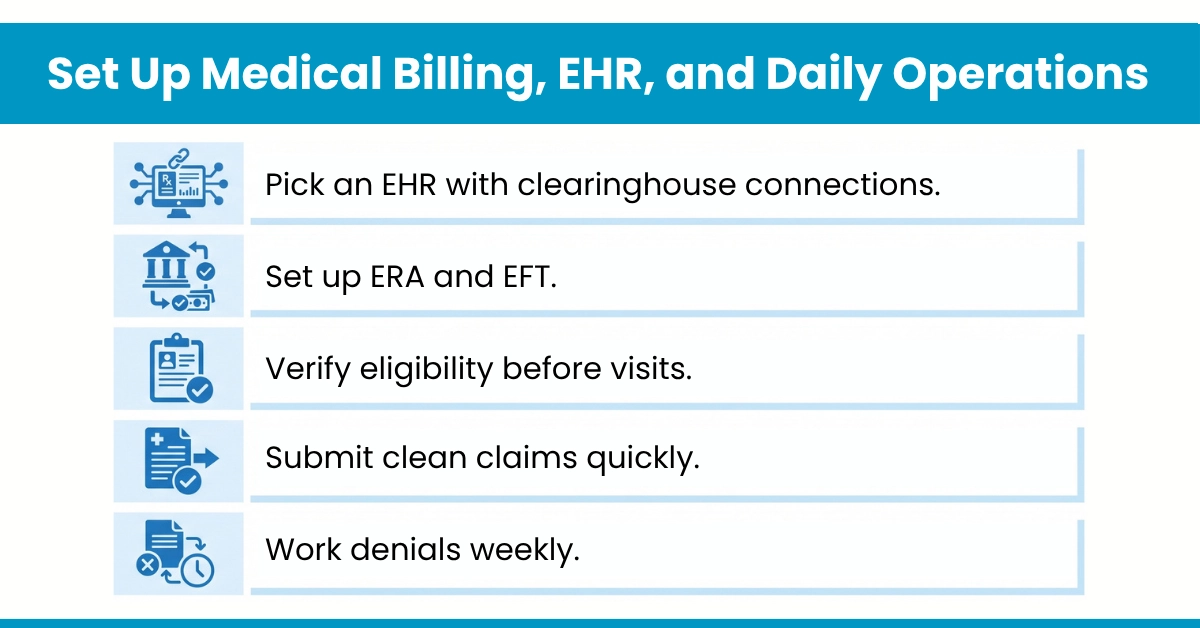
How to run a medical practice day to day, takes a repeatable workflow:
Choose your EHR and billing workflow together so documentation and coding flow straight into claims. Then study why claims get denied before your first submission.
It begins with the fee. Medicare.gov says membership fees aren’t covered, and doctors who accept assignment can’t charge extra for Medicare-covered services. Define what the fee buys. Write it into the patient agreement. Have an attorney review it. As a medical practice startup model, direct primary care typically skips insurance billing.
No fixed timeline exists. Credentialing sets the pace, with commercial payers commonly cited at 60 to 180 days. For starting a medical practice, plan about six months from entity formation to first claims, and begin credentialing once your NPI and practice address exist.
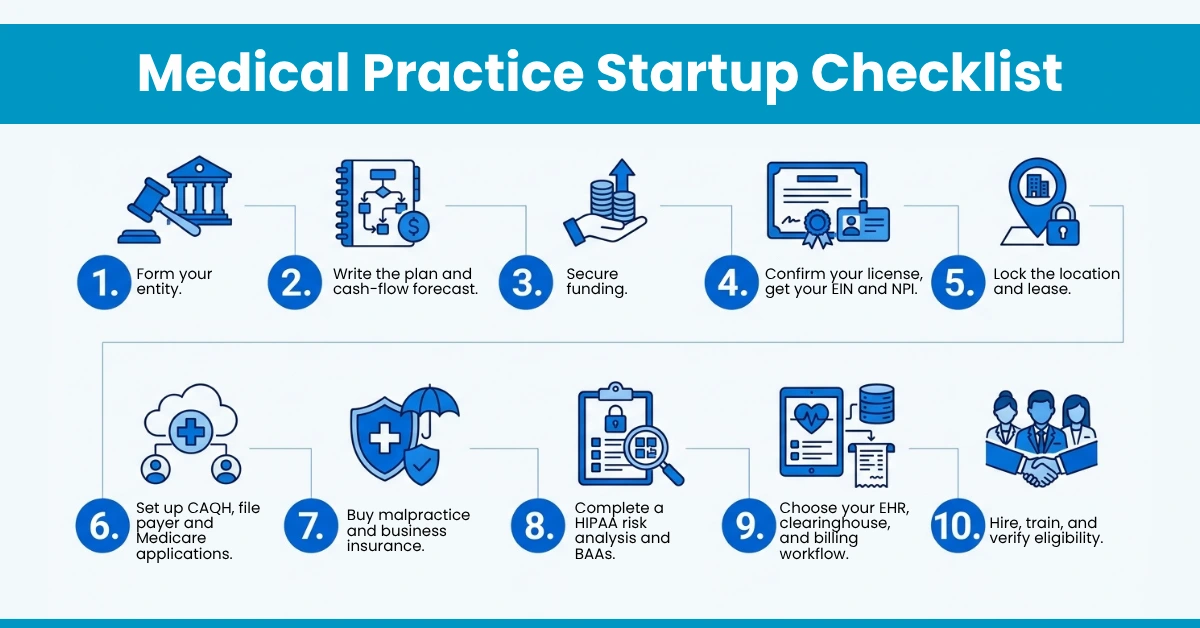
Use this how to start a medical practice checklist:
Call one before signing anything binding: entity papers, investor or management agreements, payer contracts, leases, employment agreements. A medical practice startup consultant, practice start up consulting, or physician practice consulting services can cover operations. Structure and compliance questions? Those belong with counsel. This isn’t legal advice.
Knowing how to start a medical practice is mostly about sequencing. Structure and funding first, credentialing early, and compliance and billing ready before the first patient walks in. Get the order right, and your first reimbursement shows up when the plan says it will. Practices wanting credentialing and billing help can find it at HelloMDs.
Disclaimer: This guide is for informational purposes only and is not legal or financial advice; rules and timelines vary by state and payer, so consult a qualified professional before acting.