
CPT Code

HCPCS Codes for CGM, Insulin Pumps, and Diabetes Supplies

Home / HCPCS Code

When you receive an insurance statement, you may see strange codes like A4253 or E2103 instead of plain descriptions. Most patients ignore them until a claim gets denied.

If you manage diabetes, this moment happens more often than it should. A CGM claim gets rejected. Test strips come back as “not covered.” An insulin pump rental sits in appeals for 60 days. In most of these cases, the problem isn’t your coverage; it’s the HCPCS code on the claim.

This guide explains exactly what HCPCS codes are, which ones matter most for diabetic patients, the modifier rules that silently kill claims, and the 2026 updates you need to know

What Is an HCPCS Code & Why Does It Exist?

HCPCS stands for Healthcare Common Procedure Coding System. The Center of Medicare & Medicaid Services (CMS) maintains it as a standardized way to describe medical services, equipment, and supplies on insurance claims.

CMS established HCPCS in 1978. After HIPAA made it mandatory in 1996, every provider, supplier, and insurer in the United States was required to use it. Today, you cannot submit a valid Medicare or Medicaid claim without HCPCS codes.

HCPCS Level I vs. Level II

  1. Level I (CPT codes) (5-digit numbers): These describe physician services and procedures, office visits, surgeries, lab procedures. The American Medical Association maintains them.
  2. Level II (HCPCS codes): These are alphanumeric (one letter + four numbers, like K0553) and cover medical equipment, diabetic supplies, injectable drugs, prosthetics, ambulance services, and more. CMS maintains them.

For diabetes billing, Level II codes are usually the most important because they cover CGMs, Insulin pumps, lancets, and testing supplies.

How Are HCPCS Codes Structured?

Each HCPCS Level II code starts with a letter that defines its category:

  • A codes: Medical and surgical supplies.
  • E codes: Durable Medical Equipment.
  • G codes: Medicare temporary procedure codes.
  • J codes: Injectable drugs.
  • K codes: DME not classified elsewhere.
  • L codes: Orthotics and prosthetics.
  • Q codes: Temporary drug codes and certain services pending permanent assignment.

For example:

  • A4253: Blood glucose test strips.
  • E0784: External insulin pump.
  • E2103: Non-adjunctive CGM receiver.

Important:

Codes K0553 and K0554 were deleted effective January 1, 2023, and replaced by A4238/A4239 and E2102/E2103. If you or your supplier is still using K0553 or K0554 for CGM claims in 2026, those claims will be denied; no grace period applies.

HCPCS Codes Every Diabetic Patient Should Know

Diabetes billing is one of the most error-prone areas in medical coding. These are the most critical codes:

  • A4253: Blood glucose test strips.
  • A4258: Lancet device.
  • E0784: Insulin pump.
  • E2102: Adjunctive CGM receiver.
  • E2103: Non-adjunctive CGM receiver.
  • A4238: Adjunctive CGM supplies.
  • A4239: Non-adjunctive CGM supplies.
  • A5500: Diabetic shoes.
  • G0108: Diabetes self-management training.

Each HCPCS code must be paired with a valid ICD-10 diagnosis code such as:

  • E11.9 (Type 2 diabetes).
  • E10.9 (Type 1 diabetes).
  • Z79.4 (Long-term insulin use).

A mismatch between HCPCS and ICD-10 is one of the most common causes of denial.

The CGM Billing Issues Most Patients Never Hear About

This is the single biggest billing confusion for diabetic patients. There are two different CGM categories:

Adjunctive CGM:

Codes (E2102 + A4238). Used alongside a standard blood glucose monitor. The CGM does not replace your test strips. Both the CGM supply allowance and separate BGM supplies can be billed together.

Non-adjunctive CGM: Codes (E2103 + A4239). Replaces the standard BGM entirely. You cannot bill BGM test strips separately when a non-adjunctive CGM is in place. Medicare will deny it as a duplicate.

This distinction is one of the common causes of claim rejection.

What’s the Difference Between HCPCS, CPT, & ICD-10 Codes?

A complete claim requires all three.

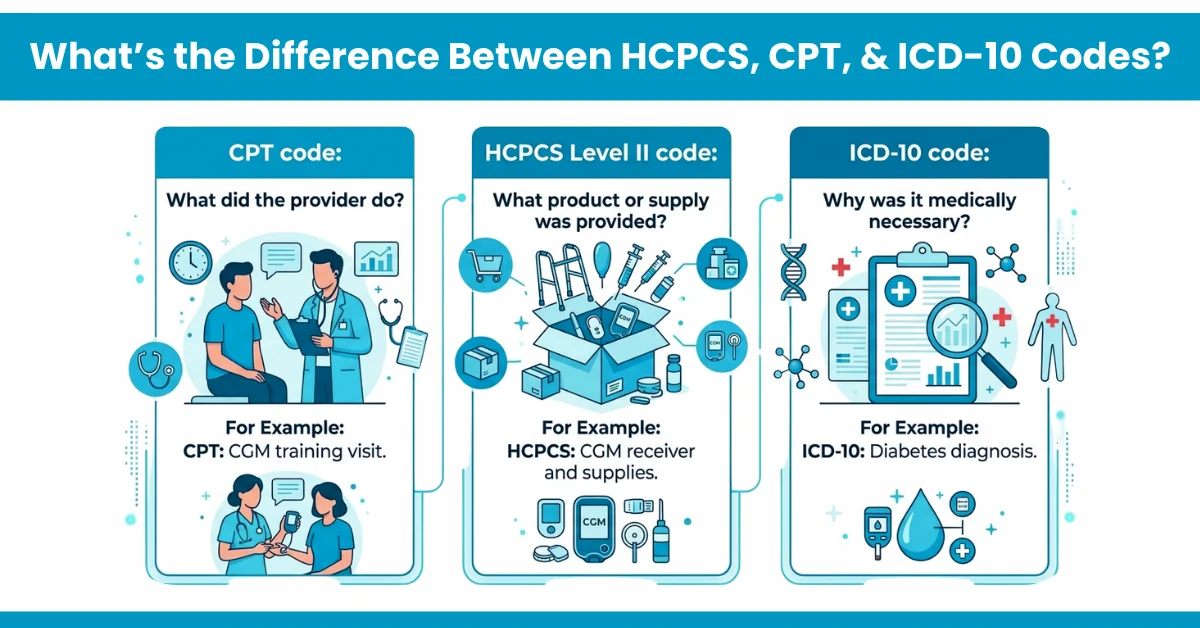
They answer three different questions:

  • CPT code: What did the provider do?
  • HCPCS Level II code: What product or supply was provided?
  • ICD-10 code: Why was it medically necessary?

For Example:

  • CPT: CGM training visit.
  • HCPCS: CGM receiver and supplies.
  • ICD-10: Diabetes diagnosis.

Even small gap, like missing documentation of insulin use, can lead to denial or audit.
What’s the Difference Between HCPCS, CPT, & ICD-10 Codes

Real scenario:

A patient on Medicare receives a CGM. The supplier bills E2103 + A4239. But the patient’s chart doesn’t document the required in-person or telehealth practitioner visit within the past 6 months, confirming CGM adherence. CMS data shows this documentation gap accounted for 67.6% of improper CGM payments in 2024, leading to recoupments from suppliers and unexpected bills for patients.

HCPCS Modifiers That Impact Payment

Modifiers provide additional billing context:

  • KX: Confirms medical necessity documentation exists.
  • GA: Advance Beneficiary Notice (ABN) on file.
  • GY: Item is not covered by Medicare.
  • NU: New equipment purchase.
  • RR: Equipment rental.
  • GT: Telehealth service modifier.
  • 25: Significant, separately identifiable E/M service on same day.

Common billing trap:

Applying the wrong modifier to an HCPCS J code or E code drug claim. J codes often require a dosage modifier (e.g., J1817 for insulin). Submit without the correct units, and the claim either denies or gets paid at the wrong amount.

2026 HCPCS Updates Providers Need to Know

CMS updates HCPCS Level II quarterly. There is no grace period, a discontinued code used after its effective date is an instant denial. The April 2026 quarterly update introduced 36 new codes, primarily for injectable drugs, biologics, and skin substitutes.

Key Changes Effective 2026

  • 36 new HCPCS codes added (April 1, 2026) for injectables and biologics.
  • CGM supply codes A4238 and A4239 now support up to 90-day billing.
  • Older skin substitute codes (C5271-C5278) were replaced with a flat rate of $127.14 per cm per square, significantly impacting wound care billing.
  • Telehealth diabetes training codes (G0108, G0109) remain permanently covered and modifier GT is required.
  • All CGM devices billed under E2102 or E2103 must be listed on the CMS PDAC Product List.

Why this matters:

These updates directly affect DME suppliers, endocrinology practices, and diabetes billing workflows. Even small mismatches in coding, outdated files, or missing PDAC validation can trigger automatic denials.

At HelloMDs, our coding team updates code libraries every quarter before the effective date, not after denials start appearing. That’s how we maintain a 99% first-pass claim ratio for our DME and endocrinology clients.

Why HCPCS Code Errors Cause Denials & How to Fix Them

Most denials aren’t about coverage; they’re about coding. Here are the most common HCPCS-related denial patterns we see every week:

  • Using deleted or revised HCPCS codes.
  • Diagnosis mismatch between the HCPCS and ICD-10 code.
  • Missing modifier KX on DME and CGM claims.
  • Billing test strips alongside non-adjunctive CGM codes such as E2103.
  • PDAC non-compliance for CGM devices.
  • Missing documentation supporting continued CGM use.
  • Wrong billing entity submitting the claim.

What to Fix a Denied Claim
Most denied claims can still be recovered.

Steps:

  • Check denial reason (CARC/RARC codes).
  • Verify HCPCS code accuracy.
  • Confirm ICD-10 medical necessity.
  • Review modifiers (KX, GA, etc.).
  • Ensure CGM device is PDAC-listed.
  • Resubmit the corrected CMS-1500 claim or contact HelloMDs denial management team for a root-cause audit and resubmission.

CMS data shows over 50% of corrected claims are eventually paid.

What Experienced Billing Teams Know

Advanced billing teams also account for:

  • Different LCD rules for Type 1 vs Type 2 diabetes.
  • Strict Medicare CGM documentation requirements.
  • Smart-device-only CGM coverage limitations.
  • Competitive bidding impacts on DME reimbursement.
  • Pump and CGM coding conflicts between suppliers.

These small details often determine whether a claim gets paid or denied.

Conclusion:

HCPCS codes are not just administrative details; they directly determine whether diabetes supplies like CGMs, insulin pumps, and test strips are covered or denied. Most claim failures come from coding errors, missing documentation, or outdated HCPCS codes, not from lack of insurance coverage. Understanding how HCPCS, CPT, and ICD-10 work together helps prevent unnecessary denials and delays in care.

HelloMDs specializes in exactly this. Our AAPC-certified coders handle DME billing, CGM claims, endocrinology coding, and denial management for practices and suppliers nationwide. With a 99% first-pass ratio and a 15% average reduction in denial rate, we close the gaps before they become write-offs. Follow us on Instagram and Facebook to get the latest updates.

Disclaimer:

This article is for general educational purposes only. Billing rules, HCPCS codes, Medicare policies, and insurance coverage may change over time. Always confirm coding and coverage requirements with CMS, your insurance provider, or a certified billing professional before submitting claims or making healthcare decisions. Visuals aren’t real; they are created from AI tools.

Frequently Asked Questions

Healthcare Common Procedure Coding System. It is maintained by CMS and used to standardize billing for medical supplies, equipment, and non-physician services across all U.S. insurance programs.

CPT codes are Level I of HCPCS. They cover physician services and procedures. HCPCS Level II codes (alphanumeric, e.g., A4253) cover supplies, DME, drugs, and services not addressed by CPT. They are related but serve different billing purposes.

E2102 is for adjunctive CGM receivers; E2103 is for non-adjunctive CGM receivers. Supply allowances are A4238 (adjunctive) and A4239 (non-adjunctive). All devices must be verified on the CMS PDAC Product Classification List before billing.

The most common reasons are a missing KX modifier, a diagnosis code that doesn't confirm diabetes or insulin use, use of a deleted code (such as K0553, discontinued in 2023), or, for CGM claims, lack of documented practitioner visit in the past 6 months.

KX confirms that the supplier has documentation supporting medical necessity for the billed DME item. It is required on most DME and CGM supply claims. Claims submitted without KX when the payer requires it are automatically denied.

CMS updates HCPCS Level II codes quarterly: January 1, April 1, July 1, and October 1. There is no grace period; discontinued codes used after their end date result in immediate denial.

Yes. A5500 covers one pair of diabetic shoes per calendar year. Inserts are billed under A5512 (prefabricated) or A5513 (custom-molded). The claim must link to a diabetes ICD-10 code with a documented foot complication. Medicare covers this under the Therapeutic Shoe Benefit.

The claim will be denied as incorrect coding, regardless of the patient's diagnosis or how accurate the documentation is. Before billing E2102 or E2103, confirm the specific device model appears on the PDAC Product Classification List for that exact HCPCS code at cms.gov.

No. Medicare does not cover CGM supply allowances if a smart device (phone, watch, or tablet) is the sole display. A Medicare-covered DME receiver must be part of the system. Claims for smart-device-only CGM use must be filed as A9270 (non-covered item).

Leave a Reply

Your email address will not be published. Required fields are marked *

×

Request a Free Consultation