
Home health agencies are already billing under one rate cut this year, and a second CMS home health payment rule, this one a proposed increase. It is sitting open for public comment with a deadline just weeks away. Teams still planning off last year’s numbers are working from the wrong baseline.
Here’s what’s actually locked in, what’s still just a proposal, and the ICD-10, HCPCS, and coding details that connect both to your reimbursement.
Each year, CMS publishes a rule in the Federal Register that resets Medicare payment rates, quality-reporting requirements, and billing policy for home health agencies (HHAs) under the Home Health Prospective Payment System (PPS). A proposed version comes out mid-year; a final version follows in the fall; the new rates start every January 1. Right now, two versions are live: CY 2026, already paying claims, and CY 2027, proposed on July 1, 2026, and still accepting public comment.
Nationally, home health agencies are collecting about $220 million less under CY 2026 than they did in 2025, a 1.3% aggregate cut. CMS had originally floated a 6.4% reduction; sustained pushback from provider groups brought the final number down substantially.
The pieces behind that net number:
Two operational shifts came bundled in:
HHVBP payment swings of up to ±5% now apply based on 2024 performance data, and CMS loosened documentation rules around the face-to-face encounter requirement.
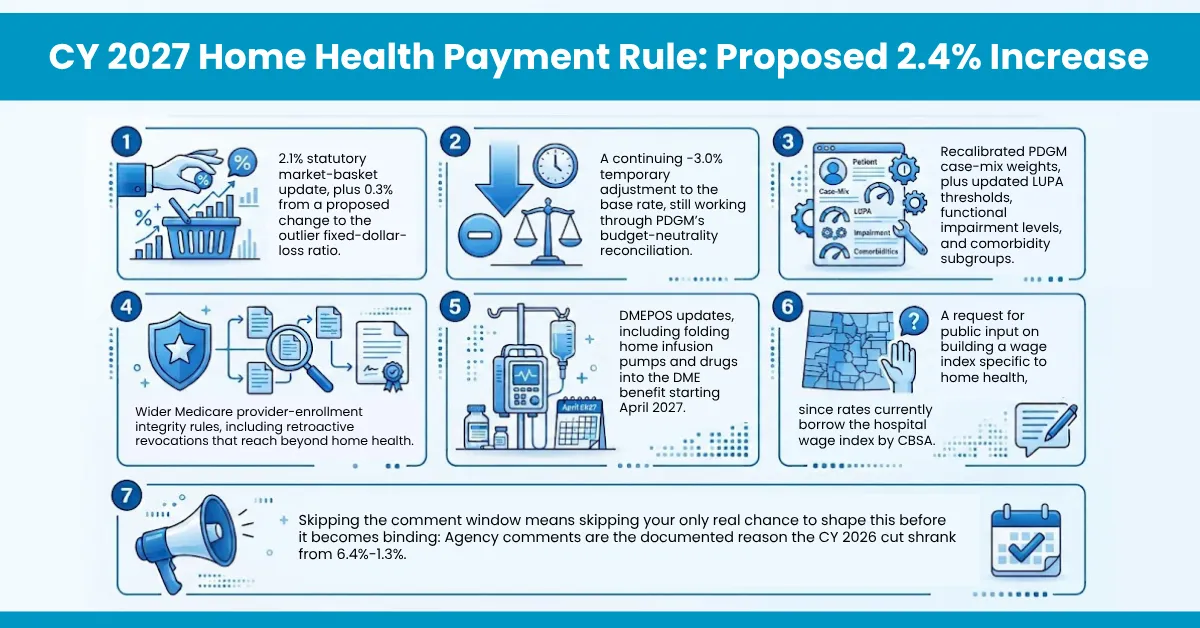
CMS’s CY 2027 proposed rule (CMS-1844-P) calls for a 2.4% aggregate increase, roughly $420 million above CY 2026 levels, and skips an additional permanent cut for the first time since CY 2022. Public comments close August 31, 2026.
Under the Patient-Driven Groupings Model (PDGM), the principal diagnosis on the claim, not a CPT procedure code, sorts every 30 days into one of 12 clinical groups, and that single assignment drives a large share of what Medicare actually pays.
The 12 groups:
Teaching & Assessment (MMTA) subgroups:
Surgical Aftercare, Cardiac/Circulatory, Endocrine, GI/GU, Infectious Disease, Respiratory, and Other.
A symptom-level or nonspecific ICD-10 code that doesn’t map cleanly into one of those 12 groups gets flagged as an unacceptable principal diagnosis, and the whole claim bounces back to your agency for recoding, a delay that stalls cash flow for weeks. Get the secondary diagnoses sequenced correctly, though, and a comorbidity adjustment can add up to 20% more per episode. Coding precision here isn’t just compliance hygiene; it’s one of the few levers that moves revenue without touching a single visit count.
A Low-Utilization Payment Adjustment (LUPA) applies when a 30-day period falls below the visit threshold associated with its PDGM case-mix group.
Instead of receiving the case-mix-adjusted 30-day payment, the HHA receives applicable per-visit payments. CMS updates LUPA thresholds periodically using claims and utilization data.
For CY 2026, CMS updated LUPA thresholds using CY 2024 data. For CY 2027, CMS proposes another recalibration using CY 2025 data.
That means agencies should not assume a period that avoids LUPA under CY 2026 will automatically have the same threshold under CY 2027.
Billing teams should review the proposed case-mix and LUPA files when modeling 2027 reimbursement.
Home health PPS claims skip the office-visit CPT codes a physician practice would use. Payment runs on ICD-10 diagnosis coding, plus a narrow set of HCPCS codes covering physician certification and oversight:
Code | What It Covers | Who Bills It |
G0179 | Physician re-certification of the home health plan of care, once every 60 days | Certifying physician/NPP |
G0180 | Initial physician certification of home health services (patient hadn’t had Medicare HH care in 60+ days) | Certifying physician/NPP |
G0181 | Home health care plan oversight, 30+ minutes in a calendar month | Certifying physician/NPP |
If your agency also handles Remote Patient Monitoring, keep CPT 99453, 99454, and 99457 on a separate claim track; RPM sits outside the home health 30-day episodic payment entirely.
Going from a 1.3% cut to a proposed 2.4% increase in a single year shows how much one comment letter, one diagnosis code, or one missed LUPA threshold can swing your bottom line.
HelloMDs AAPC-certified coders and RCM team track every CMS home health payment rule change as it happens. Schedule a free consultation to see how the CY 2027 proposal and your current PDGM coding are affecting what you’re actually paid.
This article is educational, not legal, compliance, or coding-certification advice. Confirm exact rates, codes, and effective dates against the current Federal Register publication or your compliance officer; the CY 2027 figures above are proposed and can still change before finalization.