
Your CGM claim gets denied. Your staff spends three hours on hold with a payer. The resubmission goes out late. And the billing company? They mark it as a write-off and move on.
Most practices lose 5% to 15% of annual revenue to prevent billing errors. On a $2 million practice, that is $100,000 to $300,000 walking out the door every year, not from clinical mistakes, but from billing gaps.
This is not a rare story. It is what thousands of endocrinology practices across the U.S. deal with every single month and why choosing the right endocrinology medical billing company is one of the most important decisions your practice will make in 2026.
This guide covers the top 5 billing companies, the exact billing process, denial causes, and when outsourcing actually makes financial sense.
Endocrinology is not like general medicine billing. It sits at the intersection of chronic disease management, DME billing, prior authorization, and constantly shifting payer rules, all at once.
According to CMS data, CGM-related claims are among the highest denied categories under the Medicare DME benefit. A single missing modifier or incorrect diagnosis code results in automatic rejection, no review, and no appeal prompt.
What makes it uniquely difficult:
Important Information:
CMS requires that CGM devices meet the “therapeutic CGM” definition to qualify under Medicare Part B. Billing under the wrong benefit category is the single most common CGM denial cause, and most in-house teams never catch it.
HelloMDs is built specifically for specialty revenue cycle management with strong endocrinology expertise.
Key strengths:
Best for: All practice sizes needing full RCM control, from solo clinics to multi-site groups.
Medatron is a technology-forward billing company with automated workflows and EHR-integrated systems built for endocrinology practices.
Key Strength:
Best For: Practices that want automation-driven, error-reducing workflows without heavy manual intervention.
SybridMD focuses on combining billing services with operational efficiency.
Strengths:
Best for: Mid-size practices wanting structured support, integration, and clear performance metrics.
CureMD provides a technology-first approach to revenue cycle management.
Strengths:
Best for: Tech forward clinics wanting AI assisted claims, rapid posting, and low touch management.
Transcure specializes in recovering lost revenue from denied claims.
Strengths:
Best for: Practices struggling with unpaid claims, chronic backlog, or a history of poor coding performance.
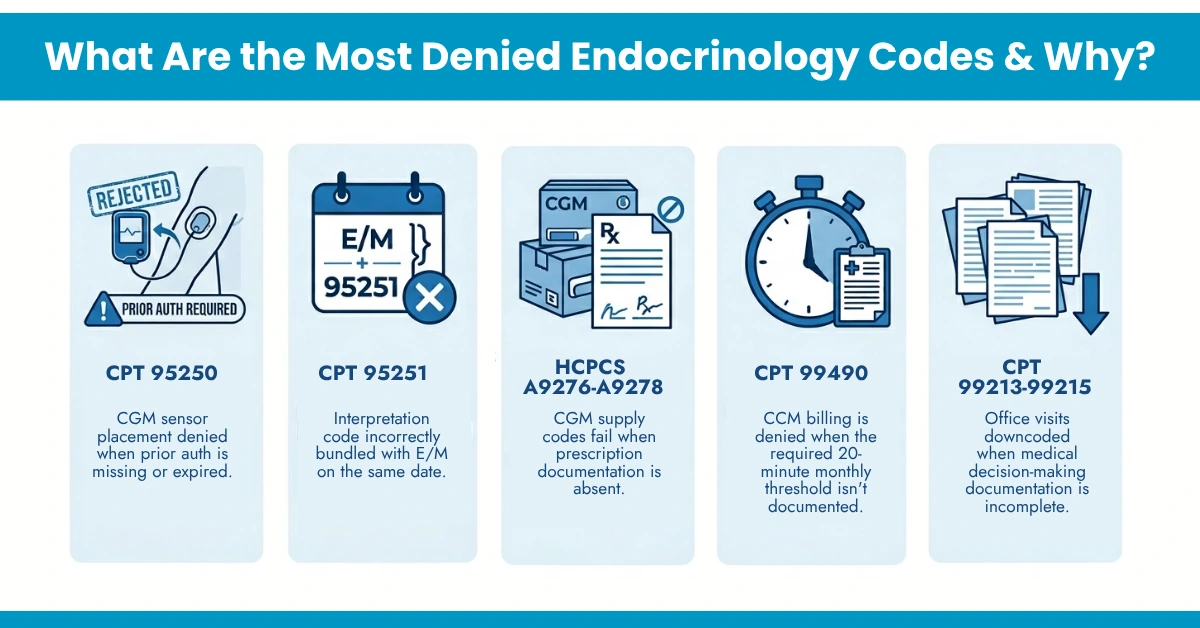
These codes generate the highest denial volume across endocrinology practices in 2025-2026:
Do You Know?
Endocrinology practices with no dedicated billing partner report payment cycles of 45 to 60 days. Practices with specialty billing support typically collect within 28 to 32 days.
HelloMDs Advice:
Our coders audit payer-specific CGM coverage rules before every submission. This single step reduces endocrinology denial rates by up to 35% within the first 90 days.
This is the question most providers ask too late. If any of these apply to your practice right now, outsourcing is overdue:
Important Information:
The average endocrinology practice that switches from in-house billing to a specialized RCM company recovers 15-30% more monthly revenue, not from seeing more patients, but from collecting what they were already earning.
Use the free HelloMDs ROI Calculator to see your exact recovery potential and compare in-house vs. outsourced revenue.
Not every billing company understands endocrinology. A general biller will cost you more in denials than they save in service fees.
The Pre-Hire Checklist
Ask This Before You Sign:
“What is your average days-in-AR for endocrinology practices?”
“Do you rework every denial or write them off?”
Anything over 35 days is a red flag for specialty billing.
HelloMDs checks every single one of these boxes, backed by AAPC certification, HIPAA-compliant infrastructure, and specialty-specific billing workflows built for endocrinology.
Endocrinology billing fails when generalist billing teams handle specialist problems. CGM denials, CCM documentation gaps, insulin pump code errors. These require training, payer knowledge, and a workflow built specifically for this specialty.
Among the top 5 companies reviewed, HelloMDs stands out for combining full RCM, DME expertise, AAPC-certified coders, and one of the lowest starting rates in the industry at 2.95%. They serve endocrinology practices across all 56 U.S. states and territories, and they rework every denial instead of writing it off.
Follow HelloMDs on Facebook and Instagram for weekly billing tips, coding updates, and revenue cycle insights.
This content is for informational purposes only. The companies, services, and billing insights mentioned are based on publicly available information and industry understanding. Readers should verify details directly with each provider before making any business decisions. Visuals shown in this blog are generated with the help of AI.