Understanding the distinction between Medical Billing vs RCM is essential for healthcare leaders who want to stop silent revenue leaks. You might pay faithfully for outsourced billing services each month, yet denials continue landing in your work queue. When accounts receivable (A/R) over 90 days steadily climbs, teams often fail to diagnose the underlying financial breakdown.
Evaluating Medical Billing vs RCM is never merely a debate over healthcare vocabulary. Rather, it decides who touches a patient account before expensive operational errors occur. Traditional billing converts an encounter into a claim and chases reimbursement, whereas comprehensive revenue cycle management initiates weeks prior at patient scheduling, verification, and provider credentialing.
Is Medical Billing Part of Revenue Cycle Management?
Yes, medical billing is a critical operational stage contained within broader revenue cycle management. While billing handles the middle and tail end of claim creation, RCM directs the entire financial roadmap from initial intake to final reconciliation. According to the Healthcare Financial Management Association (HFMA), comprehensive revenue cycle management encompasses all administrative and clinical functions that contribute to the capture, management, and collection of patient service revenue.
When analyzing Medical Billing vs RCM, when healthcare facilities isolate billing from the surrounding clinical workflow, costly administrative blind spots emerge. Billing specialists can only work with documentation already completed by providers and front-desk personnel. If errors occur prior to charge entry, simple billing protocols cannot prevent catastrophic payer rejections.
Medical Billing vs RCM: Fundamental Differences Explained
To establish where your financial pipeline breaks, you must analyze where each service begins and ends. In the ongoing assessment of Medical Billing vs RCM, organizational scope represents the defining boundary. Medical billing responds reactively to completed visits, while RCM proactively manages clinical workflows before services are rendered.
What Traditional Medical Billing Covers
Medical billing focuses exclusively on processing clinical charts into reimbursable claims once an encounter concludes. Billers perform rigorous transactional tasks designed to collect legitimate insurance balances. A qualified medical biller reviews coding accuracy, transmits standardized transactions, and updates billing software.
- Charge Entry: Entering documented encounters directly into practice management systems.
- Coding Translation: Assigning applicable CPT, ICD-10-CM, and HCPCS Level II procedural codes.
- Claim Scrubbing and Submission: Transmitting EDI 837P or 837I files through clearinghouses.
- Payment Posting: Reconciling electronic remittance advice (ERA 835) against outstanding charges.
- Secondary Claims and Patient Invoicing: Generating secondary balance billing and direct patient statements.
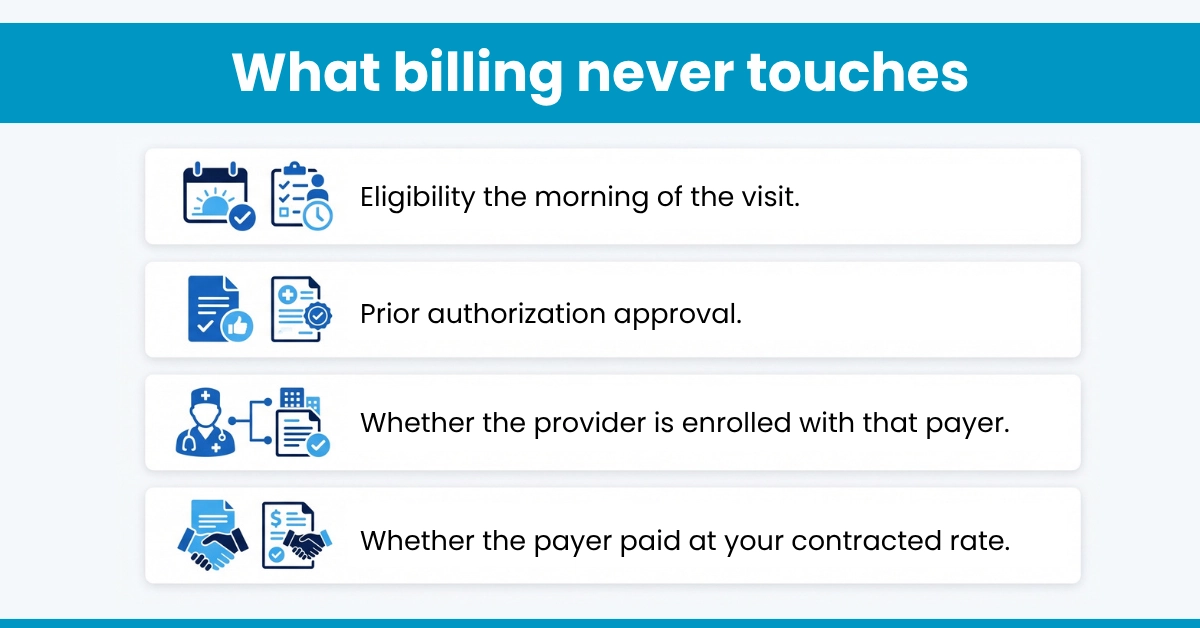
Every single step within standard billing occurs strictly after the patient departs your facility. Consequently, traditional billing never addresses front-desk inefficiencies or administrative gaps that create payment obstacles.
What Revenue Cycle Management (RCM) Covers Upstream
Revenue cycle management begins well before an appointment takes place and concludes long after zero balances post. An effective RCM architecture bridges clinical coordination, patient registration, compliance, and accounts receivable reconciliation. This holistic oversight insulates providers from unforeseen clinical denials.
- Patient Scheduling and Demographic Verification: Capturing complete, error-free patient identifiers.
- Real-Time Eligibility and Benefits Verification: Verifying active coverage, deductibles, copayments, and co-insurance.
- Prior Authorization Procurement: Obtaining prerequisite payer approvals before initiating treatments.
- Provider Credentialing and Enrollment: Maintaining uninterrupted commercial and government payer contracts.
- Clinical Documentation Improvement: Assisting providers in substantiating medical necessity.
- Underpayment Recovery: Reconciling actual remitted amounts against agreed fee schedule benchmarks.
Where Practices Leak Money: Upstream vs. Downstream Breaks
When analyzing operational revenue leaks under Medical Billing vs RCM, root-cause analysis is paramount. If you treat pre-service administrative errors as billing oversights, your internal staff wastes endless hours submitting futile appeals. Financial failures fall distinctly into upstream operational gaps or downstream processing errors.
Analyzing CARC Codes to Diagnose Revenue Gaps
Claim Adjustment Reason Codes (CARC) disclose exactly which operational department triggered an initial denial. Reviewing your remittance data highlights whether clinical staff, intake personnel, or billing agents caused the stoppage.
- CARC 16 (Missing or Incomplete Documentation): Typically points to downstream billing or charge entry data errors.
- CARC 50 (Service Deemed Not Medically Necessary): Highlights incomplete provider clinical charting or improper code linking.
- CARC 197 (Precertification/Authorization Missing): Represents a severe upstream failure belonging exclusively to RCM workflows.
- Unenrolled Rendering Provider Rejections: Directly indicates lapses in medical credentialing and payer revalidation.
One Clinical Encounter: Three Failure Points
Consider an established patient visiting an orthopedic clinic for chronic lower back pain. The physician documents an evaluation and management visit (CPT 99213) with ICD-10 code M54.5, delivers a therapeutic ketorolac injection (HCPCS J1885), and appends Modifier 25. Three separate breakdowns can occur across this single encounter:
First, if billing staff omits Modifier 25, the payer unbundles the office consultation into the minor surgical procedure. A knowledgeable biller can append the modifier, appeal the remittance, and recover payment within weeks.
Regarding Medical Billing vs RCM, second, if the front desk fails to obtain prior authorization for specialized therapeutic injectables, the payer delivers a CARC 197 rejection. Because retro-authorizations are rarely approved, no billing remediation will secure that revenue.
Third, if the rendering specialist failed to complete revalidation with the contracted commercial insurer, the claim is permanently non-payable. This catastrophic mistake represents a pre-service breakdown that basic billing vendors cannot detect.
Comprehensive Comparison: Medical Billing vs RCM
Comparing operational parameters helps healthcare organizations determine whether transactional billing or strategic management is needed. Evaluating Medical Billing vs RCM through functional criteria reveals distinct differences in staffing, technology, and oversight.
| Operational Dimension |
Traditional Medical Billing |
Revenue Cycle Management (RCM) |
| Process Initiation |
Post-encounter clinical chart sign-off |
Patient pre-registration and appointment booking |
| Operational Scope |
Coding, submission, ERA posting, basic follow-up |
Front-desk workflows, pre-authorizations, billing, reporting |
| Upstream Protection |
None; assumes incoming intake data is accurate |
Comprehensive eligibility, benefits, and authorization checks |
| Credentialing Support |
Excluded; claims submitted regardless of enrollment |
Continuous tracking of CAQH profiles and revalidation dates |
| Fee Structure |
Lower base percentage on raw collections |
Comprehensive percentage covering end-to-end administration |
| Primary Value |
Transactional throughput of undisputed claims |
Systemic denial prevention and sustained margin expansion |
Which Solution Does Your Medical Practice Actually Need?
Evaluating your clinical specialty, payer complexity, and financial performance metrics answers the Medical Billing vs RCM dilemma. If your adjusted collection rate lingers below industry benchmarks, comprehensive intervention is necessary.
Evaluating Billing-Only Services
Straightforward billing services suit low-complexity practices with minimal procedural variances. If your clinic relies primarily on cash-pay patients or a single, predictable payer, standalone billing provides an affordable solution. Onboarding happens swiftly with minimal disruption to front-desk scheduling routines.
Also read: Explore our complete guide on CPT Code 64721: ICD-10, Modifiers & Coding Guide.
However, billing-only contracts leave practices exposed to repetitive eligibility write-offs. Without dedicated credentialing tracking or underpayment auditing, clinics consistently surrender legitimate receivables without knowing a breach occurred.
Evaluating Full-Service Revenue Cycle Management
Full-service RCM is vital for multi-specialty practices, surgical groups, and providers encountering heavy prior authorization requirements. High patient deductibles demand front-end financial clearance before procedures are rendered. RCM provides the infrastructure necessary to capture patient responsibility and audit payer compliance.
Practices struggling with chronic staff turnover benefit immensely from end-to-end management. By standardizing front-desk intake protocols and automating eligibility checks, RCM eliminates administrative drag across every clinical department.
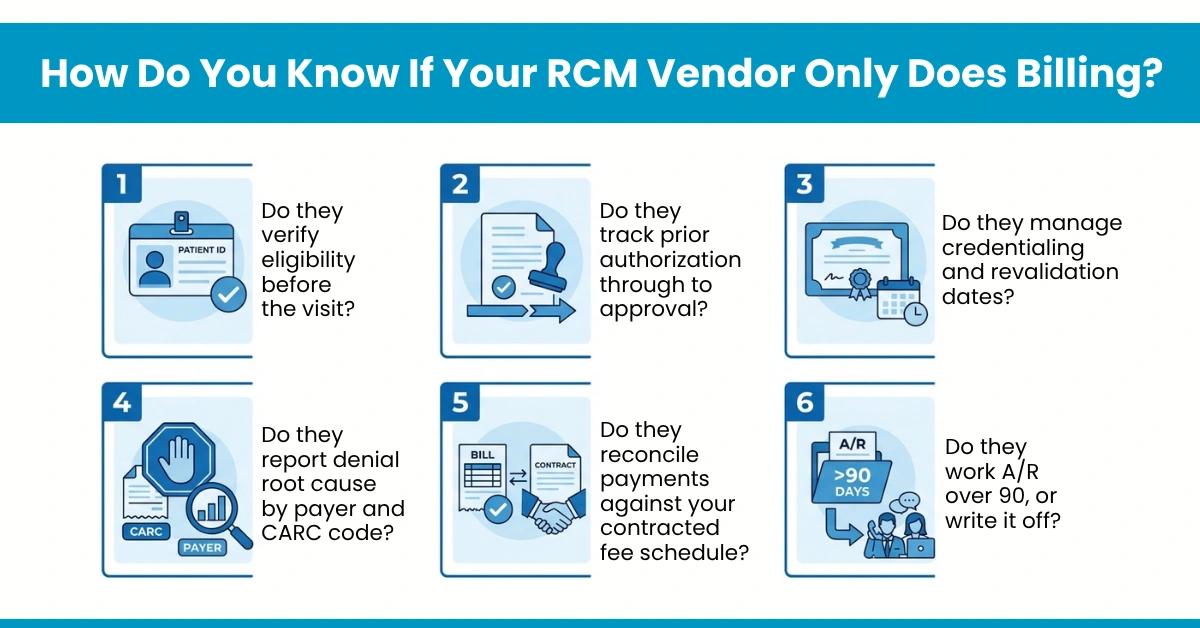
How to Identify If Your Vendor Only Provides Basic Billing
Many outsourced billing agencies market basic services under the guise of modern revenue management. Medical leaders can definitively evaluate their current partner during any Medical Billing vs RCM audit by asking critical questions:
- Do you verify real-time patient co-pays, deductibles, and benefits before patients step into the office?
- Do you take full accountability for initiating and securing required prior authorizations?
- Do your specialists continuously monitor provider re-credentialing cycles and CAQH attestations?
- Do you deliver customized monthly reporting detailing root causes across discrete CARC codes?
- Are all processed remittances systematically audited against our executed fee schedule rates?
- Does your organization resolve lingering aged balances past 90 days, or are they written off?
If your vendor answers negatively to multiple inquiries, your clinic possesses simple billing repackaged as RCM. This operational gap explains persistent cash-flow interruptions and inflated aged receivables.
In terms of Medical Billing vs RCM, at HelloMDs, our credentialed specialists analyze stale accounts to identify overlooked revenue leaks. Performing a rigorous audit reveals the root drivers behind recurring claim adjustments. Our multidisciplinary team combines certified professional coders, front-end intake consultants, and dedicated credentialing managers.
We actively work accounts receivable up to three years old on a performance contingency model. By isolating historical denial patterns, HelloMDs resolves past-due balances while engineering upstream safeguards to prevent future claim collapses.
Conclusion: Choosing Between Medical Billing vs RCM
Distinguishing Medical Billing vs RCM is clear: billing recovers claims downstream, while RCM insulates your practice from the errors that cause rejections. If your practice battles chronic administrative denials, investing strictly in claims processing will not resolve the underlying breakdown.
Examine your ninety-day remittance records, sort claims by denial categories, and identify where money leaks. Transforming your financial health requires aligning intake, clinical charting, and claims submission into one cohesive system.
Frequently Asked Questions
Is RCM software the same as a healthcare clearinghouse?
No, a clearinghouse acts solely as an electronic conduit transmitting 837 claim files to payers and returning 835 remittance data. In contrast, RCM software tracks the patient financial journey from appointment scheduling and benefit verification through final payment reconciliation.
Can an independent solo practice utilize full revenue cycle management?
Yes, solo practices frequently benefit from comprehensive RCM, particularly when dealing with complex prior authorizations or multiple commercial contracts. Operational denial patterns dictate RCM necessity rather than patient volume alone.
What is an acceptable benchmark for days in accounts receivable?
Leading industry standards recommend maintaining days in A/R below 40 days, with 30 to 35 days considered optimal. Metric readings surpassing 50 days typically signify unworked denial queues or poor patient balance collection protocols.
Does medical coding fall under medical billing or revenue cycle management?
Medical coding serves as the bridge between clinical care and claim processing, sitting technically within medical billing. However, coding audits, physician documentation improvement, and payer reimbursement optimization belong squarely within comprehensive RCM.
How long does the provider credentialing process take?
Most commercial and Medicaid payers take between 60 to 120 days to complete initial provider credentialing. Incomplete documentation, lapsed revalidations, or outdated CAQH profiles can extend this window and cause non-payable claims.