
We audited a family practice last month. They were losing $38,000 a year to claim denials and had no idea. Sound familiar? Most doctors we talk to know denials are a problem but can’t figure out where to start fixing them. Here’s what years in medical billing taught us: tighten your eligibility checks, get your coding right, and track every prior auth those three things alone kill most of your denials.
That’s it. No magic software, no fancy trick. The seven fixes below are what we actually do for our 100+ clients. How to reduce claim denials isn’t complicated, but it does take discipline.
Honest question. Most practice owners we meet can’t tell us their denial rate off the top of their head. Look at this chart and figure out where you sit.
|
Your Denial Rate |
What It Means |
Action Required |
|
Under 5% |
Healthy, minor gaps only |
Monitor trends monthly |
|
5-10% |
Fixable workflow issues |
Target top 3 denial reasons |
|
10-15% |
Systemic problems |
Audit front-desk and coding workflows |
|
15%+ |
Revenue emergency |
Get outside expertise immediately |
If you’re above 10%, we need to talk about real money. Your medical claim denial rate isn’t just a number on a report. At $118 per rework (that’s HFMA’s number, not ours), a practice doing 500 claims a month with a 10% denial rate burns $70,800 a year reworking claims that should have gone through clean. That’s a full-time salary. Just gone.
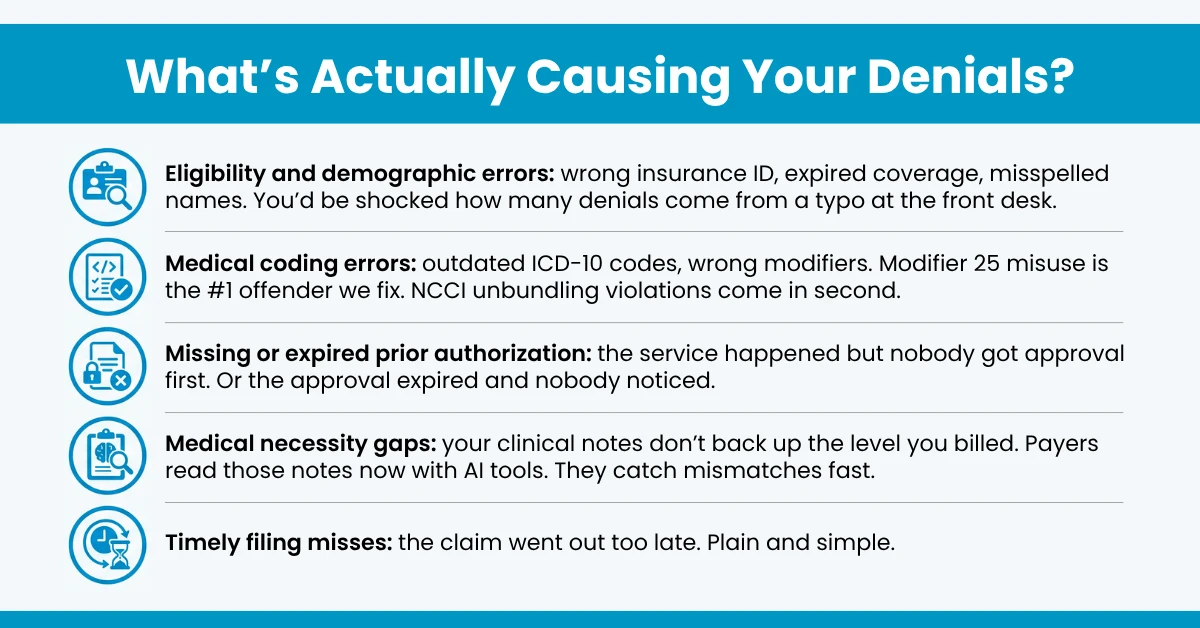
Pull your last 90 days of claims. Sort by CARC code. We’d bet money you find that two or three common causes of medical claim denials drive most of your pain. Verimedix research backs this up 60-70% of denied revenue comes from just a handful of categories. Medical claim denial reasons are almost never random. There’s a pattern. Find it and you’re halfway done.
We see the same five things over and over. Every single week.
Insurance eligibility verification at scheduling AND check-in stops the biggest one cold. We tell every client: run a 270/271 transaction before the patient walks in. Confirm coverage, copay, coordination of benefits. Five minutes at the front desk saves hours of rework later.
And here’s something a lot of practices are missing right now. CMS dropped 487 new ICD-10 codes this year and deleted 28. If your coders are still working off last year’s book, you’re generating medical billing errors causing denials that didn’t even exist six months ago. Get a coding audit done. Seriously. This quarter.
A claim scrubber is basically your bouncer. It checks everything before the claim walks out the door.
Here’s what a good one catches:
We run medical claim scrubbing against payer-specific rules, LCD/NCD policies, and clearinghouse edits before anything gets submitted. Clean claim submission means nobody had to touch that claim manually. It went through clean.
The clean claim rate target across the industry is 95% or higher, per MGMA. We hit 99% first-pass with our clients. That’s not us bragging that’s what happens when you scrub every claim against the right rules before it leaves the building.
This one is getting worse, not better. Prior auth denials are the fastest-growing category we deal with in 2026.
Three things changed on January 1st that you should know about:
Prior authorization medical billing is a discipline now. Not a checkbox. Here’s what we tell every practice we work with, build a matrix. List every service that needs auth for your top 5 payers. Put one person in charge of high-dollar procedure approvals. Track your auth completion rate every week. And set expiration alerts, because auths expire quietly and then a claim gets denied three weeks later and nobody can figure out why.
Don’t assume an old approval still covers a new visit. Check every time.
Medical necessity denials are the other side of this coin. Your documentation has to justify the service level you billed. We train providers to write down WHY the service was needed, link the diagnosis to the treatment, and list comorbidities. Payer AI in 2026 reads your clinical notes and decides if they match the CPT code. If they don’t match, you get denied.
Look, a denial isn’t a death sentence. We overturn denials every day. The trick is having a process instead of just reacting.
This is the loop we run for every client:
Denial → Categorize by CARC code → Find what caused it upstream → Fix that workflow → Stop it from happening again → Track the results
Denied claim follow up needs to happen within 30 days. After that, your appeal window starts closing. Claims older than 90 days? Those need a dedicated AR recovery push because they’re not going to fix themselves.
Medical claim appeals win at 60%+ when you attach the right documentation. If your medical billing denial management process has an appeal win rate below 40%, something is broken and you need to find out what.
You changed things. Great. Now prove it.
We track four numbers every month for every client:
Denial trend analysis might be the most useful thing you can do this month. Seriously. Pull 90 days of denials, sort by CARC code, add up the dollars for each category. You’ll see that 2-3 categories account for most of your pain. Fix those and everything else gets easier.
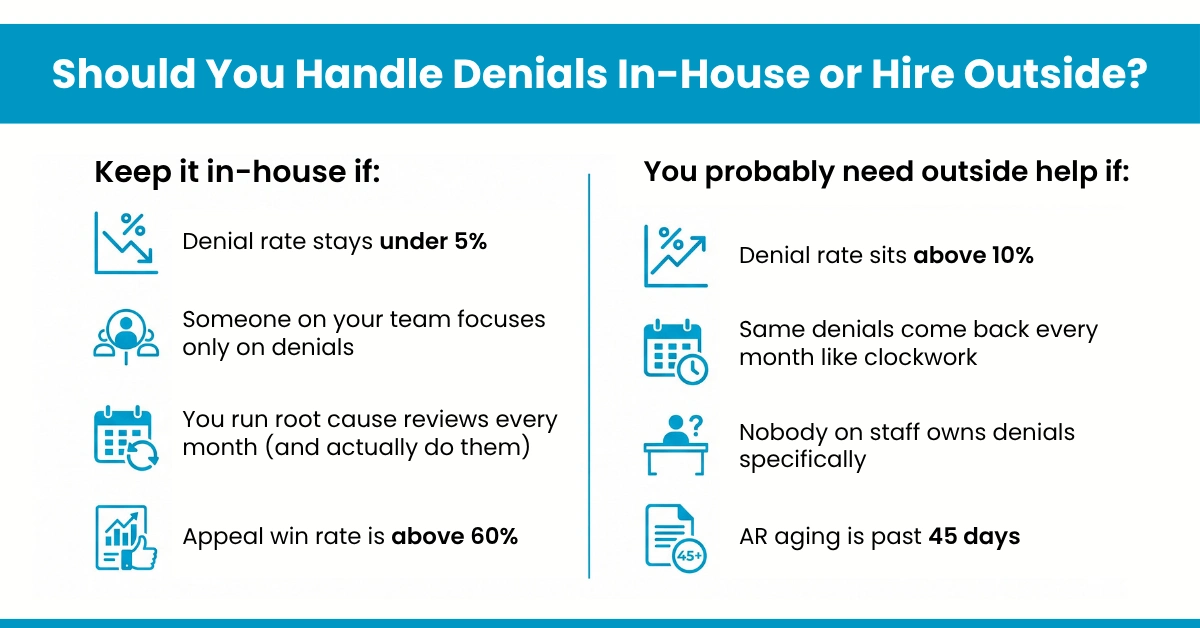
Not every practice needs to be outsourced. Here’s how we help clients figure it out.
You’re fine in-house if:
You probably need outside help if:
Our guide on In-House vs. Outsourced Home Health Billing: True Costs explain everything you searching right now.
Before you sign with any billing company, ask them these five things:
If they can’t answer those, keep looking.
How can I reduce medical claim denials? Start with that diagnostic chart. Find your top 3 denial categories. Attack them with the feedback loop. Prevention is cheaper than rework. It always is.
Book a free denial audit with HelloMDs We’ll show you where the money’s leaking and how to plug it.
Follow us on Facebook and Instagram for weekly billing tips.
This article draws on authoritative sources, including CMS.gov prior authorization guidelines and appeals procedures, HFMA rework cost data, MGMA denial rate benchmarks, and KFF research on health insurance claim denials. HelloMDs-specific performance information is based on data published on hellomds.com. AI tools were used to support research, editing, and formatting. Visuals throughout this article were created with the assistance of AI to enhance clarity, illustrate key concepts, and support the educational purpose of the content.