
Supplier Enrollment

DMEPOS Supplier Enrollment Moratorium Ends August 2026

Home / DMEPOS Supplier Enrollment Moratorium

On August 27, 2026, CMS lifted the DMEPOS supplier enrollment moratorium it had imposed six months earlier. If you run or manage a durable medical equipment, prosthetics, orthotics, and supplies (DMEPOS) company, the freeze on new Medicare DMEPOS enrollment applications is over, but a filing backlog and a 36-month ownership rule are not. Here’s exactly what changed, who it touches, and what to do this week.

What Is the DMEPOS Enrollment Moratorium?

The DMEPOS supplier enrollment moratorium was a six-month freeze on new Medicare supplier enrollment applications for seven categories of DMEPOS “medical supply companies,” effective February 27, 2026, per CMS’s original Federal Register notice.

Key facts on how it worked:

  • Legal basis: CMS acted under its authority at 42 CFR § 424.570, citing years of fraud tied to off-the-shelf orthotic braces and urinary catheters.
  • Who it blocked: Brand-new DMEPOS applicants, and any supplier undergoing a change in majority ownership.
  • Who it didn’t touch: Already-enrolled suppliers, who kept billing, submitting claims, and updating their enrollment records as usual.
  • How it was enforced: NPE Contractors denied any new or ownership-change DMEPOS enrollment application filed after the effective date.

If your practice needs help sorting a stalled application from a denied one, HelloMDs’ enrollment and credentialing team can walk through your PECOS status with you.

Why Did CMS Impose the DMEPOS Moratorium?

CMS cited a combination of factors behind the decision:

  • OIG findings on billing schemes involving intermittent urinary catheters and off-the-shelf (OTS) braces.
  • Several multimillion-dollar fraud convictions tied to DMEPOS suppliers in recent years.
  • Supplier saturation: with more than 79,000 DMEPOS suppliers already enrolled nationwide, CMS’s fraud, waste, and abuse team determined beneficiary access wasn’t at risk from pausing new entrants.
  • A broader enforcement push: The moratorium fit into CMS’s Task Force to Eliminate Fraud, alongside separate hospice and home health enrollment moratoria that remain active today.

When Did the DMEPOS Moratorium End?

Yes, the DMEPOS enrollment moratorium expired on August 27, 2026, exactly six months after it began, and CMS did not renew it. NPE Contractors are now accepting initial DMEPOS enrollment applications again for all seven affected supplier types, confirmed on CMS’s Provider Enrollment Moratoria page.

What suppliers should know about the transition back to normal processing:
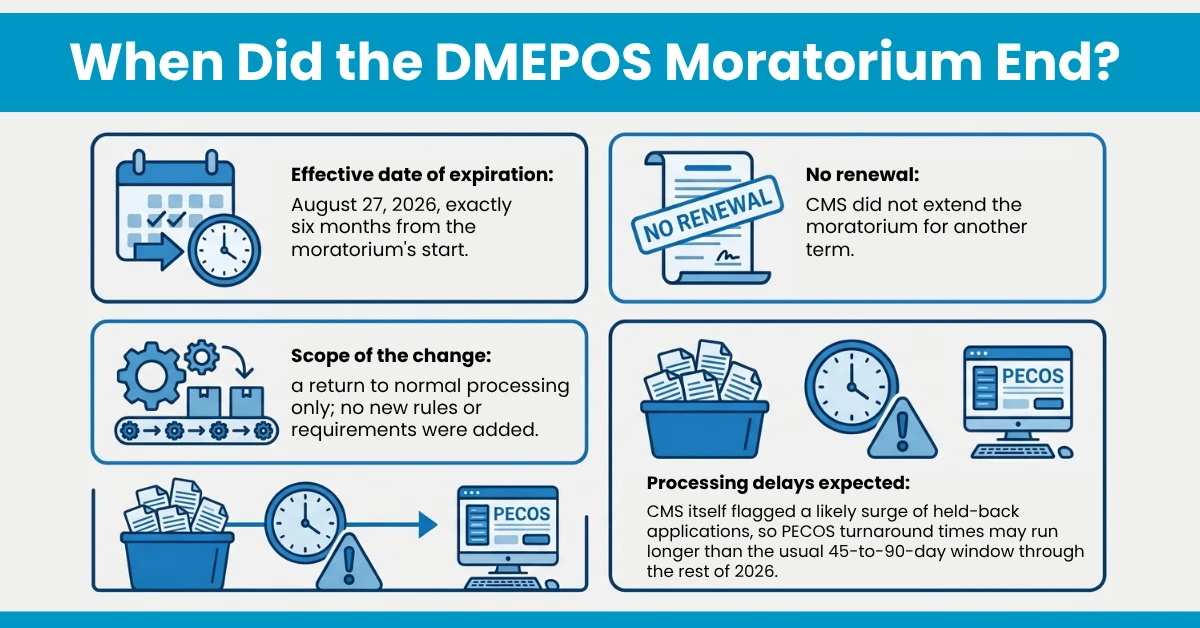
  • Effective date of expiration: August 27, 2026, exactly six months from the moratorium’s start.
  • No renewal: CMS did not extend the moratorium for another term.
  • Scope of the change: a return to normal processing only; no new rules or requirements were added.
  • Processing delays expected: CMS itself flagged a likely surge of held-back applications, so PECOS turnaround times may run longer than the usual 45-to-90-day window through the rest of 2026.

When Did the DMEPOS Moratorium End

Which DMEPOS Suppliers Were Affected?

Seven “medical supply company” categories were locked out of new Medicare DMEPOS enrollment while the moratorium was active.

All seven reopened on August 27, 2026:

DMEPOS Supplier Category

Distinguishing Personnel Requirement

Enrollment Status Now

Medical supply company

No specialized personnel required

Applications reopened

Medical supply company with orthotics personnel

Certified orthotist or orthotic fitter on staff

Applications reopened

Medical supply company with pedorthic personnel

Certified pedorthist on staff

Applications reopened

Medical supply company with prosthetics personnel

Certified prosthetist on staff

Applications reopened

Medical supply company with prosthetic and orthotic personnel

Certified prosthetist-orthotist on staff

Applications reopened

Medical supply company with registered pharmacist

Licensed registered pharmacist on staff

Applications reopened

Medical supply company with respiratory therapist

Licensed respiratory therapist on staff

Applications reopened

One state-level wrinkle to watch: Florida’s Agency for Health Care Administration (AHCA) ran its own Medicaid-specific DMEPOS moratorium, separate from CMS’s, and it stays in effect through September 20, 2026. If your DME business touches multiple states, our DME accreditation team can help you check for overlapping state rules before you file.

Does the DMEPOS 36-Month Rule  Still Apply?

No, the moratorium’s end doesn’t touch the DMEPOS 36-Month Rule. This is a separate, permanent CMS policy that suppliers need to track independently:

  • Effective date: January 1, 2026, CMS expanded this rule (42 CFR § 424.551) to DMEPOS suppliers, the same standard already used for home health agencies and hospices.
  • What triggers it: a change in majority ownership, with more than 50% direct interest changing hands.
  • Look-back window: 36 months from initial enrollment, or 36 months from the supplier’s last ownership change.
  • What’s required: a brand-new DMEPOS supplier enrollment application, not a simple change-of-information request.
  • Current status: unaffected by the moratorium’s expiration, it remains active, permanent CMS policy, and it’s exactly the kind of detail an acquisition due-diligence checklist can miss.

How Does This Affect DMEPOS Round 2028 Bidding?

CMS explicitly linked the moratorium’s end to the DMEPOS Competitive Bidding Program’s next cycle, Round 2028, urging suppliers who plan to bid to file enrollment applications immediately. Here’s why the timing matters:

  • A supplier needs active, unrevoked Medicare enrollment before CBIC will accept a Round 2028 bid.
  • Six months of paused applications, plus a post-moratorium filing surge, mean processing queues are longer right now, not shorter.
  • Suppliers who wait until the official bidding window opens to start enrollment risk missing it entirely.

Suppliers billing under our durable medical equipment specialty services should treat the next few months as prep time for Round 2028, not a waiting period.

What Should DMEPOS Supplier Do Next?

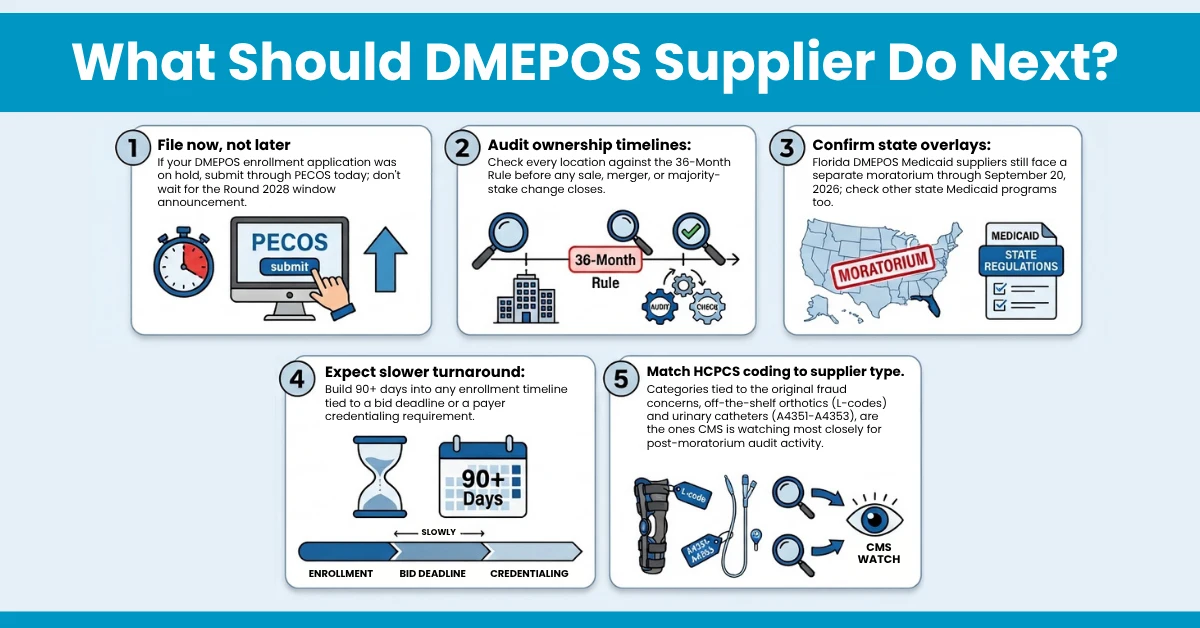
  • File now, not later: If your DMEPOS enrollment application was on hold, submit through PECOS today; don’t wait for the Round 2028 window announcement.
  • Audit ownership timelines: Check every location against the 36-Month Rule before any sale, merger, or majority-stake change closes.
  • Confirm state overlays: Florida DMEPOS Medicaid suppliers still face a separate moratorium through September 20, 2026; check other state Medicaid programs too.
  • Expect slower turnaround: Build 90+ days into any enrollment timeline tied to a bid deadline or a payer credentialing requirement.
  • Match HCPCS coding to supplier type. Categories tied to the original fraud concerns, off-the-shelf orthotics (L-codes) and urinary catheters (A4351-A4353), are the ones CMS is watching most closely for post-moratorium audit activity.

Not sure where your application stands, or worried an ownership change might trigger the 36-Month Rule? Talk to HelloMDs’ credentialing team before you files a rejected application costs more time than a five-minute review would have.
What Should DMEPOS Supplier Do Next

Conclusion

The DMEPOS supplier enrollment moratorium ran for six months and ended on August 27, 2026, with no renewal. CMS is back to normal processing for all seven affected supplier categories. Two things haven’t changed, though: The permanent 36-Month Rule on ownership changes, and Florida’s separate state-level Medicaid moratorium, which runs through September 20, 2026. With Round 2028 bidding on the horizon and a likely application backlog ahead, the practical move for any DMEPOS supplier is to file now, verify ownership timelines, and confirm state-specific rules before submitting.

If you’d rather have a credentialing specialist review your DMEPOS enrollment status before you file, schedule a consultation with HelloMDs.

Frequently Asked Questions

Yes. CMS counts calendar days, not business days, starting the day after SOC. A Friday SOC still allows until the following Wednesday to file.

No. Unlike RAP, the NOA is a one-time submission per admission that covers every contiguous 30-day period until discharge.

The agency corrects the error and resubmits. If a timely NOA needed correction (TOB 032D, then refiled), note that in the remarks field and append modifier KX so the original timely date carries over.

Not a signature specifically, but a written or verbal order from a physician or allowed practitioner, plus a completed initial visit, must come first.

Often, yes. Many MA plans mirror the traditional 5-day structure, but timelines and enforcement vary. Confirm requirements with each MA payer directly.

Leave a Reply

Your email address will not be published. Required fields are marked *

×

Request a Free Consultation