
A denied claim for CPT 64721 rarely comes down to the surgery itself; it’s a modifier, a mismatched diagnosis code, or a documentation gap that a payer’s system flags before anyone reviews the chart. Carpal tunnel release is one of the most frequently performed hand surgeries in the country, and 64721 is the code billed for the open version of that procedure.
This guide covers what 64721 actually includes, how it differs from the endoscopic code (29848), which ICD-10 code has to match it, whether Medicare covers the procedure, and the specific denial patterns our coding team sees most often on these claims.
CPT 64721 describes neuroplasty and/or transposition of the median nerve at the carpal tunnel and includes the open release of the transverse carpal ligament. The surgeon makes an incision in the palm, divides the transverse carpal ligament, and frees the median nerve, repositioning it too, if that’s part of the procedure.
The code bundles the full service into one line: The incision, exposing the ligament, dividing it, checking the nerve is fully decompressed, and closing the wound. Because it’s billed per wrist, a laterality modifier has to go with it every time.
Carpal tunnel release is one of the most common procedures orthopedic and hand-surgery practices bill, which is exactly why getting this single code right has an outsized effect on collections. Most claim problems with 64721 aren’t about whether the surgery was medically justified; they’re about how the claim line itself was built.
The same nerve decompression gets billed two different ways, depending on the surgical technique used:
64721 (Open) | 29848 (Endoscopic) | |
Technique | Open incision in the palm | Small incision, scope-guided |
Billed together, same wrist/session | No | No |
Endoscopic converts to open mid-surgery | Report this code | Not reportable |
As AAPC’s coding guidance on carpal tunnel procedures lays out, 64721 already includes 29848 when both approaches would apply to the same wrist during the same encounter; a payer’s system reads them as one decompression, not two separate services. If a surgeon starts endoscopically and switches to an open approach partway through, only 64721 goes on the claim.
Open release (64721): A well-established code most reviewers recognize immediately, with a documentation pattern that’s straightforward to match to the op note.
Endoscopic release (29848): Same reimbursement logic once billed correctly, but the op note needs more specific detail (scope entry, full visualization of the ligament before release); thinner notes here are a common reason coders default to 64721 by mistake.
Neither code is the “better” choice on its own: The correct code depends on the surgical approach actually performed and supported by the operative documentation. Do not select 64721 or 29848 based only on the planned procedure or diagnosis.
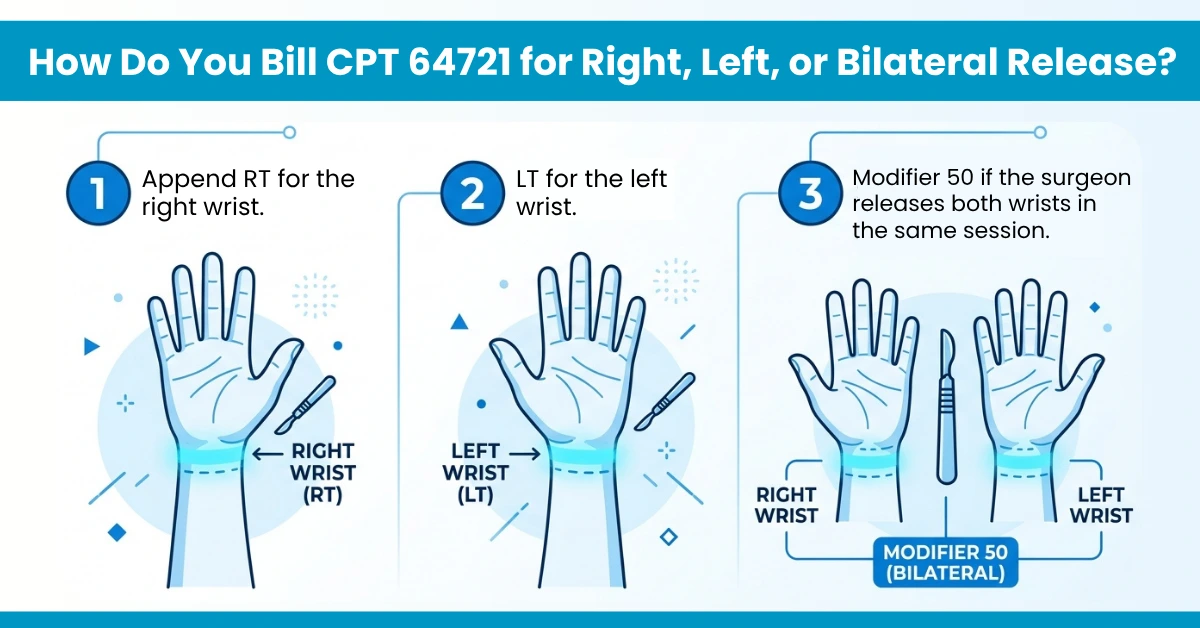
A laterality modifier does the work:
Some payers want a single line with modifier 50; others want two separate lines, each carrying RT or LT. Check the specific payer’s preference before submitting, since this is a common source of avoidable rejections.
This is also where a lot of “right carpal tunnel release” and “left carpal tunnel release” searches land: The CPT code itself doesn’t specify a side, so the modifier is what makes the claim specific.
The category-level code, G56.0, isn’t billable on its own; it needs a fourth digit specifying which side is affected:
A mismatch between the diagnosis code’s side and the procedure modifier’s side is one of the more common, entirely avoidable reasons these claims come back. If the op note says “right,” the diagnosis code and the modifier both need to say right; pulling the diagnosis from an older note or a different visit is a frequent source of this error.
There’s no blanket federal coverage policy written specifically for carpal tunnel release surgery. Medicare Part B and Medicare Advantage plans cover it case by case once a physician documents medical necessity; current policy language for a given jurisdiction is searchable in the CMS Medicare Coverage Database. Most plans expect a documented trial of conservative treatment first: Wrist splinting, anti-inflammatory medication, or a corticosteroid injection that didn’t provide lasting relief, along with exam findings or nerve conduction testing pointing to median nerve compression.
Commercial payers generally follow the same logic. A prior authorization request that skips straight to “surgery recommended” without documenting what was tried first is far more likely to come back for additional information.
Three patterns account for most of the denials our coding team sees on carpal tunnel release claims:
All three are documentation and coding-line issues, not clinical ones, which is what makes them preventable before the claim ever goes out.
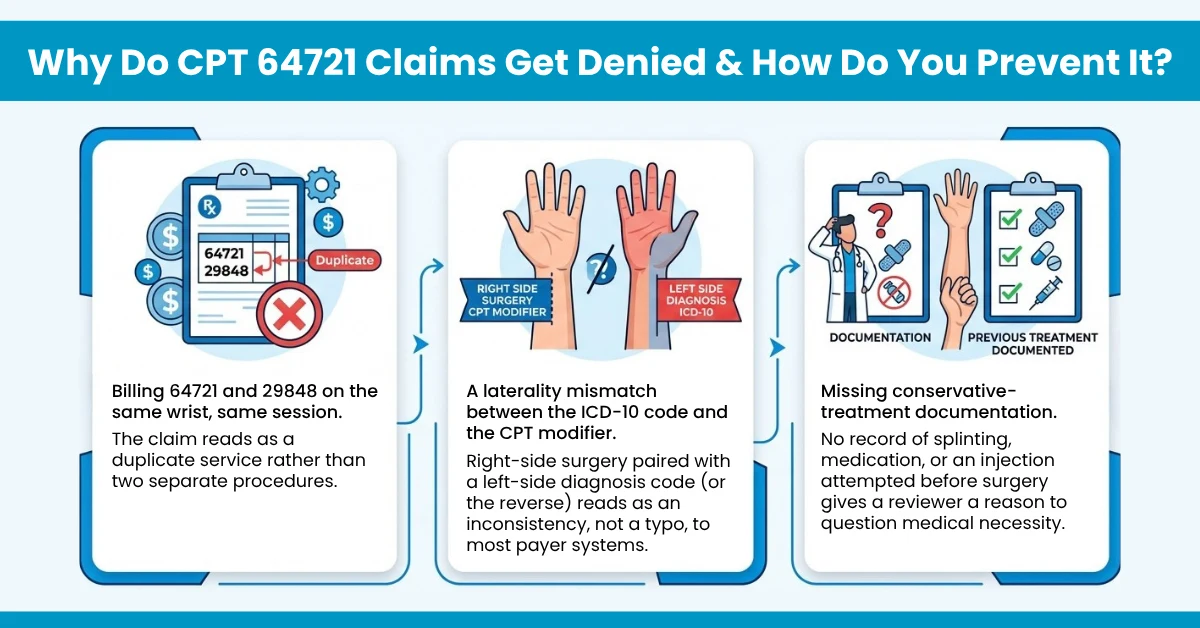
64721 is a high-volume, predictable code, which is exactly why small, repeatable errors on it add up faster than they would on a rarer procedure. Matching the CPT modifier to the ICD-10 laterality, choosing the code for the surgical approach actually performed, and documenting conservative treatment before surgery cover most of what a payer’s system checks before a person ever sees the claim, and a solid prior authorization request up front avoids a chunk of these problems before surgery even happens.
If your practice keeps seeing repeat denials on carpal tunnel release claims, HelloMDs’ medical coding and denial management teams can run a free audit of your recent claims and show you exactly where the pattern is breaking down. Get a free coding and denial audit.