
Three infusion codes sit on the same decision tree: 96360, 96365, and 96374. Coders mix them up more often than payers allow, and that single mix-up causes a large share of infusion denials. CPT code 96365 covers the first hour of a non-chemo IV infusion, but only under specific timing and drug rules that trip up even experienced billers.
This piece breaks down what 96365 covers, where it splits from 96360 and 96374, how the JZ modifier changed drug-waste billing in 2023, and why a drug like Injectafer bills under 96365 without ever touching a chemo code. Every rule below traces back to CMS billing policy and CPT guidance, not guesswork.
96365 reports the first hour of an IV infusion given for a therapeutic, prophylactic, or diagnostic reason. A single drug or substance running through the line, not plain fluids and not a chemo agent. Picture IV antibiotics for an infection, a pre-op antibiotic, a biologic infusion, or IV contrast before imaging; all of those land under 96365.
Two limits define the code. It doesn’t cover the drug itself; that’s billed under its own J-code separately. And the clock matters: Most payers, Medicare included, expect the infusion to run past 15 minutes before 96365 applies. Anything shorter belongs under an IV push code (96374), covered next.
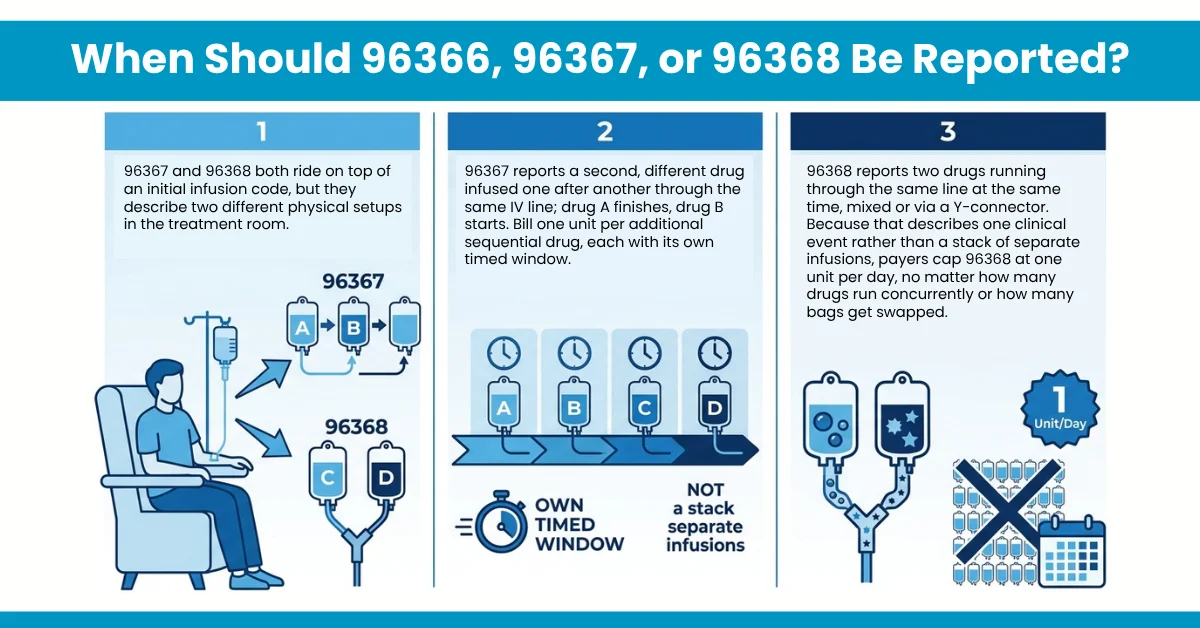
96365 is billed once per encounter as the “initial” service. A second drug on the same visit moves to an add-on code, 96366 for another hour of the same drug, or 96367 for a different one.
The easiest way to distinguish these codes is to identify what is being administered and how it is administered.
Code | What it covers | Time | Add-on for more |
96360 | Hydration only (saline/electrolytes, no drug) | Initial hour | 96361 (each additional hour) |
96365 | Therapeutic, prophylactic, or diagnostic drug infusion | 16 min to 1 hour | 96366 (each additional hour) |
96374 | IV push of any substance or drug | 15 minutes or less | 96375 (each additional push, new drug) |
Infusion and IV push services are not interchangeable. The documentation should support the method and duration of administration under the applicable CPT rules.
Also, saline used as a carrier fluid does not automatically make an encounter hydration. CMS states that fluid used to administer a drug is considered incidental hydration and is not separately reportable simply because it was used with the medication.
Both codes need their own start and stop documentation. A biller who logs one combined time block for a sequential pair, instead of two separate windows, hands the payer an easy reason to downcode the claim.
Yes, the separately payable drug may be reported with its appropriate HCPCS code in addition to 96365.
Take Injectafer (ferric carboxymaltose), a common IV iron drug for iron-deficiency anemia. It bills under J1439, one unit per milligram, paired with either 96374 (if pushed) or 96365 (if infused over time), never a chemo code, even though it’s given by infusion. Both the J-code and the administration code belong on the claim; dropping either one is a near-certain partial denial. (An oral drug with no dedicated code falls back to J8499, a rare situation for infusion-heavy visits, but worth knowing the code exists.)
Saline gets its own two codes, J7030 (1000 mL) and J7040 (500 mL), but they’re rarely payable next to 96365. CMS treats the fluid that carries a drug as incidental to that drug’s infusion, not a billable line on its own. Saline only earns separate payment when rehydration is the actual reason for the visit documented as such.
One more line item belongs on every drug claim now: The JZ modifier. Since July 1, 2023, CMS has required JZ on any single-dose-vial drug claim where nothing got thrown away, and JW on the line where a leftover amount did. Skip both modifiers on a single-dose drug, and the claim can come back unprocessable, not just underpaid.
CPT splits infusion drugs into two buckets, and the split isn’t cancer versus everything else. The dividing line is complexity.
Codes 96401 through 96549 cover chemotherapy and other drugs CPT defines as “highly complex”, a category that includes some non-cancer biologics too, per Johns Hopkins Medicine’s infusion coding guidance, because complexity is measured by the monitoring and risk a drug demands, not its diagnosis code. 96413 is the initial-hour version of that bucket; 96417 adds a second, different highly complex drug at the same sitting. Anything that doesn’t meet that complexity bar, cancer-related or not, stays under 96365.
This mix comes up constantly in oncology billing: a patient gets a chemo drug (96413) plus an anti-nausea drug on the same line. That anti-nausea drug isn’t chemo administration; CMS specifically excludes anti-emetic and anti-anemia drugs from the chemo definition, so it rides in as a non-chemo add-on (96366, 96367, or 96368) attached to the 96413 encounter, not as its own 96365 line.
Getting this split backward is one of the fastest ways to trigger a coding audit in an oncology practice.
Four issues account for most 96365 denials:
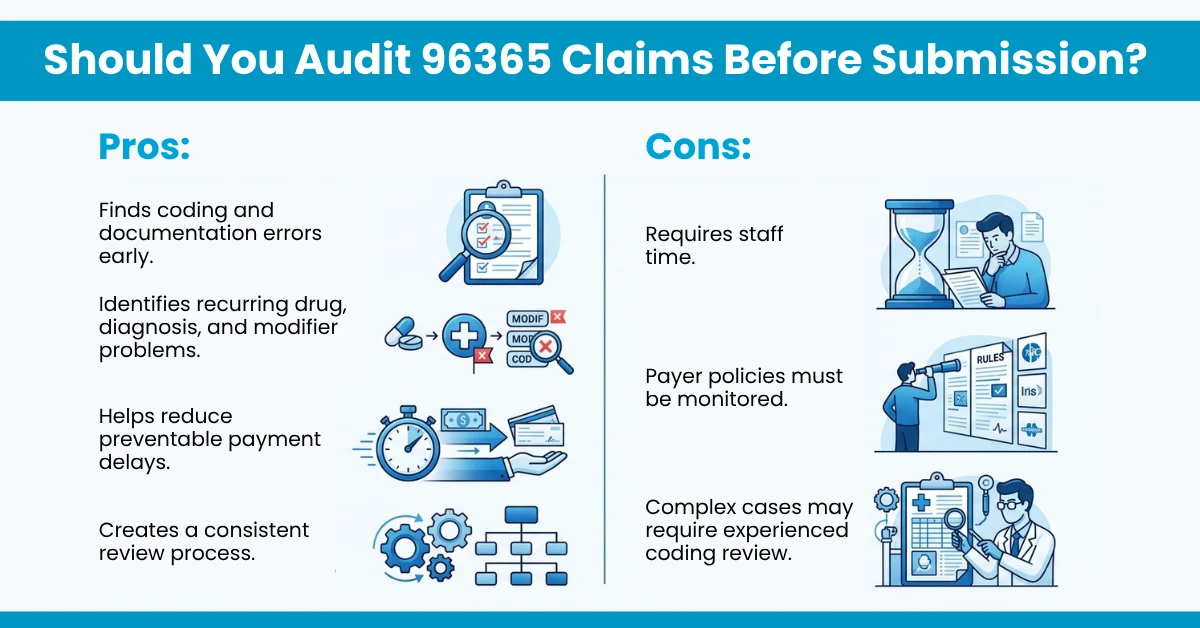
For high-volume infusion practices, a pre-bill review can catch problems before they become denials.
Pros:
Cons:
For practices experiencing recurring infusion denials, internal pre-bill checks plus periodic external coding review can provide stronger protection than relying only on denial follow-up.
CPT code 96365 billing requires more than selecting an IV infusion code. Verify the drug, diagnosis, administration time, sequencing, documentation, and applicable JW/JZ requirements before submitting the claim.
For recurring 96365 denials, reviewing the complete claim workflow can uncover preventable revenue leaks. HelloMDs helps medical practices improve coding, billing, denial management, and reimbursement.