
Home health agencies lose real revenue every day a claim sits unworked, miscoded, or denied. The real question isn’t whether billing matters; it’s who should run it. Should your agency build an in-house home health billing team, or move to outsourced home health billing? The honest answer depends on numbers most agencies never fully add up: Salary, software, training, staff turnover, and the claims that stall when your only biller calls in sick. This home health billing cost comparison breaks down the true price of both models, shows where the hidden costs of in-house billing hide, and explains how coding accuracy under PDGM protects your reimbursement. HelloMDs has spent 15+ years inside this exact decision with agencies nationwide.
In-house home health billing costs far more than one paycheck. The real number includes payroll taxes, benefits, software, clearinghouse fees, continuing education, and the revenue lost every time a claim waits.
Outsourced home health billing typically replaces fixed payroll with a service fee, either a flat rate or a percentage-based billing fee tied to what your agency actually collects. HelloMDs, for example, prices plans starting as low as 2.95% of monthly collections, so the cost moves with revenue instead of sitting on the books as fixed overhead.
A full-service home health billing partner typically includes:
The clearest way to compare home health billing cost is side by side. Here’s how the total cost of ownership stacks up:
Cost Factor | In-House Billing | Outsourced Billing |
Staffing | Salary + benefits, ~$60K+ per biller | Included in service fee |
Software & clearinghouse | Thousands per year, agency-paid | Included |
Training & continuing education | Ongoing, agency-funded | Included |
Coverage during PTO or turnover | Gaps likely | Built-in team redundancy |
Denial management | Requires a dedicated hire | Included as standard |
Pricing model | Fixed cost regardless of collections | Starts at 2.95% of monthly collections |
Scalability | Requires new hires to grow | Moves automatically with claim volume |
Fixed in-house costs stay the same in a slow month. Outsourced fees move with collections, which matters more as Medicare tightens home health payments.
Most home health denials trace back to coding, not the care itself. A wrong HCPCS code, a mismatched ICD-10-CM diagnosis, or a claim billed under the wrong code set turns a clean claim into a stalled claim.
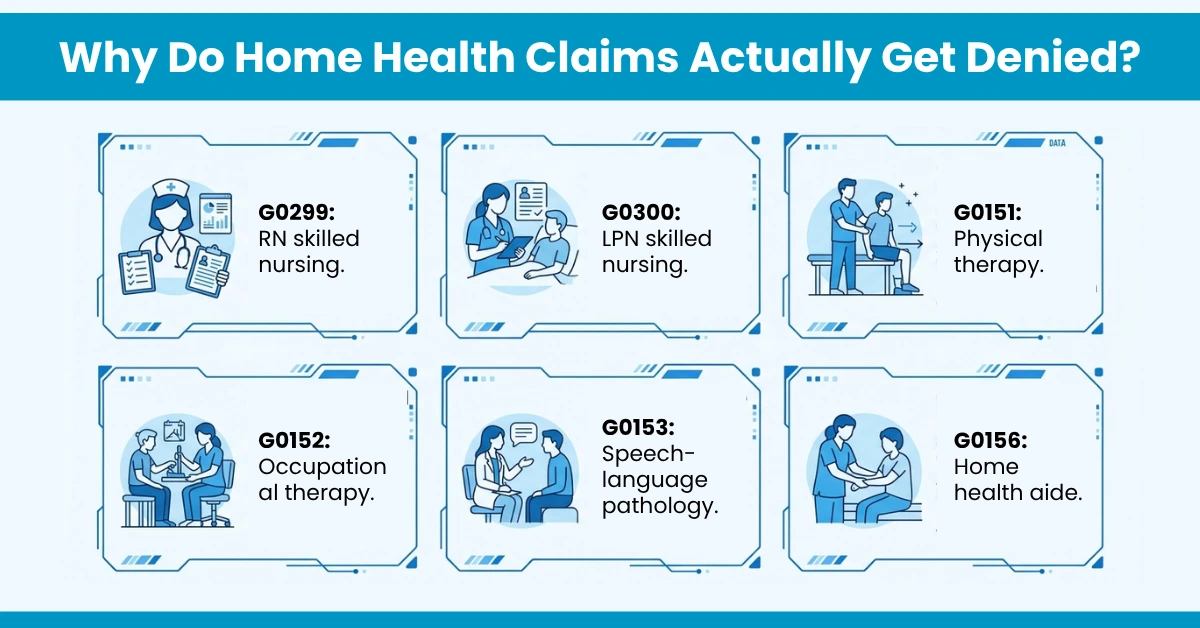
Visit-level billing relies on discipline-specific HCPCS Level II G-codes, reported in 15-minute increments, one G-code per visit, regardless of how many services were provided during it:
Physician oversight billing is a common, avoidable source of denial. Medicare pays G0180 (certification), G0179 (recertification), and G0181 (30+ minutes a month of care plan oversight), not the equivalent CPT codes 99374-99375, which aren’t payable under the Medicare Physician Fee Schedule. Billing the CPT version instead of the correct HCPCS code is a quiet, common way to lose a claim.
On the diagnosis side, the principal ICD-10-CM code (for example, I50.9 or E11.9) drives the PDGM case-mix group and the resulting HIPPS code. A miscoded diagnosis can quietly downcode an entire 30-day payment period; pairing the right G-code, revenue code, and payer-specific modifier is what keeps a claim clean the first time.
Yes, when the team behind it specializes in home health billing. HelloMDs’ AAPC-certified coders maintain a 99% first-pass ratio and a 97% first-pay ratio, and have helped agencies cut denial rates by 15%, thereby shortening DSO and steadying cash flow.
That accuracy matters more now than it used to. CMS’s finalized CY2026 Home Health Prospective Payment System rule cuts aggregate Medicare home health payments by 1.3%, on top of a permanent PDGM behavior adjustment. The National Alliance for Care at Home, the industry’s leading advocacy group, has pushed back on the reduction, but home health payments are moving in one direction: Down. A denied or downcoded claim now costs an agency more than it did a few years ago.
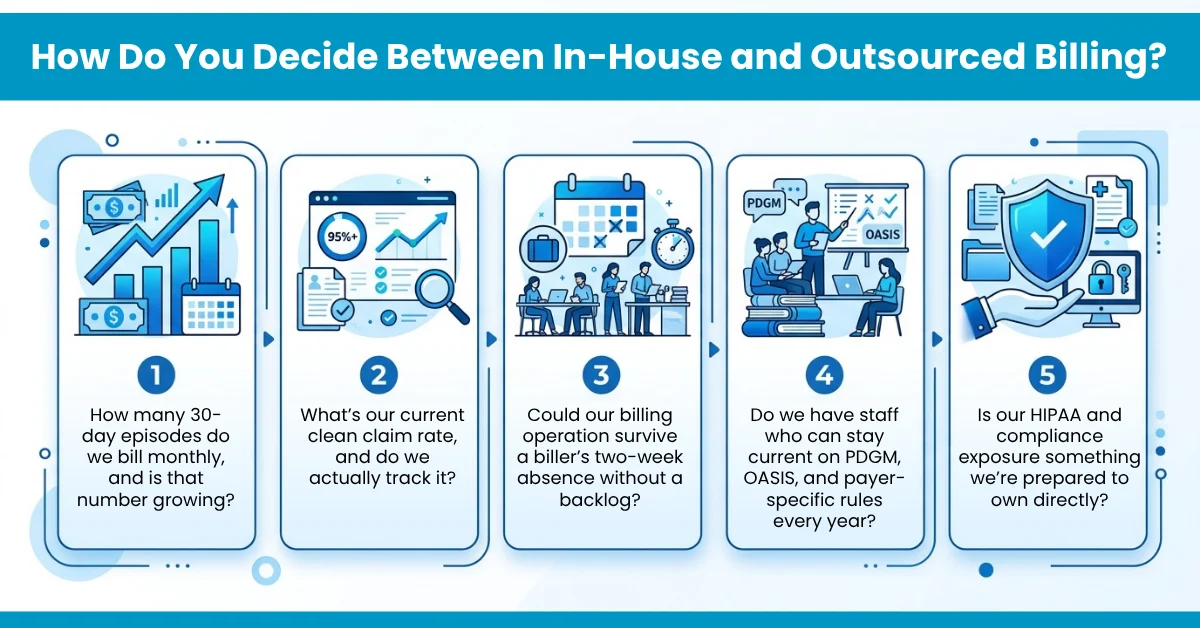
There’s no universal answer. The right call depends on your agency’s size, growth plans, and current denial rate. Ask:
Agencies with high claim volume and a stable, experienced team sometimes make in-house billing work. Most others find the math and the denial rate favors outsourced home health billing.
In-house home health billing and outsourced home health billing both cost money. The difference is whether that cost is fixed and hidden, or variable and visible. Once you count salary, software, training, turnover, and denied claims, most agencies find outsourcing protects more revenue than it spends.
Schedule a free billing audit with HelloMDs to see exactly where your agency’s claims are getting stuck, and what switching could save you.