
If your cardiology claim for a coronary CT angiography (CCTA) just got denied, or you’re unsure whether CPT code 75574 covers calcium scoring too, you are not alone. Billing errors on this code cost cardiology practices thousands of dollars every month, and most of the time, the fix is simpler than you think.
This guide breaks down everything: the description, Medicare coverage, medical necessity rules, correct ICD-10 codes, how it compares to 75571, 75572, and 75573, the 2026 Medicare reimbursement update, and the billing traps that quietly drain your revenue.
CPT 75574 describes a Coronary Computed Tomographic Angiography (CCTA) performed with contrast material and 3D image postprocessing to evaluate:
75574 = Coronary CT angiography with contrast + 3D post processing.
This is a diagnostic cardiovascular imaging test, not a general CT scan.
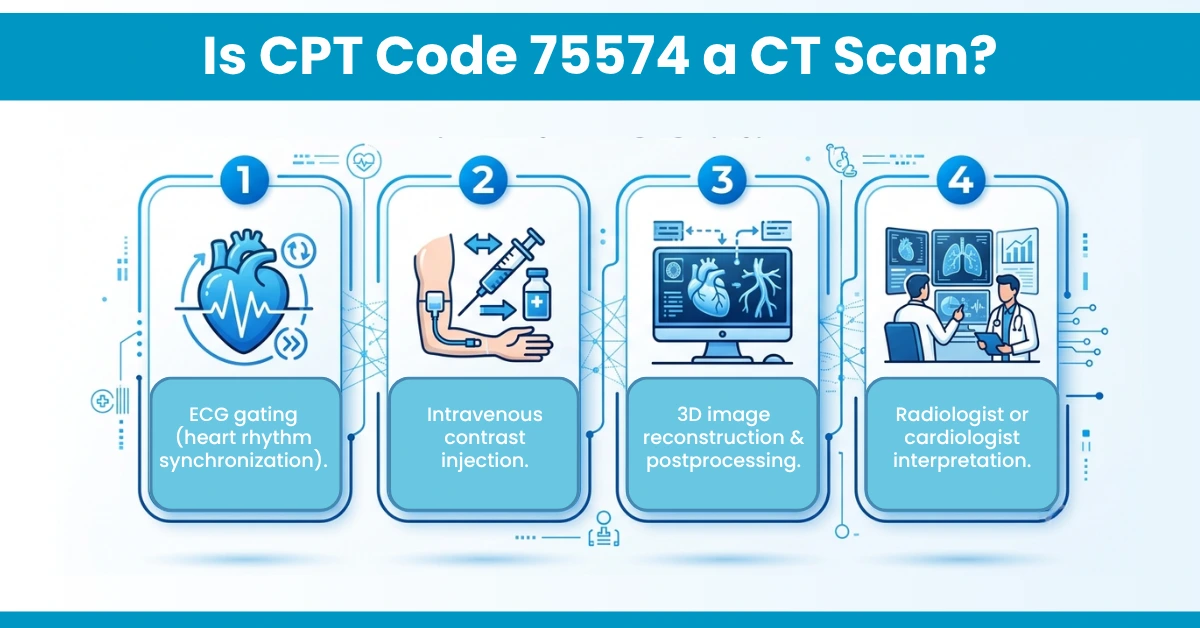
Yes, but a highly specialized cardiac CT angiography, not a routine CT chest.
It requires:
Unlike traditional CT imaging, CPT 75574 specifically evaluates coronary arteries and blood flow patterns without invasive cardiac catheterization. According to the American College of Cardiology (ACC), CCTA has a negative predictive value exceeding 97% for ruling out obstructive coronary artery disease.
This is one of the most misunderstood billing questions in cardiology coding.
According to CMS LCD L33559, calcium scoring is:
“Calcium scoring isn’t separately payable when done with CT angiography.â€
Billing Rule Summary:
The Audit Risk:
One of the most common cardiology billing mistakes is submitting 75571 & 75574 for the same clinical encounter without supporting documentation or payer guidance.
Understanding the full CCTA family prevents undercoding and overcoding.
CPT Code | Primary Focus | Contrast Used | Key Distinction |
75571 | Calcium scoring | No | Screening/Preventive only. |
75572 | Structure & morphology | Yes | Focuses on chamber/valves; no coronary vessel evaluation. |
75573 | Congenital heart disease | Yes | Focus on complex birth-related structural anomalies |
75574 | Coronary CT angiography | Yes | The Gold Standard for vessels, grafts & structure |
75580 | FFR-CT analysis | Uses prior CTA data | Advance flow assessment |
Critical Billing Distinction
Misusing these codes leads to undercoding or payer denials.
Yes, Medicare covers CPT 75574, but with strict conditions.
Medicare Medical Necessity Requirements
According to CMS (Centers for Medicare & Medicaid Services) and Local Coverage Determinations (LCDs), coverage typically requires:
Not Covered:
Is There an Age Limit?
Medicare doesn’t set a strict age cap, but medical necessity documentation becomes more critical for patients under 40 or over 80. Some commercial payers impose age-based restrictions (typically 18+ for standard CCTA), so always verify payer-specific criteria before submitting.
CPT 75574 has no official age limit, but clinical guidelines recommend it primarily for patients with symptoms or high-risk factors.
Pairing the right ICD-10 code with your CCTA claim is where most denials begin. These are the most commonly accepted diagnosis codes:
The Screening Trap: Using Z13.6 (Encounter for screening for cardiovascular disorders) alone as the primary diagnosis for a Medicare CCTA claim almost always triggers a denial. Screening is a non-covered benefit; you must lead with a symptomatic or risk-based ICD-10 code.
Patient costs vary significantly depending on location, payer, and facility type.
Typical Cost Range:
Medicare Reimbursement (2025 Trend)
Modifiers Used:
HelloMDs cardiology billing specialists handle modifier application, NCCI edits, and payer-specific bundling for CCTA claims, reducing denials before they happen. Our team maintains a 99% first-pass ratio across cardiology specialties.
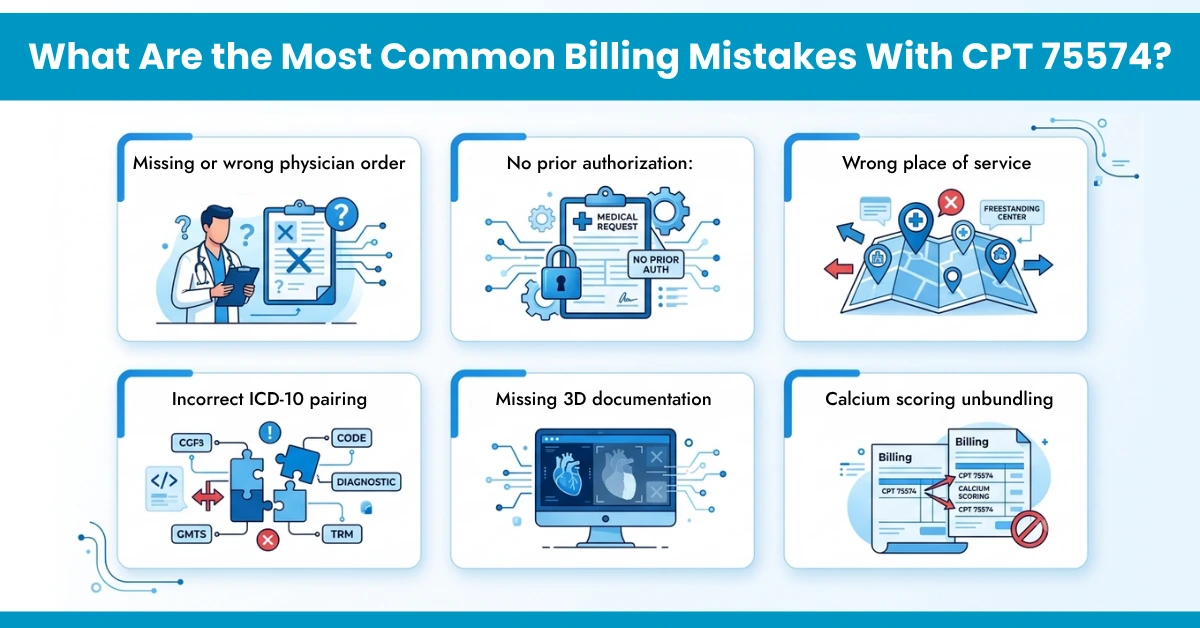
These are the denial triggers most billing guides never explain clearly:
HelloMDs offers Denial Management Service and Medical Billing Audits specifically designed to catch these errors before they cost your practice money.
Cardiac imaging is evolving rapidly.
New technologies now support:
As these technologies expand, documentation requirements and payer scrutiny are increasing.
Practices that fail to update coding workflows may experience more denials and reimbursement delays.
CPT code 75574 is one of the highest-value imaging codes in cardiology billing and one of the most frequently denied. Getting it right means understanding the difference between related codes, pairing the correct ICD-10 diagnoses, applying modifiers accurately, knowing when prior authorization is required, and understanding that calcium scoring is included when performed during the same session.
At HelloMDs, our AAPC-certified coders and cardiology billing specialists manage every step, from eligibility verification and prior authorization to denial resolution and AR follow-up. We serve cardiology practices nationwide, from Texas to New York, with transparent reporting and a proven 99% first-pass ratio.
This article is provided to improve understanding of CPT 75574 billing, coding practices, and reimbursement trends. It is not a substitute for official coding manuals, payer policy updates, or professional clinical billing guidance. Healthcare regulations, payer rules, and CMS policies may vary and change over time. Always verify before making any decisions. Some images used in this article are created with the help of AI.