
Billing CPT code 76942 looks routine, until the denial lands. The procedure happened, the physician used real-time ultrasound, the note is there, yet the claim comes back rejected and nobody can explain why.
CPT 76942 is surrounded by bundling traps, strict documentation rules, and 2026 policy changes that most billing guides never fully explain. If your practice treats diabetic patients, the risk is even higher. This population needs guided procedures more often, and their claims carry the strictest medical necessity scrutiny.
This guide covers the 2026 MPFS cut, medical necessity language that holds up on audit, correct ICD-10 pairing for diabetics, and the modifier mistakes draining revenue right now.
The American Medical Association (AMA) defines CPT 76942 as: “Ultrasonic guidance for needle placement (e.g., biopsy, aspiration, injection, localization device), imaging supervision and interpretation.”
This is a radiology add-on code. It reports real-time ultrasound guidance alongside a primary procedure, the physician guides the needle, monitors placement on live imaging, and produces a documented interpretation. It is not a standalone diagnostic ultrasound, and it is only valid for non-vascular targets. When the needle enters a vein or artery, the correct code is CPT 76937. Confusing the two is one of the most flagged errors in radiology audits.
Procedures Commonly Paired With CPT 76942
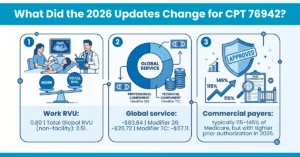
The 2026 MPFS Final Rule finalized a -2.5% efficiency adjustment on work RVUs for all non-time-based services. CPT 76942 took this cut directly. Current 2026 figures:
NCCI Version 32.0 (January 1, 2026) and the Q2 2026 update (April 1, 2026) refined PTP edits and MUEs for imaging guidance codes. The MUE for CPT 76942 is 1 unit per patient encounter; billing more triggers an immediate audit flag.
For high-volume specialties like endocrinology, orthopedics, and radiology, the only practical response to this revenue reduction is ensuring every eligible claim is documented cleanly and submitted correctly the first time.
CPT 76942 cannot stand alone. It always requires a primary procedure code. The denial happens when coders pair it with a code that already includes guidance.
Code | Pair With 76942? |
10005, 10006: FNA with ultrasound | Guidance already included |
62321, 62323: Epidural injections | Bundled per NCCI |
32554–32557: Thoracentesis | Bundled into descriptor |
20610, 20611: Major joint injection | Yes, with real-time documentation |
19083: Breast biopsy | Yes, when separately documented |
60100: Thyroid biopsy | Yes, most common pairing |
Two rules important for you:
This is the primary denial reason per CMS Local Coverage
Determinations (LCDs) and First Coast Medicare contractor reviews.
CMS is clear: convenience alone does not establish medical necessity.
The note must explain why blind or palpation-based placement was insufficient for that patient. These specific phrases satisfy payer LCD requirements and survive appeal:
Required documentation elements on every claim:
Diabetic patients need ultrasound-guided procedures far more often than the general population. Most billing guides never address this, yet it directly affects claim volume and denial risk for endocrinology, podiatry, nephrology, and internal medicine practices.
Why do diabetics need this code more often:
ICD-10 Codes for Diabetic Patients Using CPT 76942
Code to the highest level of specificity:
Always sequence the diabetic complication first, then the anatomical condition. That pairing makes medical necessity clear to the payer and reduces denials significantly.
The wrong modifier in the wrong setting causes consistent underpayment on this code.
Based on our RCM experience, these are the four most common denial types and their direct fixes:
CPT code 76942 rewards precise documentation and strategic billing. The 2026 MPFS cut reduced reimbursement. NCCI Q2 updates tightened PTP edits. Commercial payers are adding prior authorization, especially for diabetic populations with repeat guided procedure needs.
The fix is four things on every encounter: a specific medical necessity statement, the right ICD-10 pair, a retained permanent image, and the correct modifier for the place of service. When all four align, this code pays cleanly and holds up on audit.
At HelloMDs, our AAPC-certified coders handle this from charge capture to denial resolution for practices across all 50 U.S. states, specializing in radiology, endocrinology, orthopedics, and every specialty where CPT 76942 appears regularly.
The information in this article is for educational purposes only and does not constitute medical, legal, or financial advice. CPT codes, ICD-10 codes, modifiers, and reimbursement figures are subject to change. Always verify current guidelines with the AMA, CMS, and your payer contracts before submitting claims. Some visuals used in this article are AI-generated for illustrative purposes only.