
Medical Billing

Is Outsourcing Medical Billing Worth It? 2026 Cost Check

Home / Is Outsourcing Medical Billing Worth It

Is outsourcing medical billing worth it? For many healthcare practices, it can be especially when claim denials, delayed payments, staff shortages, and rising administrative costs affect cash flow.

Small practices with limited billing resources may benefit most. Larger groups with experienced staff, low denial rates, and steady collections may save money by staying in-house.

The right decision depends on your actual costs, claim volume, payer mix, and vendor performance. This article breaks down pricing, break-even calculations, potential drawbacks, and questions to ask before hiring a medical billing company.

What Does Medical Billing Outsourcing Include?

Medical billing outsourcing means hiring a third-party company to manage some or all of your practice’s billing and revenue cycle management (RCM).

Depending on your contract, outsourced medical billing services may cover:

  • Insurance eligibility and benefits verification.
  • Medical coding using CPT, ICD-10-CM, and HCPCS code sets.
  • Claim submission through a clearinghouse.
  • Payment posting and claim reconciliation.
  • Denial management, appeals, and accounts receivable (A/R) follow-up.
  • Patient statements and billing inquiries.

Your practice remains responsible for accurate clinical documentation and appropriate oversight. A billing company should define its duties, reporting requirements, and security obligations in writing.

Under CMS’s HIPAA guidance, covered entities generally need a written business associate agreement (BAA) with vendors performing covered functions involving protected health information.

What Does Outsourcing Medical Billing Cost in 2026?

Medical billing companies commonly charge a percentage of collections, a fee per claim, or a fixed monthly amount. Percentage-based quotes vary by specialty, claim volume, service scope, and the revenue used to calculate the fee.

Common pricing structures include:

  • Percentage of collections: A negotiated share of collected revenue. Quotes around 4%–10% are commonly advertised, though actual offers vary.
  • Per-claim pricing: A set fee for each claim handled.
  • Monthly fee: A fixed amount based on practice size or service requirements.
  • Hybrid pricing: A base fee plus charges tied to volume or specific tasks.

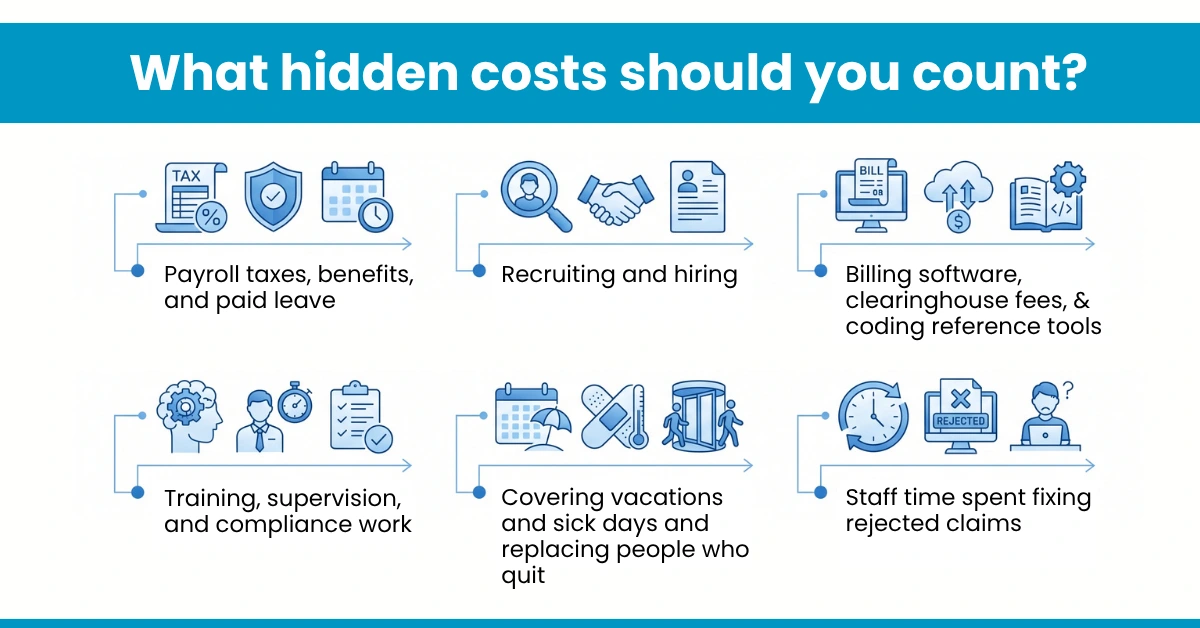
What hidden costs should you count?

This is where most owners get a surprise. Salary is just the starting point. The U.S. Bureau of Labor Statistics put median pay for medical records specialists at $51,140 a year (May 2025). That job includes coding work too, so treat it as a ballpark not an exact salary for your biller.

On top of salary, you are also paying for:

  • Payroll taxes, benefits, and paid leave
  • Recruiting and hiring
  • Billing software, clearinghouse fees, and coding reference tools
  • Training, supervision, and compliance work
  • Covering vacations and sick days and replacing people who quit
  • Staff time spent fixing rejected claims

Offshore medical billing can come in cheaper. Before you jump, compare the fine print: same services, same security, same ability to reach a real person when you need one?
What hidden costs should you count

Is Outsourcing Medical Billing Worth It for Your Practice?

The honest answer: it depends on your collections. Here’s a simple table with round numbers not a quote, just math you can redo with your own figures.

Annual collections

Outsourcing at 4%–7%

At HelloMDs’ advertised starting rate of 2.95%

$600,000

$24,000–$42,000

$17,700

$1.6 million

$64,000–$112,000

$47,200

$3 million

$120,000–$210,000

$88,500

HelloMDs advertises rates starting at 2.95% of monthly collections. Always confirm the exact rate, how the fee is calculated, what’s included, and what costs extra in writing. More details on the medical billing services page.

Two things the table doesn’t show:

  • The vendor fee is a cost, but better billing can also bring in more money, fewer denials, faster payments, old claims finally recovered.
  • A percentage fee grows as your collections grow. So the math works best for smaller practices and gets closer for bigger ones.

What five warning signs suggest outsourcing may be worth considering?

Pull your own numbers, especially if you are running medical billing for a small practice. If any of these sound familiar:

  • Denials keep coming back: Your team resubmits claims, but the same problems repeat.
  • Claims sit unpaid: A/R keeps aging 60 days, 90 days, longer.
  • You’re collecting less than you should: Write-offs and adjustments quietly eat your revenue.
  • One person holds it all together: If your biller quits or gets sick, billing stops.
  • You’re growing fast: Claim volume is outpacing what your team can handle.

If that’s you, outsourcing can bring certified coding expertise, real denial follow-up, and reports you can use. One honest limit: no billing company can fix missing documentation or wrong patient details on its own. That part still needs your team.

When Is Keeping Medical Billing In-House the Better Choice?

Stay in-house if your team is stable, denials are low, A/R is under control, and your reporting is clean. A larger practice with steady, high claim volume can spread salary and software costs across enough claims to make its own department worth it.

And here’s something some vendors won’t tell you: a really good in-house biller beats a mediocre outsourcing company. Look at your actual results before you change anything.

The pros and cons of outsourcing medical billing, straight

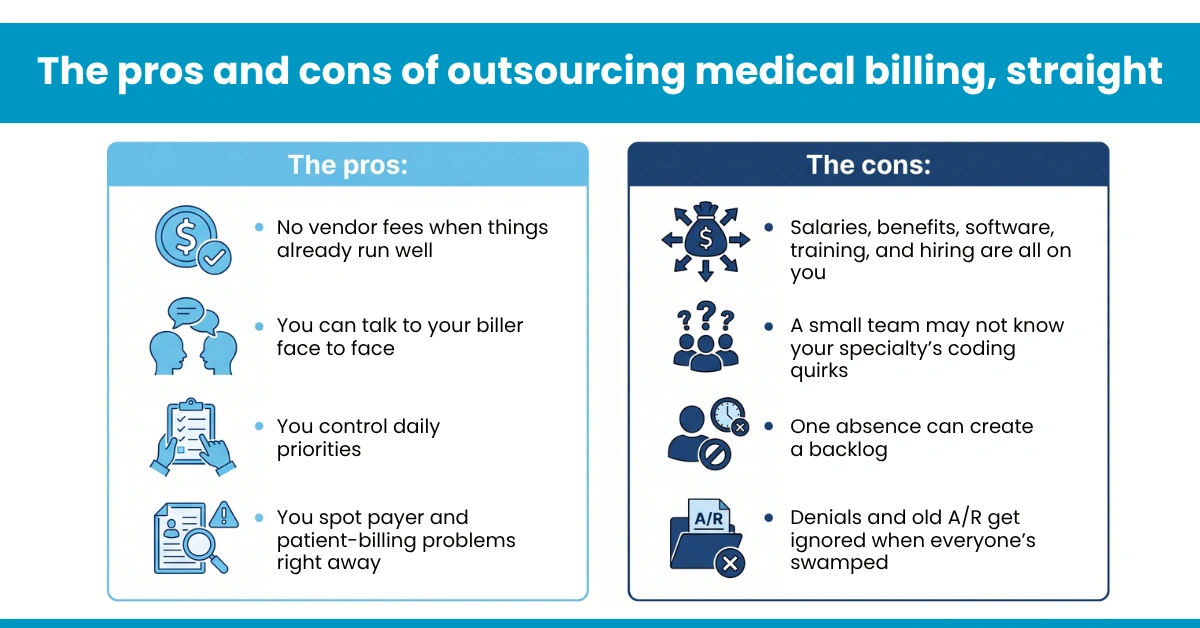
If you stay in-house, the pros are:

  • No vendor fees when things already run well
  • You can talk to your biller face to face
  • You control daily priorities
  • You spot payer and patient-billing problems right away

The cons:

  • Salaries, benefits, software, training, and hiring are all on you
  • A small team may not know your specialty’s coding quirks
  • One absence can create a backlog
  • Denials and old A/R get ignored when everyone’s swamped

Outsourcing flips most of these: you trade some control for expertise, and fixed costs for a fee that rises and falls with your collections.
The pros and cons of outsourcing medical billing

What Results Can You Expect, and How Long Might They Take?

The medical billing outsourcing market is growing fast from about $7.2 billion in 2026 to a projected $21.4 billion by 2035, per market research firm Towards Healthcare mostly because denials keep climbing and practices are tired of chasing them.

Realistic timeline: cleaner claims and better denial handling often show up within 30–60 days. The full financial payoff usually takes three to six months, depending on where you’re starting, what’s in your contract, and how much old A/R needs cleaning up. Plan for it this is not an overnight fix.

The switch itself takes time: data access, system permissions, training, moving responsibilities over. Collections can dip for a month or two during the transition if open claims slip through the cracks. A good vendor plans for this; ask how they handle it.

One more time-suck worth knowing about: prior authorization. The American Medical Association’s research documents how much staff time it eats. Outsourcing can give some of that time back if the vendor actually takes over those duties.

Quick math example: a practice collecting $600,000 a year pays 5%; that’s $30,000. If in-house billing costs $85,000 all-in, the gap looks like $55,000. But subtract transition costs, and check whether collections actually improve, before you call that real savings.

How Can You Vet Medical Billing Outsourcing Companies?

Pick a partner based on what they can prove, not what they promise.

Ask every company:

  • What’s your clean-claim rate and denial rate and how do you measure them?
  • Can I see A/R aging reports and how you work denials?
  • Can I talk to references in my specialty with a similar payer mix?
  • Who’s my named account manager, and what reports do I get, how often?
  • Will you sign a BAA, and what security controls do you have?
  • What are the contract terms, ending it, getting my data back, performance reviews?

Red flags: promises of guaranteed revenue, vague answers about fees, hidden add-on charges, or a long contract with no easy way out.

Could a hybrid model work better?

Yes. Your team could retain patient registration, eligibility checks, and charge capture while outsourcing medical coding, denial management, or aged A/R follow-up. This arrangement lets you test a vendor on a defined workload before transferring the full billing function.

HelloMDs lists denial management, accounts receivable management, and medical billing and coding among its services. Match any proposed arrangement to the specific work your practice needs covered.

Conclusion

Is outsourcing medical billing worth it? It can be if the savings, improved collections, and reduced administrative workload outweigh the service fees. Before making a decision, compare your total in-house costs with a vendor’s pricing, review your denial and accounts receivable trends, and ask for clear performance reports. HelloMDs offers a free consultation to discuss your practice’s billing needs and options.

Disclaimer:

This article is for informational purposes only and does not constitute professional advice. AI tools provided limited assistance with research, editing, and drafting. All images are AI-generated. Verify information before making billing or business decisions.

Frequently Asked Questions

It may be, especially when hiring a full-time biller creates a high fixed cost or unpaid claims keep accumulating. Compare actual annual expenses and vendor fees before signing.

It can be for smaller practices, but not in every case. Include payroll costs, software, training, supervision, and vendor fees in your comparison.

Some claim-level changes may appear within 30–60 days. A full financial assessment may require three to six months or longer.

It depends on cost, quality, security, communication, and specialty knowledge. Require a BAA where applicable and verify how the vendor protects patient information.

The main risks include reduced day-to-day control, poor vendor communication, hidden fees, data-security failures, and transition delays. Written service levels, accessible reports, and clear termination terms help manage these risks.

Leave a Reply

Your email address will not be published. Required fields are marked *

Outsourcing medical billing has become a pivotal financial strategy for healthcare practices in 2026 seeking to optimize cash flow and eliminate administrative burden. As claim denials rise, payer policies grow increasingly complex, and staffing shortages persist, medical practice leaders are continuously evaluating whether managing billing in-house remains financially sustainable.

For small and independent practices with limited resources, third-party revenue cycle management often yields immediate improvements in claim turnaround times and collection efficiency. Conversely, larger healthcare organizations with established internal billing departments and low denial rates must carefully weigh fixed operational costs against vendor commission models.

Determining whether this procedure is worth the investment requires a clear analysis of pricing models, hidden operational expenses, performance metrics, and potential transition risks. This comprehensive guide breaks down 2026 market standards, cost formulas, warning signs, and key criteria for selecting the best billing partner.

What Does Outsourcing Medical Billing Include?

Understanding the full scope of outsourcing medical billing is essential before transitioning away from an internal setup. When a practice contracts with a professional billing vendor, the partner takes over end-to-end revenue cycle workflows.

Depending on your contract and service level agreement, complete billing services typically cover:

  • Insurance Eligibility & Benefits Verification: Confirming coverage, co-pays, and deductibles prior to patient appointments.
  • Medical Coding: Accurately applying CPT, ICD-10-CM, and HCPCS coding standards to match provider clinical documentation.
  • Claim Submission & Scrubbing: Transmitting clean claims through electronic clearinghouses to reduce initial rejection rates.
  • Payment Posting & Reconciliation: Accurately logging electronic remittance advices (ERAs) and explanation of benefits (EOBs).
  • Denial Management & Appeals: Investigating unpaid claims, correcting coding errors, and submitting formal appeals.
  • Accounts Receivable (A/R) Follow-Up: Systematically contacting commercial and government payers for aged claims over 30, 60, and 90 days.
  • Patient Billing & Support: Issuing clear patient statements and managing inbound billing inquiries.

Your practice remains responsible for thorough clinical documentation and maintaining administrative oversight. Furthermore, under federal regulatory guidelines, healthcare providers must execute a Business Associate Agreement (BAA) with billing companies to ensure compliance with HIPAA privacy standards.

What Does this procedure Cost in 2026?

When evaluating pricing models, healthcare managers must align vendor compensation structures with practice volume and revenue goals. Vendor fees generally fall into percentage-based, per-claim, flat monthly, or hybrid pricing arrangements.

Common fee models across the healthcare industry include:

  • Percentage of Collections: A agreed percentage of total collections received. Market averages typically range between 4% and 10%, depending on specialty, claim volume, and local market factors.
  • Per-Claim Pricing: A fixed fee charged for every claim processed, which benefits high-volume practices with low claim values.
  • Flat Monthly Fee: A predictable, fixed subscription cost suitable for practices with consistent baseline patient volume.
  • Hybrid Pricing: A lower baseline monthly retainer combined with small performance incentives for clean claim yields.

2026 Cost Comparison Matrix

To evaluate potential return on investment when considering this procedure, review this revenue benchmark table comparing industry standard pricing to competitive starting rates:

Annual Practice CollectionsIndustry Standard Rates (4%–7%)HelloMDs Advertised Rate (2.95%)
$600,000$24,000 – $42,000$17,700
$1,600,000$64,000 – $112,000$47,200
$3,000,000$120,000 – $210,000$88,500

While vendor fees are a variable operating expense, working with an experienced team often yields higher net revenues by recovering aged accounts receivable and eliminating billing errors.

Evaluating Hidden In-House Medical Billing Expenses

Comparing third-party percentage fees solely against an in-house biller’s base salary creates an incomplete picture. Base compensation is only a fraction of the actual expense associated with maintaining internal staff.

Data from the U.S. Bureau of Labor Statistics indicates that median annual pay for medical records and coding specialists continues to rise. However, direct wage costs represent only the starting baseline.

Internal billing operations incur several non-salary expenses:

  • Mandatory Overhead: Payroll taxes, health insurance, retirement contributions, and paid leave.
  • Recruitment & Retention: Expenses tied to hiring, onboarding, and training replacement staff.
  • Technology Costs: Practice management software licenses, clearinghouse transmission fees, and coding books.
  • Continuity Risks: Lost revenue during employee sick days, vacations, or unexpected resignations.
  • Uncollected Revenue: Time constraints that prevent internal staff from appealing complex rejections.

When these combined variables are calculated, maintaining internal staff often exceeds the cost of hiring an external medical billing firm.

5 Key Warning Signs Your Practice Needs Outsourcing

Identifying operational vulnerabilities early enables practice leaders to address revenue leakage before cash flow becomes critical. If your medical practice is experiencing any of these five red flags, transitioning to an outsourced model may be advantageous:

  1. Escalating Claim Denial Rates: Recurring technical errors or coding inaccuracies keep claims stuck in endless resubmission cycles.
  2. Aging Accounts Receivable: Uncollected claims exceeding 60, 90, or 120 days continue to accumulate on your aging schedule.
  3. Declining Net Collection Rates: Unresolved balance adjustments and premature write-offs quietly diminish monthly profits.
  4. Single-Point-of-Failure Risk: Billing operations rely entirely on one individual, making your practice vulnerable to disruption.
  5. Rapid Practice Expansion: Patient appointment volume is outpacing the operational capacity of your administrative staff.

Is Outsourcing Medical Billing Right for Your Practice?

Selecting between internal billing and third-party management requires balancing control against operational efficiency. Examining the advantages and disadvantages of each model provides essential clarity.

Pros and Cons of In-House Medical Billing

Pros: Immediate on-site communication, complete physical oversight of billing priority tasks, and direct supervisory control over operational workflows.

Also read: Explore our complete guide on 96127 CPT Code: Mental Health Risk Assessment and Billing Guide.

Cons: Substantial fixed salary overhead, ongoing software expenditures, continuous training burdens, and severe revenue vulnerability during employee absences.

Pros and Cons of Outsourcing Medical Billing

Pros: Specialized coding expertise, reduced fixed administrative costs, automated claims follow-up, strict denial monitoring, and fee structures aligned with collection performance.

Cons: Reduced direct control over day-to-day administrative routines, reliance on external communication, and potential variable costs during high-revenue months.

Expected Timeline and Implementation Results

According to industry research, the global revenue cycle management market is growing rapidly as healthcare organizations respond to heightened clearinghouse scrutiny and complex payer rules. Transitioning billing workflows requires realistic planning and performance benchmarks.

Initial improvements in clean-claim submittals and reduced clearinghouse rejections generally become visible within 30 to 60 days. However, full financial recovery—including the collection of legacy aged accounts receivable—typically takes three to six months.

During the onboarding phase, practices should expect initial setup steps involving system access permissions, clearinghouse re-enrollment, and documentation alignment. A seamless onboarding timeline requires transparent communication between practice leadership and the billing vendor.

How to Vet Outsourcing Medical Billing Vendors

Partnering with a reliable vendor requires asking rigorous, metric-focused questions prior to contract execution. Ensure prospective vendors provide documented proof of operational success in your specialty.

Essential Questions to Ask Prospective Partners:

  • What is your documented clean-claim rate and average denial resolution timeframe?
  • Can you provide sample accounts receivable aging reports and appeal tracking metrics?
  • Do you have verified references within our specific clinical specialty?
  • Will our practice be assigned a dedicated account manager?
  • Is a signed Business Associate Agreement (BAA) included in the primary service contract?
  • What are the exact procedures for data retrieval and transition should contract termination occur?

Avoid billing providers that promise unrealistic collection guarantees, conceal software fees, or push long-term commitments without performance-based exit clauses.

Exploring a Hybrid Billing Framework

For practices reluctant to hand over complete operational control, adopting a hybrid model offers a balanced solution. Under this setup, internal staff manage patient check-in, demographic verification, and initial charge capture, while the external vendor handles specialized medical coding, denial appeals, and aged A/R recovery.

Frequently Asked Questions

Is outsourcing medical billing worth it for a small practice?

Yes, outsourcing medical billing is often highly cost-effective for small practices. It converts fixed employee salary overhead into a flexible variable expense, ensuring you only pay relative to collected revenue.

Is outsourcing cheaper than employing an in-house biller?

In most instances, third-party billing costs less than maintaining dedicated internal staff when accounting for benefits, software fees, administrative space, recruiting expenses, and continuing education.

How quickly will our practice see results after outsourcing?

Clean claim submission improvements usually manifest within 30 to 60 days, while comprehensive financial recovery and old A/R resolution typically peak between three and six months.

Is offshore medical billing safe and compliant?

Offshore processing can be safe if the vendor strictly complies with HIPAA regulations, executes a formal BAA, maintains encryption protocols, and employs certified medical coders.

What are the primary risks associated with outsourced billing?

Primary risks include reduced direct oversight, delayed communication with third-party staff, transition delays, or unstated software add-on charges. Selecting a transparent vendor with strong service guarantees mitigates these risks.

Visual Walkthrough: Outsourcing Medical Billing In-Depth Analysis

Conclusion

Ultimately, outsourcing medical billing is worth it if the resulting operational savings, improved collection efficiency, and reduced administrative stress outweigh total service fees. Before deciding, conduct a thorough audit of your practice’s internal costs, current denial rates, and average collection turnaround times. Partnering with a dedicated revenue cycle expert can help stabilize your practice’s financial future.

×

Request a Free Consultation