
A billing sales rep promises you’ll be live in a week. Two months later, your front desk is printing superbills by hand and nothing has been paid. That gap is where practices lose real money. The honest answer on the medical billing outsourcing timeline is that it runs on two clocks, your billing company’s clock and your payer’s clock. Here’s both, week by week, so you know what happens on day 1, when claims go out, and when cash lands.
Most practices submit their first claims within 7 to 14 days of signing. First payments post around week 4 to 6, because payers take 14 to 45 days to adjudicate after a claim leaves. Full stability, denials under control, old AR tracked, reports you trust, lands at the 60 to 90 day mark.
Your setup moves those numbers more than your vendor does:
|
Your setup |
First claims out |
First payments |
Steady state |
|
Solo or primary care, keeps current EHR |
Days 7–10 |
Weeks 4–5 |
Day 45–60 |
|
Specialty group, keeps current EHR |
Days 10–14 |
Weeks 4–6 |
Day 60 |
|
Practice switching EHR at the same time |
Weeks 3–4 |
Weeks 7–9 |
Day 90 |
|
New payer credentialing required |
Days 10–14 |
Weeks 4–6 |
+60–120 days per new payer |
For payers you’re already credentialed with.
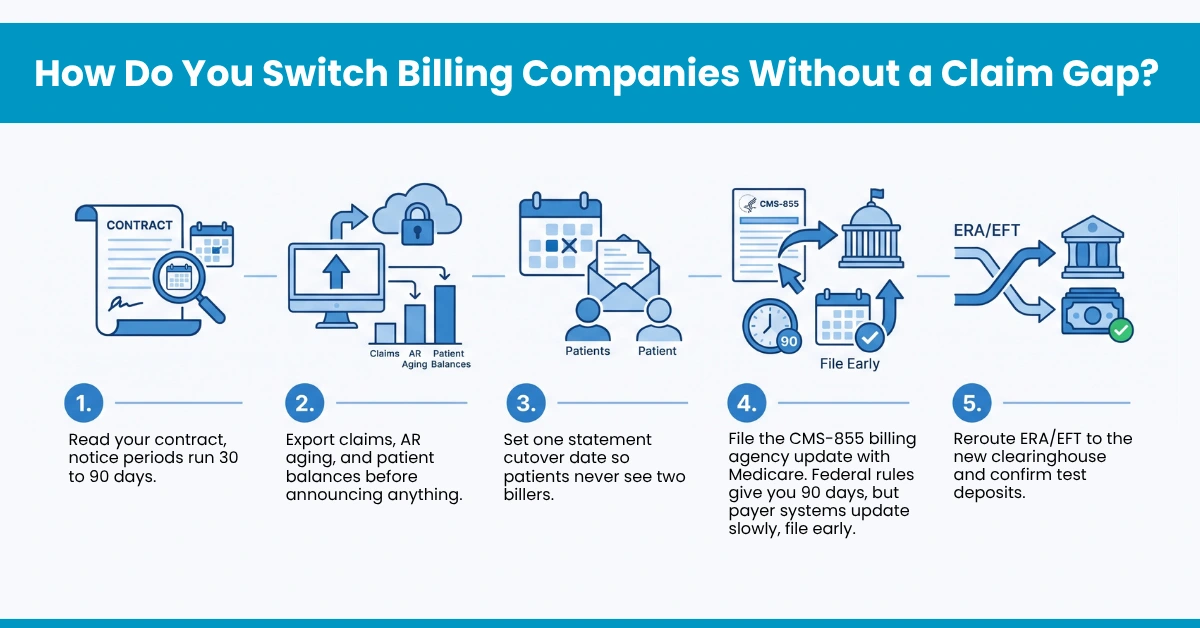
The onboarding steps look identical across serious companies:
HelloMDs’ medical billing services follow this exact sequence, with a dedicated team on each account.
Bring these to kickoff and you cut a week off onboarding. Miss them and everything stalls:
Because the second clock starts when the first one stops. Your billing company’s clock ends the day claims clear the clearinghouse. The payer clock starts there: Medicare pays clean electronic claims in roughly 14 days, and commercial contracts run 14 to 45 days.
A flawless week-2 launch posts its first deposits in week 4 or 5, no vendor can shorten payer speed. Practices that panic at week 3 and re-key lost claims create duplicates, which trigger CO-18 denials and audit headaches.
Expect the dip. Track claim acceptance, not deposits, during the launch month.
Six delays explain almost every blown timeline:
Run both companies in parallel for 2 to 4 weeks. The outgoing biller owns everything dated before cutover; the new team takes every encounter after it.
That single rule prevents missed charges, duplicates, and finger-pointing.
The steps that protect the move:
Runout by the outgoing company
Takeover by the new team
HelloMDs runs AR recovery as its own service, so legacy claims get a team regardless of which option you pick.
This is where transitions bleed money. CMS allows 12 months from the date of service on Medicare claims, some commercial plans cut you off at 90 days. Claims already filed are safe. The danger is unfiled charges sitting in charge-entry carts at cutover.
Hand your new team one report at kickoff: every encounter not yet billed, sorted by oldest date of service. Anything past 60 days goes out in week 1. Save every clearinghouse acceptance report that’s your proof of timely submission if a payer loses a claim mid-move.
And fix rejected claims as corrected claims (frequency code 7), never as fresh resubmits, or the payer will flag a duplicate.Our denial management team cleans up exactly this mess during switches.
Miss two of these three checkpoints and the timeline was never the problem, the vendor was. Hold every bidder to numbers. HelloMDs publishes a 99% first-pass ratio and prices at 2.95% of monthly collections, so the incentive is your deposits, not your hours.
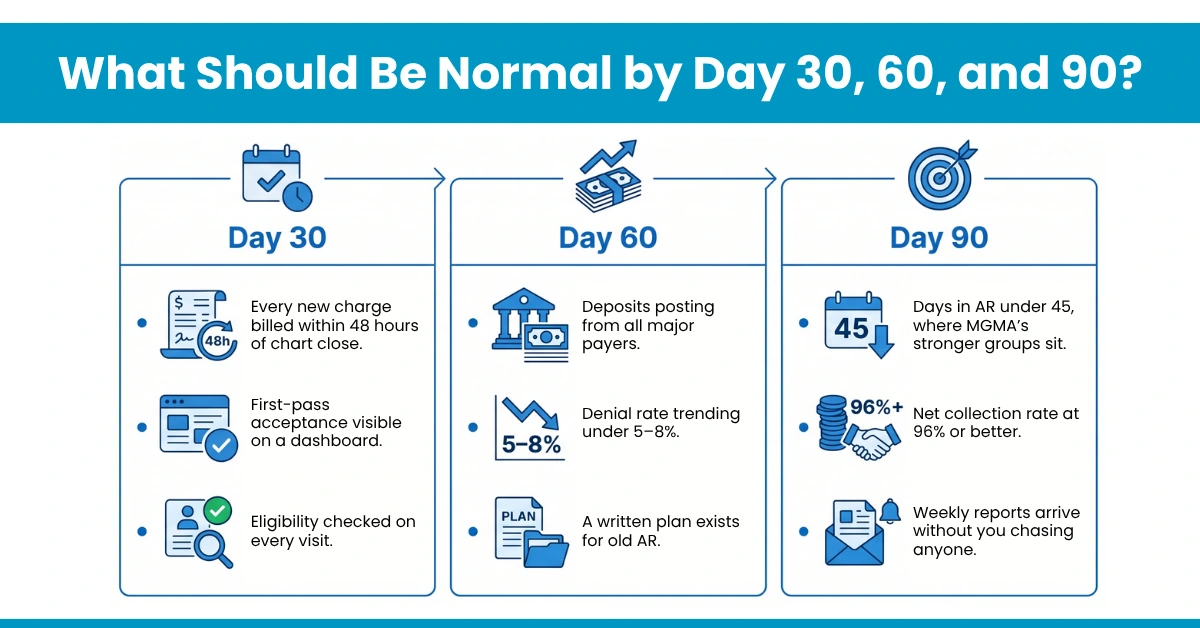
The medical billing outsourcing timeline typically includes two weeks to begin submitting claims, four to six weeks to receive initial payments, and 60 to 90 days to reach a steady state. While payer processing times are outside your control, a timely data handoff, complete CAQH files, and accurate fee schedules can help prevent onboarding delays.
Prepare the eight essential documents, request a parallel billing run, and include measurable day-30, day-60, and day-90 performance targets in your contract.
HelloMDs has run these transitions for 15+ years, in every U.S. state, inside practices’ existing EHRs. Call (469) 421-2777 or book a free consultation and get a transition plan built around your contract dates. Follow us on Facebook and Instagram for weekly billing fixes.
This article is for informational purposes only and is not legal, medical, or financial advice. Facts were verified against sources including CMS, NCQA, and MGMA. AI tools assisted research, drafting, and editing. All images on this page are AI-generated.
They shouldn't. Set one statement cutover date, move active payment plans and credit balances with the accounts, and keep one phone number on every statement. Patients seeing two bills from two companies means the cutover wasn't set properly.
Yes, and it should. Parallel running is standard. Check your notice clause, and define old vs. New claims by date of service so you never pay two companies for the same encounter.
Add one to two weeks per location for payer mix and fee schedule mapping. Credentialing runs per provider, not per location groups with lapsed CAQH profiles wait the longest.
Whoever owns the runout owns those denials. Get denial history with reason codes and appeal deadlines in the handoff export, appeal windows don't pause because you changed vendors.
A billing sales rep promises you will be live in a week. Two months later, your front desk is printing superbills by hand and nothing has been paid. That gap is where practices lose real money. The honest answer on the Medical Billing Outsourcing timeline is that it runs on two distinct clocks: your billing company’s clock and your payer’s clock. Here is both, week by week, so you know exactly what happens on day one, when claims go out, and when cash lands.
Most practices submit their first claims within 7 to 14 days of signing. First payments post around week 4 to 6 because payers take 14 to 45 days to adjudicate after a claim leaves. Full stability, with denials under control, old AR tracked, and reports you trust, lands at the 60 to 90 day mark. Your specific setup moves those numbers more than your vendor does.
When analyzing Medical Billing Outsourcing, as noted by the Centers for Medicare & Medicaid Services, understanding proper claim submission guidelines is essential for accelerating reimbursement cycles during any operational transition.
Your Setup |
First Claims Out |
First Payments |
Steady State |
Solo or primary care, keeps current EHR |
Days 7–10 |
Weeks 4–5 |
Day 45–60 |
Specialty group, keeps current EHR |
Days 10–14 |
Weeks 4–6 |
Day 60 |
Practice switching EHR at the same time |
Weeks 3–4 |
Weeks 7–9 |
Day 90 |
New payer credentialing required |
Days 10–14 |
Weeks 4–6 |
+60–120 days per new payer |
The onboarding steps look identical across serious companies. A structured approach ensures minimal disruption to your daily clinical workflow.
Also read: Explore our complete guide on Get DME Accreditation Services Built for CMS Rules.
HelloMDs’ medical billing services follow this exact sequence, with a dedicated team assigned to each account to guarantee accountability.
Regarding Medical Billing Outsourcing, bring these documents to kickoff and you can easily cut a week off onboarding. Miss them, and everything stalls:
Because the second clock starts when the first one stops. Your billing company’s clock ends the day claims successfully clear the clearinghouse. The payer clock starts there: Medicare pays clean electronic claims in roughly 14 days, while commercial contracts typically run 14 to 45 days.
In terms of Medical Billing Outsourcing, a flawless week-2 launch posts its first deposits in week 4 or 5; no vendor can shorten payer speed. Practices that panic at week 3 and re-key lost claims create duplicates, which trigger CO-18 denials and audit headaches.
Expect the dip. Always track claim acceptance rather than immediate deposits during your launch month.
Six common delays explain almost every blown timeline during a transition:
For optimal results with Medical Billing Outsourcing, run both companies in parallel for 2 to 4 weeks. The outgoing biller owns everything dated before cutover, while the new team takes every clinical encounter after it.
That single rule prevents missed charges, duplicates, and finger-pointing between vendors.
The steps that protect the move:
Runout by the outgoing company: They already know the claims and have zero learning curve. However, motivation dies fast; demand a 60–90-day minimum in writing with monthly AR reconciliation.
When implementing Medical Billing Outsourcing, Takeover by the new team: You gain one accountable partner, and fresh eyes often recover claims the old biller abandoned. This is usually priced as a separate percentage of old-AR collections.
HelloMDs runs professional accounts receivable recovery as its own specialized service so legacy claims get dedicated attention regardless of your chosen option.
With respect to Medical Billing Outsourcing, this is where transitions typically bleed money. CMS allows 12 months from the date of service on Medicare claims, but some commercial plans cut you off at 90 days. Claims already filed are safe, but unfiled charges sitting in charge-entry carts at cutover are at high risk.
Hand your new team one report at kickoff: every encounter not yet billed, sorted by oldest date of service. Anything past 60 days goes out in week one. Save every clearinghouse acceptance report as proof of timely submission if a payer loses a claim mid-move.
When analyzing Medical Billing Outsourcing, always fix rejected claims as corrected claims rather than fresh resubmits, or payers will flag them as duplicates. Our expert denial management team cleans up exactly this type of operational mess during switches.
Miss two of these three checkpoints and the timeline was never the problem—the vendor was. Hold every service provider accountable to measurable numbers.
The Medical Billing Outsourcing timeline typically includes two weeks to begin submitting claims, four to six weeks to receive initial payments, and 60 to 90 days to reach a steady state. While payer processing times are outside your control, a timely data handoff, complete CAQH files, and accurate fee schedules can help prevent onboarding delays.
Prepare the eight essential documents, request a parallel billing run, and include measurable day-30, day-60, and day-90 performance targets in your contract today.
They should not. Set one statement cutover date, move active payment plans and credit balances with the accounts, and keep one phone number on every statement. Patients seeing two bills from two companies means the cutover was not set properly.
Yes, and it should. Parallel running is standard practice. Check your notice clause, and define old versus new claims by date of service so you never pay two companies for the same encounter.
Add one to two weeks per location for payer mix and fee schedule mapping. Credentialing runs per provider, not per location; groups with lapsed CAQH profiles wait the longest.
Whoever owns the runout owns those denials. Get denial history with reason codes and appeal deadlines in the handoff export, as appeal windows do not pause because you changed vendors.