
Lung cancer is the leading cause of cancer death in the United States, yet thousands of high-risk patients never receive their annual low-dose CT scan because of billing errors, confusing eligibility rules, and denied claims.
If you are a medical biller, coder, RCM specialist, or healthcare provider dealing with CPT code 71271 claim denials, you are not alone. From missing the required HCPCS counseling code to pairing the wrong ICD-10 diagnosis, even experienced billers hit the same traps.
This guide gives you a direct, expert answer to every major question, built on 2026 CMS guidelines and real billing experience.
CPT code 71271 is described as: “Computed tomography, thorax, low dose for lung cancer screening, without contrast material(s).”
In plain terms, it is the billing code for a low-dose CT (LDCT) scan of the chest performed as a preventive screening for lung cancer. It applies only to asymptomatic, high-risk patients, not for diagnosing symptoms like chest pain or a chronic cough. Those situations require CPT 71250 instead.
CPT 71271 became effective January 1, 2021, replacing the now-deleted HCPCS code G0297. Any claim still using G0297 for services after 2021 is automatically denied.
The facility performing the scan must meet ACR (American College of Radiology) accreditation standards or a CMS-equivalent program. Billing CPT 71271 from a non-accredited site is both a compliance risk and a denial trigger, regardless of how clinically appropriate the scan was.
Eligibility follows CMS National Coverage Determination (NCD) 210.14, updated February 10, 2022. Not every patient over 50 qualifies. Medicare and most commercial payers require all of the following to be true simultaneously:
|
Criteria |
Requirement |
|
Age range |
50-77 years old |
|
Smoking status |
Current or former smoker |
|
Pack-year history |
20+ pack-years |
|
Quit status (if former) |
Quit within the last 15 years |
|
Symptom status |
Completely asymptomatic |
|
Written order |
From a qualified provider |
If the patient shows any symptoms like chronic cough, hemoptysis, unexplained weight loss, or shortness of breath, the scan is no longer a screening. It becomes a diagnostic CT, and CPT 71250 (without contrast) or CPT 71260 (with contrast) must replace 71271. Using 71271 for a symptomatic patient is among the top causes of medical-necessity denials.
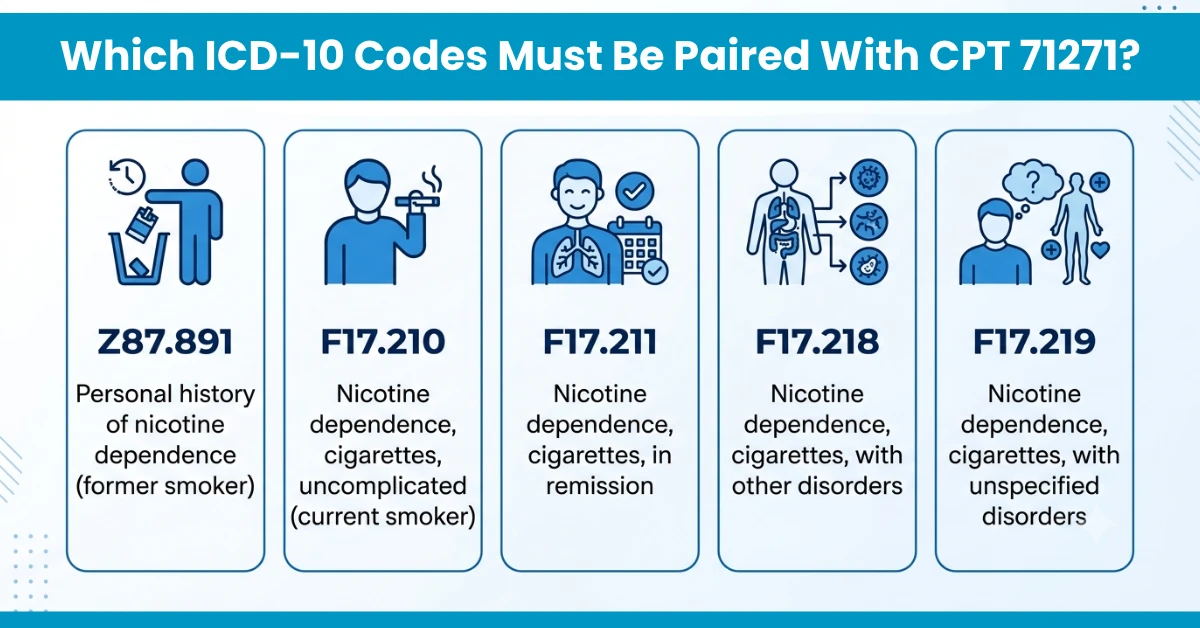
Incorrect or missing diagnosis codes are the number-one reason CPT 71271 claims are rejected. Here is the correct pairing every time:
Primary diagnosis (required first) (Z12.2): Encounter for screening for malignant neoplasm of respiratory organs. This tells the payer the scan is preventive, not diagnostic. Without Z12.2 as the primary code, the claim is misclassified and denied.
Secondary codes based on tobacco status:
Never use a diagnostic code such as R91.8 (abnormal chest imaging finding) as the primary code. That reclassifies the claim from preventive to diagnostic, triggers patient cost-sharing, and changes the payer’s reimbursement rules entirely.
HCPCS G0296: The Code That Unlocks CPT 71271 for First-Time Patients
Before a patient’s first LDCT screening, a shared decision-making visit must occur and be billed separately under HCPCS G0296. This counseling visit must cover:
G0296 is required only before the first screening. For annual re-screenings, only a written physician order is needed unless the patient’s eligibility status has changed.
If smoking cessation counseling is provided separately, on a different date, it can be reported with CPT 99406 (3-10 minutes) or CPT 99407 (over 10 minutes).
Modifiers for CPT 71271:
Independent Diagnostic Testing Facilities (IDTFs) may bill CPT 71271 for the scan itself. However, because the code includes a therapeutic element (smoking cessation must be offered to current smokers), that portion must be billed by a licensed physician. The IDTF and physician must have a documented business arrangement on file.
This is the most common coding confusion in chest imaging billing.
CPT 71271 is a screening code; preventive, for asymptomatic patients, billed once every 12 months. CPT 71250 is a diagnostic code, for symptomatic patients or follow-up CT scans needed in less than 12 months.
After a Lung-RADS assessment, if the radiologist recommends a follow-up CT within 3, 6, or 9 months, that scan is reported with CPT 71250, not 71271. Submitting 71271 for a short-interval follow-up violates the frequency limitation and will be denied.
The cost-sharing difference matters directly to your patients. Under Medicare, CPT 71271 carries zero patient cost; no deductible, no copay, when billed correctly as preventive. CPT 71250 is subject to standard Part B cost-sharing. Getting this distinction wrong does not just cause billing problems; it creates unexpected bills for patients who assumed their screening was free.
CPT 71271 falls under Medicare’s Preventive Services benefit, which means zero patient cost-sharing when eligibility, documentation, and coding requirements are all satisfied. Reimbursement is calculated using the 2026 Medicare Physician Fee Schedule (MPFS) conversion factors:
Actual payment amounts vary by geographic MAC (Medicare Administrative Contractor) region. Always verify your specific rate through the CMS MPFS Lookup Tool before setting billing expectations.
For commercial payers, rates vary significantly by contract. Many insurers, including Cigna, UnitedHealthcare, and Harvard Pilgrim, require prior authorization before coverage is confirmed. Verify benefits before the scan is scheduled, not after.
Denial patterns for CPT 71271 are highly predictable. The most common causes:
The fix most billing teams overlook: Build a pre-submission eligibility checklist that verifies age, pack-year history, G0296 status, ICD-10 pairing, and facility accreditation before every claim goes out. This single workflow change prevents the majority of CPT 71271 denials before they happen.
At HelloMDs, our AAPC-certified coders specialize in exactly this. Our Denial Management services identify root causes, correct submissions, and prevent recurrence. With a 99% first-pass ratio and 15+ years of experience across preventive medicine and diagnostic radiology, we keep your revenue cycle clean and compliant.
Lung cancer screening is a life-saving benefit, and billing errors should never stand between a high-risk patient and early detection. Whether you are navigating denials, eligibility confusion, or ICD-10 pairing questions, accurate coding and proactive processes make all the difference.
HelloMDs offers full-service Medical Billing and Coding, Revenue Cycle Management, and Prior Authorization support for preventive medicine and radiology practices across all 56 U.S. states and territories. Contact us for a free consultation today.
This information is for educational purposes only and is not medical, legal, or billing advice. CPT, ICD-10, and Medicare rules may change, and coverage varies by payer and location. Always verify current CMS guidelines and consult a qualified professional before making billing decisions. This blog includes AI-generated images.