
Billing corn or callus removal sounds simple. One procedure. One patient. One code.
But if you’ve ever had a CPT code 11055 claim, come back denied; you know it’s never that straightforward. A missing diagnosis, a wrong modifier, or incomplete documentation can quietly trigger a denial.
CPT code 11055 describes the paring or cutting of a single benign hyperkeratotic lesion, most commonly corn or callus, using a scalpel or curette. Simple procedure. Complicated billing.
Medicare has strict medical necessity rules for this code. The wrong modifier gets the claim bundled. The wrong diagnosis gets it denied as routine foot care. And one missing date on the CMS-1500 form quietly kills the reimbursement before it even starts.
This guide covers the complete 11055 CPT code description, the right modifiers, ICD-10 pairings, Medicare criteria, and documentation requirements. Everything you need to bill this code correctly and get paid without the back-and-forth.
CPT code 11055 describes the paring or cutting of a single benign hyperkeratotic lesion (e.g., corn or callus), using a scalpel or curette.”
This code falls under Paring or Cutting Procedures on the Skin within the Integumentary System section of CPT, maintained by the American Medical Association.
The rule that causes the most denials: Code 11055 covers only one lesion. If you treat one lesion on the right foot and two on the left at the same visit, you don’t bill 11055 twice. You count all lesions across both feet combined and report one single code for the entire date of service.
Only one code from this range is reported per date of service. Billing 11055 multiple times for multiple lesions is one of the most common and most avoidable errors in this category.
Podiatrists use this code most often. Corns and calluses form on pressure points when friction or weight is unevenly distributed.
Common causes include:
Dermatologists may use it for:
Which specialty is billing matters because Medicare applies different levels of scrutiny depending on your specialty and the diagnosis supporting the claim.
Step-by-step process:
What this code does NOT cover:
It is also not appropriate to bill code 11305-11308 for corn and callus removal. CMS explicitly requires 11055-11057 for these lesions.
The correct modifier is critical for CPT code 11055.
Modifier | What It Means | When to Use It |
25 | Significant, separately E/M on the same day | A documented evaluation was performed beyond the procedure. |
50 | Bilateral procedure | Lesions are treated on both sides of the body in one session. |
59 | Distinct service | Clearly separate from another same-day code. |
Q7 | Class A finding | Nontraumatic amputation of a foot or partial foot. |
Q8 | Two Class B findings | Skin discoloration or redness with a systemic condition. |
Q9 | Class B + Class C findings | Edema, paresthesia, or burning with a systemic condition. |
LT/RT | Left/right foot | Lesion on the left or right foot. |
TA | First toe, left foot | Lesion on the left great toe. |
T1-T4 | Second through fifth toes, left foot | Lesion on a specific left toe. |
T5 | First toe, right foot | Lesion on the right great toe. |
T6-T9 | Second through fifth toes, right foot | Lesion on a specific right toe. |
Important Insights:
Missing or incorrect modifier = denied or bundled claims.
Medicare treats routine foot care as non-covered unless a specific medical necessity is documented. This is where most practices lose the reimbursement they rightfully earned.
When Medicare Covers It
Medicare approves CPT 11055 when the patient has a documented systemic condition, making foot care medically necessary:
The record must also confirm:
When Medicare Denies It
No qualifying systemic condition on file means denial, regardless of how well the procedure was performed or documented.
The CMS-1500 Line 19 Rule:
When billing with an ICD-10 code marked with an asterisk (*) in the CMS coverage list, meaning it requires active care documentation, the date the patient was last seen by the supervising physician must be entered in Line 19 of the CMS-1500 claim form. Miss this one field, and the claim gets denied on a technicality even when every other detail is perfect.
A mismatched diagnosis is a silent claim killer.
Here are the most accepted pairings directly from the CMS coverage list:
* Codes with an asterisk require active care documentation. The supervising physician’s name, NPI, and date of last visit must appear in Line 19 of the claim form for these codes to clear Medicare review.
L84 alone is not enough for Medicare. Always pair with a systemic condition.
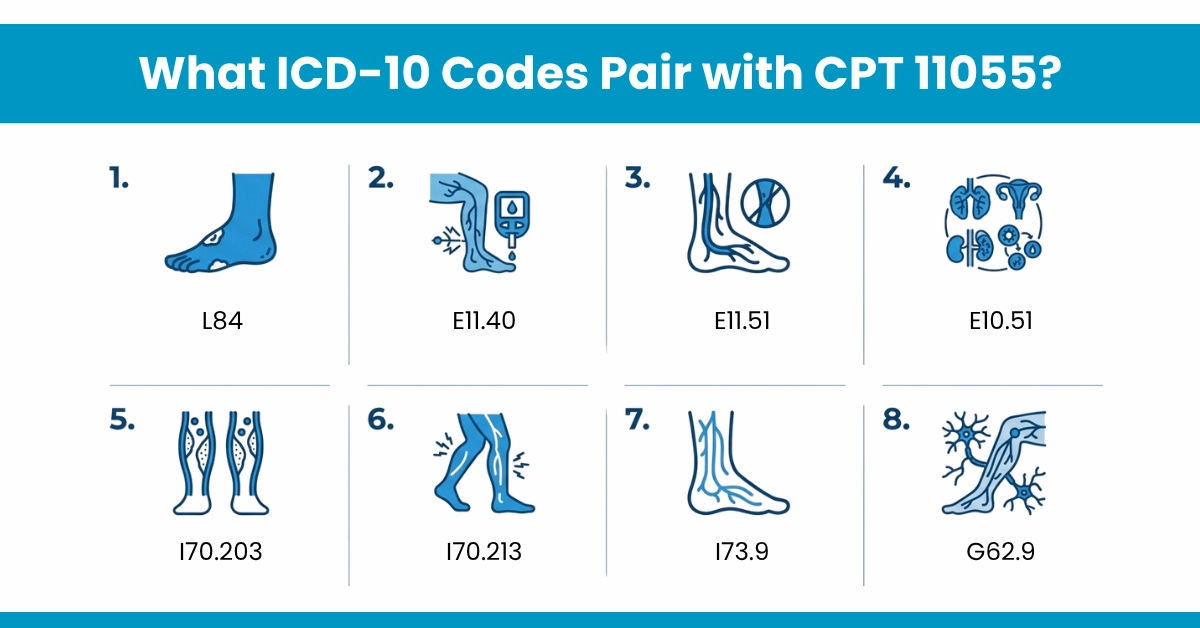
This is where most providers lose revenue.
Top Denial Reasons
Fixing these issues can significantly improve reimbursement rates.
At this stage, many practices rely on expert support like HelloMDs medical coding and denial management services to catch errors before submission and reduce revenue loss.
Most denials come from incomplete records, not incorrect codes. Here is exactly what every chart must include:
Clinical Documentation
Exact location and size of the lesion.
Systemic Condition Documentation:
CPT code 11055 is a simple procedure with surprisingly detailed billing rules. Paid claims require the right diagnosis, clean documentation, precise modifiers down to the specific toe, the correct total lesion count, and for Medicare, a date in Line 19 that most practices forget entirely.
HelloMDs is a HIPAA-compliant, full medical billing service and RCM company trusted by practices nationwide. Our AAPC-certified team handles medical billing and coding, credentialing services, and accounts receivable management, starting at just 2.95% on monthly collections.
Stop leaving revenue on the table. Contact HelloMDs today for a free consultation and follow us on Facebook and Instagram for regular billing tips and CPT code updates.
This content is for general informational purposes only. Medical billing rules, CPT codes, and payer policies can change and may vary by case. We aim to provide accurate guidance, but reimbursement is not guaranteed and depends on proper documentation and payer requirements. HelloMDs help improve billing accuracy and reduce denials. Images used in this blog may be generated by AI tools and may not represent actual results and real-life things.